NOX EA10 Ventus Attack 12K XTREM 2026
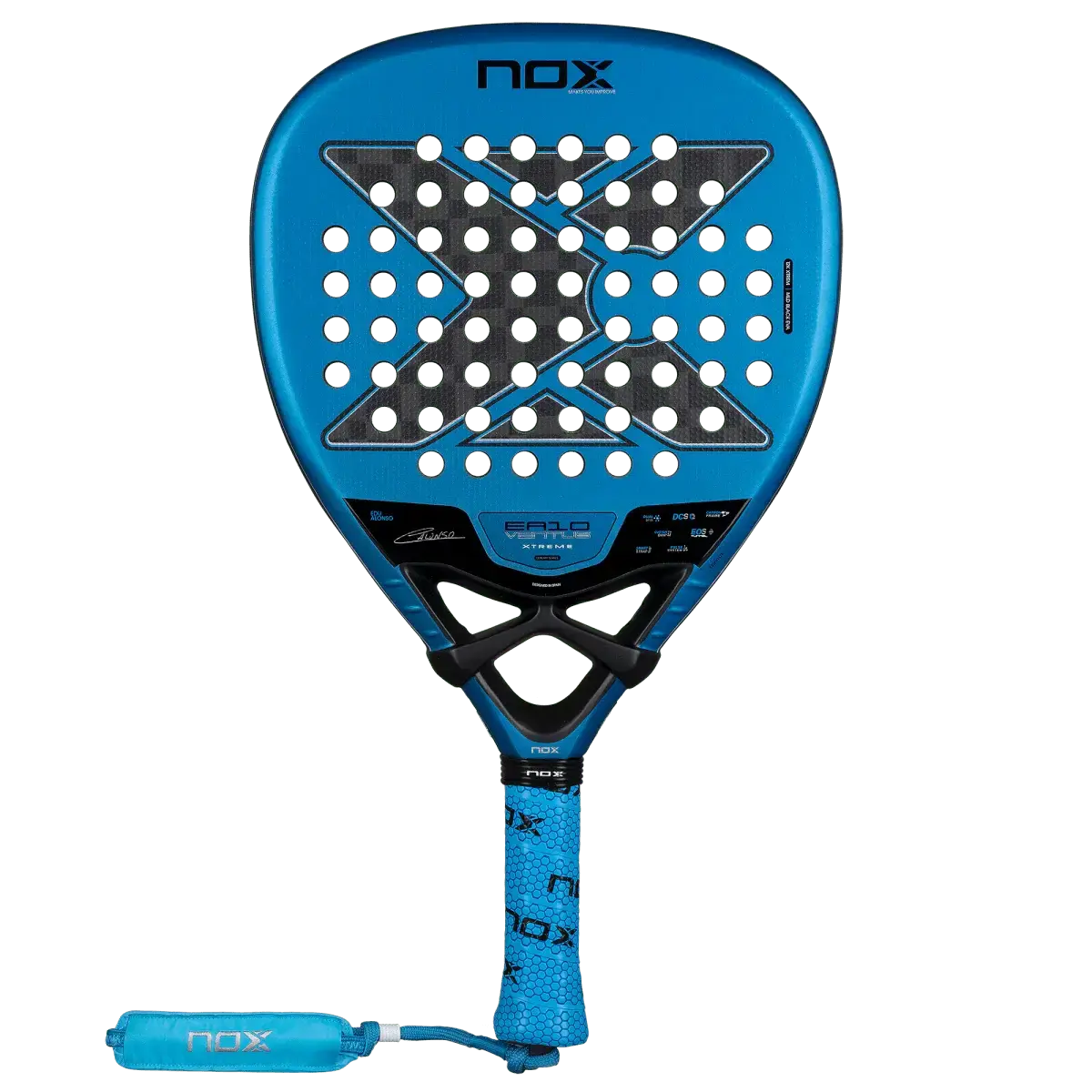
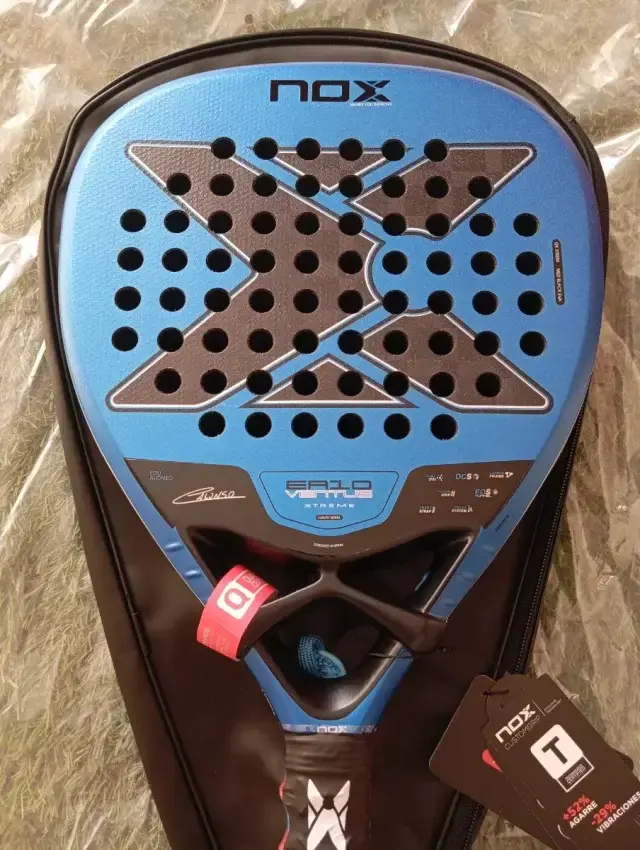
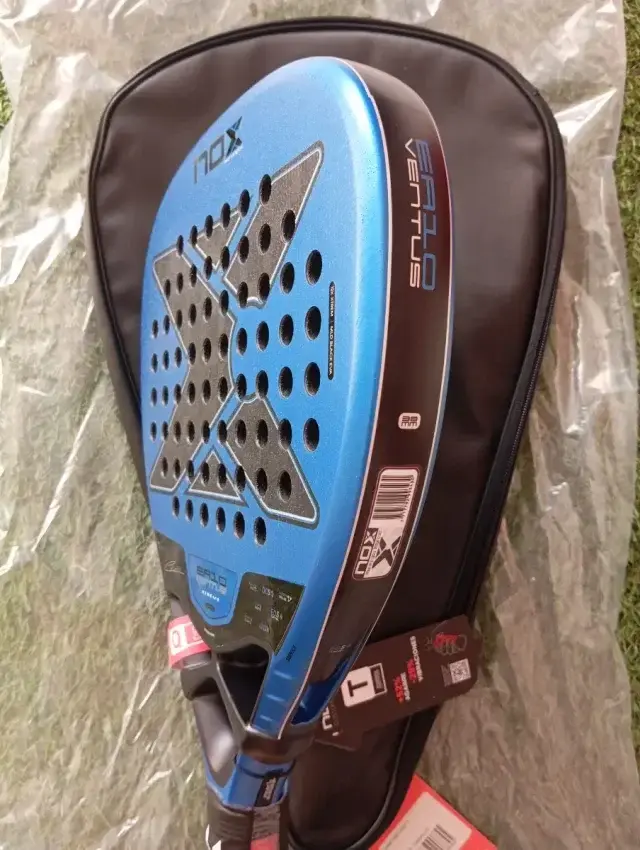
Version and lineup identification
This racket belongs to the 2026 EA10 Ventus series, developed in collaboration with Edu Alonso. Within the EA10 range, it represents the Attack branch, positioned above the Hybrid version in terms of power ceiling and swing inertia, but below the most extreme diamond frames on the market in raw explosiveness.
The EA10 Attack 12K uses a diamond-shaped mould with elevated balance, combined with a stiff 12K XTREM carbon face and a medium–firm EVA core. Compared to the EA10 Ventus Hybrid 12K XTREM, the Attack version shifts mass upward, increases swing weight, and reduces forgiveness in exchange for more decisive overhead output.
Technical specifications
| Spec | Value | What it means |
|---|---|---|
| Shape | Diamond (Attack mould) | High balance, power-oriented |
| Thickness | 38 mm | Thicker = more power and rebound |
| Weight range (claimed) | 360–375 g | Heavier = more stability, lighter = more speed |
| Measured weights | ~365–372 g | Heavier = more stability, lighter = more speed |
| Balance (measured) | ~26.3–26.8 cm | Affects swing feel and power |
| Face material | 12K XTREM Carbon | Good stiffness and durability |
| Core | Medium–firm EVA | Good balance of control and feel |
| Frame | 100% Carbon | Structural rigidity and durability |
| Surface | Dual Spin (3D texture + sand finish) | Determines feel and response |
| Adjustable balance | Weight Balance System (limited head tuning) | Affects swing feel and power |
Construction and materials
The defining characteristic of the EA10 Ventus Attack 12K XTREM is its stiff 12K XTREM carbon face. This material produces minimal trampoline effect and very short dwell time, especially at higher swing speeds. Rather than accelerating the ball automatically, the face allows players to apply force without saturation, making power output almost entirely player-driven.
The EVA core sits in the medium–firm range and firms up quickly under load. At low to medium swing speeds, ball output is limited; as acceleration increases, the core responds more directly, supporting flat, penetrating trajectories rather than high-launch shots. The full carbon frame adds torsional rigidity, particularly noticeable on clean, high-face contact during overheads.
Shape and mould behavior
The diamond mould places a significant portion of mass in the upper third of the face. Measured balance values commonly range from ~26.3 to ~26.8 cm, clearly higher than both the EA10 Hybrid and standard AT10 teardrop models.
This geometry shifts the effective sweet spot upward and increases swing inertia. The result is stronger mass transfer on overhead shots, but reduced maneuverability in fast exchanges and defensive scenarios. The mould does not attempt to compensate with an oversized face or widened hitting area, reinforcing the racket’s attack-first, precision-demanding character.
12K Attack versus Hybrid in the EA10 family
Within the EA10 lineup, the difference between the Attack 12K XTREM and the Ventus Hybrid 12K XTREM is not subtle and should not be interpreted as a simple power-versus-control split. The distinction is structural and affects how energy is transferred, how forgiving the racket is, and how much margin the player has under pressure.
The EA10 Ventus Hybrid uses a more neutral geometry with lower effective balance (typically around ~25.7–26.0 cm) and a slightly more elastic response. This allows easier depth generation from the baseline, more forgiving defensive play, and smoother transitions during neutral rallies.
By contrast, the EA10 Ventus Attack shifts balance upward into the ~26.3–26.8 cm range and pairs it with a stiffer 12K XTREM face. The result is reduced free ball output at medium swing speeds, but significantly higher stability and mass transfer when the player commits fully. Power scales almost linearly with swing speed, making the racket predictable but physically demanding.
In practical terms, the Hybrid version supports point construction and consistency, while the Attack version is designed to end points. Players who rely on pressure, overhead dominance, and aggressive positioning will feel the difference immediately. Players who defend often or rely on reactive play will also feel the limitations just as quickly.
Stiffness, feel, and comfort
The EA10 Ventus Attack 12K XTREM 2026 sits firmly in the stiff-to-very-stiff segment of the NOX lineup. The 12K XTREM carbon face is designed to minimize flex under load, and this is immediately apparent in measured rebound behavior and on-court feel. At medium swing speeds, the face shows minimal deformation, producing a muted, controlled response rather than elastic ball launch.
In practical terms, this means very low trampoline effect. Ball output does not increase disproportionately with swing speed; instead, it scales almost linearly. Compared to the EA10 Ventus Hybrid 12K, dwell time is noticeably shorter and rebound is firmer. Compared to AT10 12K (teardrop), the Attack version feels more rigid at impact due to higher swing inertia and a more concentrated mass distribution toward the upper face.
Despite this stiffness, comfort is acceptable for its category. Vibration damping is adequate, provided contact is clean and centered. The EVA core filters high-frequency shock reasonably well, preventing sharp or metallic feedback. However, comfort drops quickly on off-center contact—especially low-face or lateral mis-hits—where the stiff face transmits more feedback directly to the arm.
For players with sound mechanics and consistent contact, the racket feels solid and controlled rather than harsh. For players who frequently arrive late or hit outside the sweet spot, fatigue and discomfort can accumulate over long sessions. This behavior aligns with the racket’s attack-first design and reinforces that it is not intended for arm-sensitive or developing players.
Overall, stiffness and feel strongly favor predictability under power rather than comfort or forgiveness. The EA10 Ventus Attack 12K rewards clean technique and punishes imprecision, both in feedback and physical demand.
Sweet spot and forgiveness
The sweet spot on the EA10 Ventus Attack 12K XTREM is compact and positioned high on the face, consistent with its diamond mould and elevated balance. Clean contact in this zone delivers strong, stable output, particularly on overheads and aggressive volleys.
Outside this area, performance drops sharply. Low-face contact produces rapid loss of depth and a firmer, less controlled feel. Lateral mis-hits are penalized more strongly than on the Hybrid version, where mass distribution is more even across the face.
In practical terms, the usable hitting area is reduced by approximately 15–20% compared to the EA10 Hybrid. This reinforces the racket’s specialization: it rewards precision and preparation, while offering limited margin for error in defensive or transitional play.
Power and smash behavior
Power generation on the NOX EA10 Ventus Attack 12K XTREM 2026 is fundamentally player-driven. The racket provides very little automatic acceleration and almost no trampoline effect at medium swing speeds. Instead, ball speed scales directly with swing commitment, timing, and contact height. This creates a predictable but demanding power profile.
On flat smashes, the elevated balance (typically ~26.3–26.8 cm in real-world setups) and diamond geometry allow strong mass transfer when contact is made high and clean. The 12K XTREM face remains stable under full acceleration and does not overreact, keeping trajectories flatter and more controlled. Compared to the EA10 Hybrid, the Attack version delivers noticeably higher penetration through the court, especially on finishing shots executed above shoulder height.
Por-3 and kick smashes are achievable, but they require full technical execution. The racket does not assist lift or vertical launch on its own. Unlike more elastic power frames, it does not “catapult” the ball upward. Smash effectiveness depends heavily on player strength, timing, and contact quality rather than on face elasticity. When executed correctly, the result is heavy, controlled output rather than explosive rebound.
Compared to the AT10 Attack 12K, the EA10 Ventus Attack feels slightly more linear and marginally less explosive at peak output, but also more predictable under pressure. Compared to the EA10 Hybrid, the Attack version clearly sacrifices ease of access to power in exchange for a higher finishing ceiling.
In match conditions, this means the racket excels when the player dictates tempo and can repeatedly attack overheads from advantageous positions. In rushed or defensive situations, power access drops sharply, reinforcing the need for proactive positioning and disciplined shot selection.
Net performance under pace
At the net, the NOX EA10 Ventus Attack 12K XTREM 2026 behaves like a true attack-frame: effective when the player is set early, demanding when reactions are late. With most real-world setups expected in the ~365–372 g range and effective balance typically above ~26.2 cm, swing inertia is clearly higher than on the EA10 Ventus Hybrid 12K and noticeably heavier than on teardrop AT10 models.
On prepared volleys, directional control is strong. The stiff 12K XTREM face limits unwanted trampoline, keeping volleys low and predictable, especially on firm punch shots and controlled finishing at the net. When contact is clean and in front of the body, the racket delivers a stable, linear response that advanced players can rely on to close points.
In fast hand battles, however, the limitations are evident. Acceleration from neutral positions is slower due to higher swing inertia, and the racket offers little assistance on last-second redirections. Compared to the EA10 Ventus Hybrid 12K, recovery time between shots is longer, and the margin for error is smaller. Blocks remain structurally stable, but depth and precision depend heavily on timing rather than on racket help.
Against other attack frames such as the AT10 Attack 12K, the EA10 Ventus Attack feels slightly calmer and more linear, but not faster. Both demand proactive positioning, yet the EA10 Attack provides marginally better directional predictability at the cost of agility. Players who rely on reflex-based net play or frequent counter-volley exchanges will find hybrid or teardrop designs more forgiving.
In practical terms, net performance with the EA10 Ventus Attack 12K is effective in initiative-based play, where the player controls tempo. In reactive scenarios, the racket does not compensate for late preparation, reinforcing its specialization as a finishing tool rather than a defensive or all-court net weapon.
Off-center stability and torsional resistance
Off-center stability and torsional resistance is one of the defining trade-offs of the NOX EA10 Ventus Attack 12K XTREM 2026. The racket delivers strong torsional resistance on high-center impacts, where the diamond mould and elevated balance concentrate mass effectively. In this zone, flat smashes and aggressive overheads retain trajectory and depth with minimal twisting, even at near-maximum swing speeds.
Outside the optimal contact area, behavior changes quickly. Low-face impacts result in a noticeable drop in ball speed and firmer feedback, reflecting the stiffer 12K XTREM face and reduced dwell time. The racket does not mask imperfect contact; instead, it transmits a clear signal to the player, which advanced hitters may appreciate but intermediates may find punishing.
Lateral mis-hits are controlled reasonably well for a diamond attack frame, but stability remains inferior to hybrid or teardrop EA10 and AT10 models. Compared to the EA10 Ventus Hybrid 12K, the usable hitting zone is narrower by an estimated 15–20% in practical play, particularly during defensive digs and stretched volleys. Compared to the AT10 Attack 12K, torsional stability is similar, though the EA10 Attack feels slightly more linear and less volatile under partial contact.
In real match situations, this translates to reliable output when contact is clean and prepared, but limited forgiveness when reacting late or playing under pressure. The racket rewards precision and timing, while penalizing rushed swings and low-percentage contact points—consistent with its attack-first positioning.
Practical on-court takeaways
In real match conditions, the NOX EA10 Ventus Attack 12K XTREM 2026 performs best when the player dictates rallies and actively looks to finish points. The racket rewards initiative-based padel: stepping forward early, taking the ball high, and committing fully to overheads. When used this way, its diamond mould and elevated balance provide consistent mass transfer and predictable ball trajectories.
From the back of the court, depth and pace are achievable, but not effortless. The stiff 12K XTREM face produces minimal trampoline effect, meaning ball speed scales almost entirely with swing commitment. Players operating at 80–100% swing intensity will find the response linear and controllable; those relying on medium swings will often struggle to generate penetrating depth. Compared to the EA10 Ventus Hybrid 12K, baseline play is more physically demanding and less forgiving under pressure.
On overheads, the racket clearly justifies its Attack designation. Flat smashes and aggressive víboras benefit from the higher balance (typically ~26.2–26.6 cm), which helps convert swing speed into forward ball velocity. However, success depends heavily on contact height and timing. The racket does not assist lift or vertical launch, so por-3 and kick smashes require clean mechanics rather than racket elasticity. In this respect, the EA10 Attack behaves similarly to the AT10 Attack 12K, but with slightly calmer feedback.
In defensive situations, limitations become apparent. Lobs, resets, and stretched defensive shots require deliberate technique and full follow-through. Late contact or incomplete swings are penalized with shallow balls or loss of control. Over long defensive exchanges, fatigue accumulates faster than with hybrid or teardrop models, reinforcing that this racket is not designed for prolonged neutral rallies.
Comparison within the NOX lineup
Within the 2026 NOX range, the EA10 Ventus Attack 12K XTREM occupies a clearly defined niche: a pure attack diamond that prioritizes finishing power and stability at high swing speeds over versatility and ease of use.
Compared to the EA10 Ventus Hybrid 12K XTREM, the Attack version shifts the balance point upward by roughly +0.4–0.6 cm, resulting in noticeably higher swing inertia. While the Hybrid typically measures around 25.6–25.8 cm balance and offers a broader sweet spot with easier defensive depth, the Attack version moves closer to 26.2–26.6 cm, concentrating mass in the upper face. On court, this translates to significantly stronger overhead authority but reduced forgiveness and maneuverability. The Hybrid is calmer and more universal; the Attack is more demanding but more decisive when finishing.
Against the AT10 12K 2026 (teardrop), the differences are even more pronounced. The AT10 12K plays with a more neutral balance (~25.6 cm), larger effective hitting zone, and better defensive reliability. Although both use 12K carbon, the AT10’s geometry allows more usable dwell time and easier depth generation from the back court. The EA10 Ventus Attack 12K, by contrast, feels stiffer and more polarized: overhead power is higher, but rallies outside an attacking context are more physically taxing.
Compared to the AT10 Attack 12K 2026, the EA10 Ventus Attack 12K sits slightly lower in absolute explosiveness but offers marginally better control. Measured weights are comparable (typically ~365–370 g), but the AT10 Attack tends to feel more aggressive in rebound, while the EA10 Attack feels more linear and disciplined. In practice, the AT10 Attack rewards perfect timing with higher ceiling power, whereas the EA10 Attack emphasizes repeatability and flatter trajectories.
For a same-brand choice, compare NOX EA10 Ventus Attack 12K XTREM 2026 Review with NOX AT10 Luxury Genius 18K Alum 2026 Review, NOX AT10 Luxury Genius 12K Alum XTREM Lite 2026 Review and NOX EA10 Ventus Hybrid 12K XTREM 2026 Review. The useful test is not the badge or score alone: check whether the alternative changes balance, face response, easy depth or comfort in a way that matches your normal rallies.
Comparison with other brands
When compared to attack-oriented rackets from other manufacturers, the EA10 Ventus Attack 12K XTREM 2026 positions itself as a structured, player-driven power frame rather than a trampoline-based power amplifier. Its defining characteristic is not raw ball speed at medium effort, but stability and predictability when the player commits fully.
Against rackets such as the Bullpadel Hack 04 2026, the EA10 Attack 12K delivers less free depth and less automatic acceleration. The Hack typically plays heavier (often 370–375 g) with balance closer to ~27.0 cm, producing stronger rebound through its MultiEVA core and more elastic face behavior. While the Hack offers easier smash power and depth with less effort, it also carries a higher risk of overhitting. The EA10 Attack sacrifices some ceiling output in exchange for tighter trajectory control and calmer behavior under pressure.
Compared to the Adidas Metalbone HRD 2026, the EA10 Attack feels less customizable but more forgiving in feedback. The Metalbone HRD, with its stiff construction and aggressive weighting system, can exceed ~26.5–27.0 cm balance and deliver higher peak smash velocity. However, its sweet spot is smaller and punishment on off-center hits is sharper. The EA10 Attack 12K remains demanding, but its rebound behavior is more linear and easier to manage across long matches.
Against the Babolat Technical Viper / Viper Lebrón 2026, the contrast lies in elasticity. The Viper series uses more elastic face constructions and multilayer EVA cores, producing higher rebound and more pronounced ball kick at medium swing speeds. The EA10 Attack 12K feels significantly stiffer and less lively, offering less free power but greater control in flat overheads, counter-smashes, and blocked volleys. The Viper rewards explosive mechanics; the EA10 Attack rewards disciplined acceleration and placement.
In comparison to frames like the StarVie Triton Power+, which emphasize lift, spin, and upper-face forgiveness, the EA10 Attack feels more compact and demanding. It does not assist vertical launch or spin-heavy finishes as easily, but it maintains better consistency in flat, fast-paced exchanges.
Overall, the EA10 Ventus Attack 12K XTREM 2026 fits best among controlled attack rackets—frames designed for advanced players who want to generate their own power, maintain directional discipline, and accept a narrower margin of error in exchange for stability and predictability under full commitment.
Technical positioning
The NOX EA10 Ventus Attack 12K XTREM 2026 occupies a narrowly defined technical position within both the NOX lineup and the wider market of attack-oriented padel rackets. It is not designed to be versatile, forgiving, or accessible to a broad range of playing styles. Instead, it is engineered as a player-driven attacking tool that prioritizes stability, linear power transfer, and finishing authority at high swing speeds.
Within the NOX ecosystem, the EA10 Ventus Attack 12K sits at the intersection between the AT10 Attack concept and the EA10 Hybrid philosophy. Compared to the EA10 Ventus Hybrid 12K, it abandons universality in favor of a higher balance and more polarized mass distribution. This shift raises effective balance into the ~26.2–26.6 cm range, increasing swing inertia and overhead leverage, while simultaneously reducing defensive comfort, reaction speed, and sweet spot tolerance. The Hybrid remains the more complete all-court option; the Attack is deliberately specialized.
Against the AT10 Attack 12K, the EA10 Ventus Attack 12K is slightly more controlled and less explosive. Both rackets demand full commitment, but the AT10 Attack pushes further toward maximum ceiling power, while the EA10 Attack emphasizes repeatable output and flatter trajectories. In practical terms, this means fewer accidental long balls and better management of aggressive shots under pressure, at the cost of slightly reduced peak smash speed.
From a construction standpoint, the use of a 12K XTREM carbon face places the EA10 Attack firmly on the stiffer end of the spectrum. The face produces minimal trampoline effect and requires active acceleration to generate depth and pace. Power scales almost linearly with swing speed, which benefits advanced players with clean mechanics but penalizes incomplete or late swings. The diamond mould and elevated balance further reinforce this behavior, pushing the effective performance window toward overhead dominance rather than rally stability.
In the broader market context, the EA10 Ventus Attack 12K positions itself as a controlled attack frame, not a power amplifier. Compared to more elastic designs such as the Bullpadel Hack or Babolat Technical Viper, it delivers less free power and lift, but greater predictability and calmer feedback. Compared to extremely stiff, customizable frames like the Adidas Metalbone HRD, it offers a more manageable response over long sessions, even though it remains physically demanding.
Technical performance score
Ten categories, each 0–10. Methodology →
- Maneuverability and handling6
- Net performance under pace6
- Control and placement precision7
- Defensive output and depth access6
- Off-center stability and torsional resistance7
- Sweet spot usability6
- Spin generation potential7
- Power ceiling8
- Power accessibility6
- Comfort and impact feedback6
Final verdict — NOX EA10 Ventus Attack 12K XTREM scores 65/100. A competent mid-range option with balanced performance across categories, well suited to developing and recreational players.
Common questions
Advanced players with aggressive mechanics who prioritize overhead finishing, flat smashes, and proactive net play. It suits players who can generate their own power and consistently arrive early to the ball.
The Attack version is stiffer, more head-heavy, and more powerful at full acceleration. The Hybrid is more forgiving, easier to maneuver, and significantly more comfortable in defense and fast exchanges.
No. The sweet spot is compact and positioned high. Clean contact is rewarded, but late or off-center hits are penalized more than on hybrid or teardrop-shaped EA10 models.
No. Power scales with swing speed and technique. The stiff 12K XTREM face minimizes trampoline effect, favoring player-driven acceleration over automatic rebound.
It feels similarly aggressive but slightly more raw. Compared to AT10 Attack 12K, feedback is more direct and less moderated, with less emphasis on control under pressure.
Generally no. Right-side players who rely on consistency, resets, and defensive stability will typically perform better with the EA10 Ventus Hybrid or standard AT10 models.
For some players, yes. The firm face and limited forgiveness can increase physical demand over long sessions, especially on mis-hits.
The two faces of NOX rackets are technically identical, with rare exceptions limited to certain LTD models. The “Service” marking does not indicate any difference in performance, materials, or playing characteristics of that side of the racket. It is used only before the match to determine which team serves first. Players can spin the racket on the court, and if the side with the “Service” marking ends up facing up, the guessing team starts the match with the serve.