Adidas Metalbone HRD+ 2026
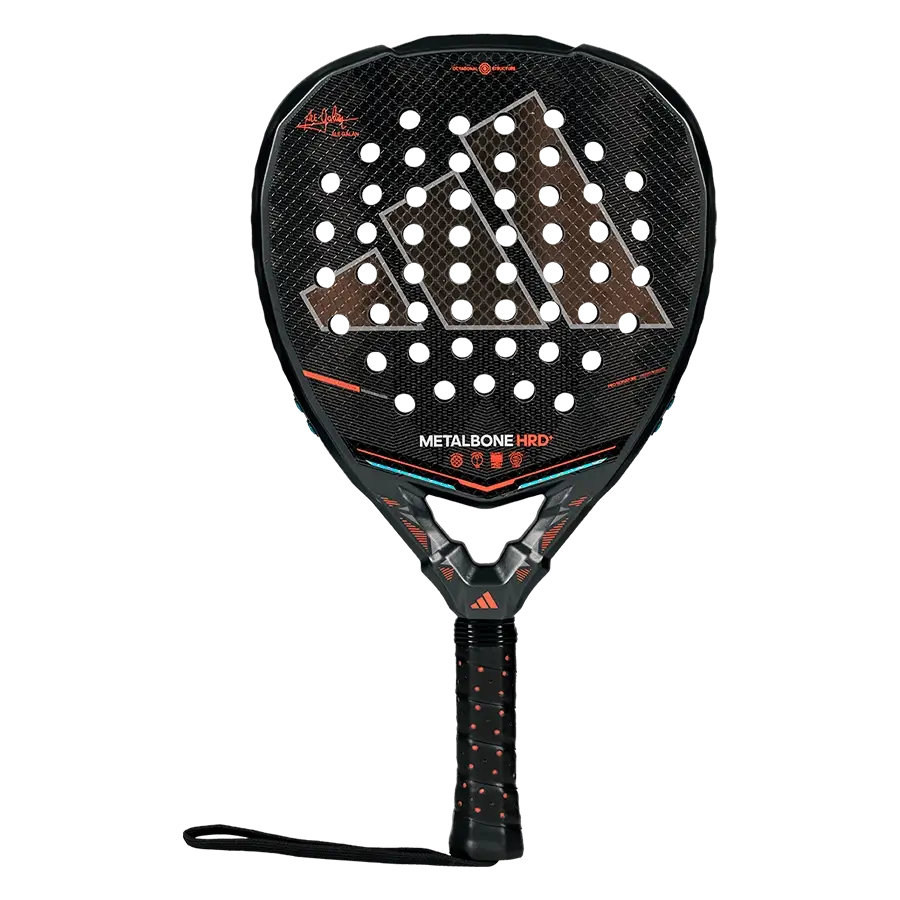
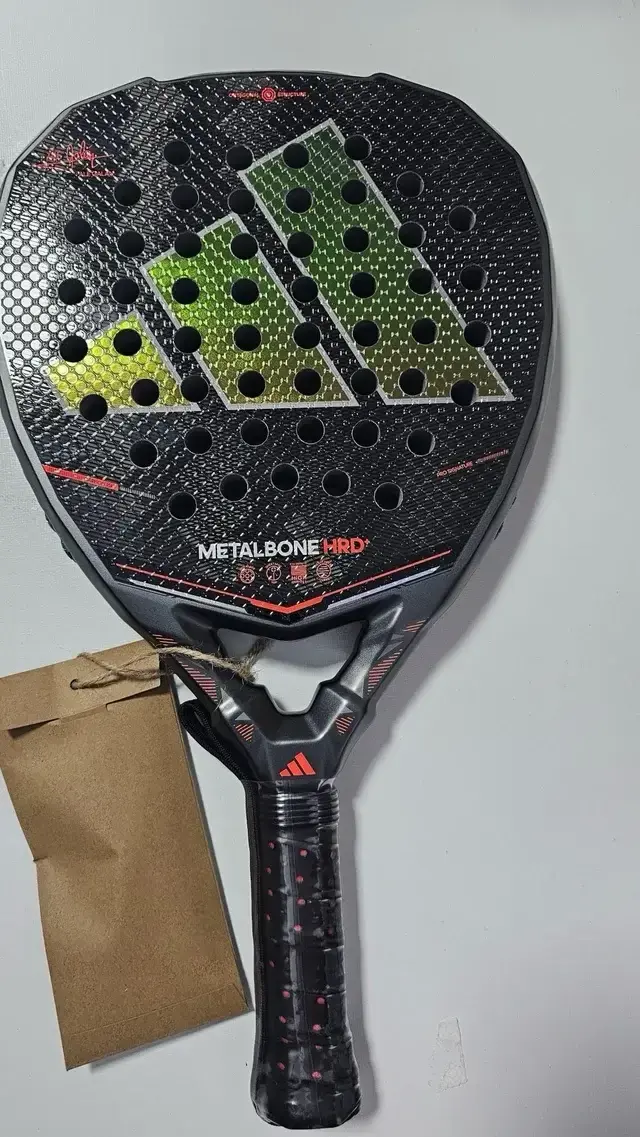
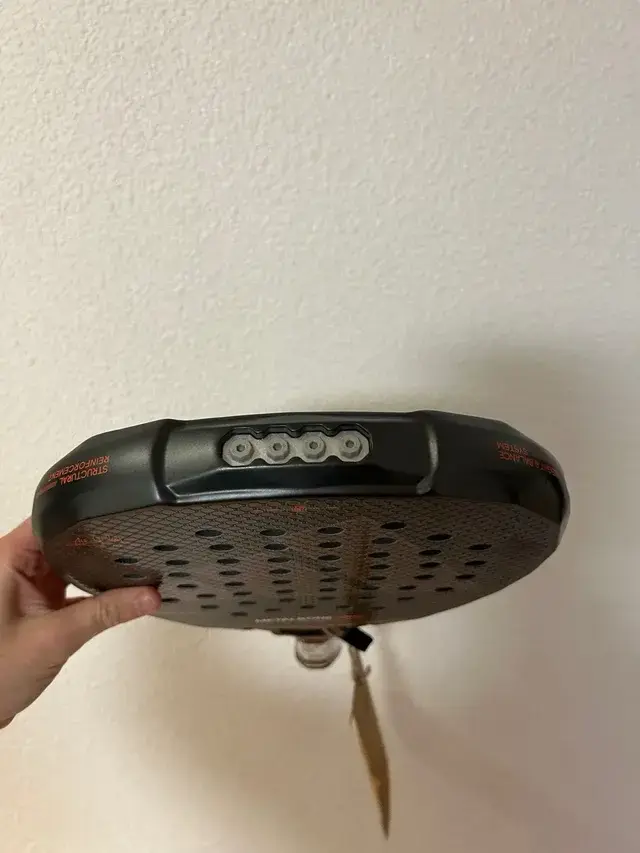
Version and lineup identification
The Metalbone HRD+ 2026 sits at the very top of the adidas Metalbone lineup and represents the hardest and most aggressive variant available in the 2026 collection. Within the Metalbone family, it is positioned above the standard Metalbone 3.5 in terms of stiffness, power ceiling, and swing inertia.
Key differentiators include the use of Carbon Aluminized 16K on the face, High Memory EVA in the core, and the full implementation of adidas’ structural rigidity technologies such as Octagonal Structure, Power Groove, and Low Poly reinforcement. While the adjustable Weight & Balance System is shared across the Metalbone range, the HRD+ configuration is clearly optimized for head-heavy, attack-focused setups rather than neutral balance.
Compared to the 2025 HRD+ generation, the 2026 version does not introduce a radical redesign. Instead, it refines stiffness distribution and maintains a very similar playing identity, confirming adidas’ intention to preserve this model as a reference point for maximum offensive output.
Technical specifications
| Spec | Value | What it means |
|---|---|---|
| Shape | Diamond | High balance, power-oriented |
| Thickness | 38 mm | Thicker = more power and rebound |
| Weight range (claimed) | 345–360 g | Heavier = more stability, lighter = more speed |
| Typical playing weight (with weights installed) | ~365–375 g | Heavier = more stability, lighter = more speed |
| Balance | Adjustable, head-heavy biased | Affects swing feel and power |
| Face material | Carbon Aluminized 16K | Stiff, precise and powerful |
| Core | High Memory EVA | Good balance of control and feel |
| Frame | Carbon Fiber with Octagonal Structure | Structural rigidity and durability |
| Surface | Spin Blade Decal | Determines feel and response |
| Grip | Power Extra Grip (extended handle) | Listed spec to confirm during demo: Power Extra Grip (extended handle). |
| Customization | Weight & Balance System (up to +11.2 g) | Listed spec to confirm during demo: Weight & Balance System (up to +11.2 g). |
Construction and materials
The defining element of the Metalbone HRD+ 2026 is its Carbon Aluminized 16K face combined with High Memory EVA, a pairing that produces one of the stiffest responses in the adidas padel lineup. The aluminized carbon layer reduces face deformation at impact, shortening dwell time and delivering immediate energy return when the ball is struck cleanly.
The High Memory EVA core reinforces this behavior by resisting compression at medium and high swing speeds. Rather than absorbing pace, the core stores and releases energy quickly, favoring explosive acceleration over comfort. This construction minimizes trampoline effect and keeps ball trajectory flat and aggressive, but significantly reduces forgiveness.
The frame structure integrates Octagonal reinforcements and the Power Groove rail along the head, increasing torsional rigidity and stability on high-face impacts. These elements are clearly tuned for overhead play, where structural integrity and mass transfer matter more than vibration filtering or comfort.
Shape and mould behavior
The diamond mould of the Metalbone HRD+ shifts mass decisively toward the upper portion of the face. In real-world configurations, effective balance frequently exceeds 26.5 cm once weights are installed, creating substantial swing inertia and a high, compact sweet spot.
This geometry strongly favors overhead dominance, particularly flat smashes and aggressive víboras, where mass concentration and rigidity translate into direct power. At the same time, maneuverability suffers in defensive transitions and fast exchanges. The mould does not attempt to widen the sweet spot or compensate for late contact, reinforcing the racket’s narrow performance window.
Compared to teardrop or hybrid designs, the HRD+ demands earlier preparation and cleaner positioning. The mould rewards players who take time away from opponents, but punishes hesitation and reactive play.
Stiffness, feel, and comfort
The adidas Metalbone HRD+ 2026 is one of the stiffest rackets in the 2026 adidas lineup, both in longitudinal flex and face response. The combination of Carbon Aluminized 16K and High Memory EVA produces a very short dwell time and a distinctly rigid impact sensation, especially at medium to high swing speeds.
On clean contact, feedback is immediate and highly structured. The racket transmits a clear sense of where the ball was struck, which advanced players often interpret as precision and control under power. However, this clarity comes at the expense of comfort. The core resists compression aggressively, and vibration filtering is limited compared to softer Metalbone or Adipower variants.
At lower swing speeds, the racket feels inert rather than elastic. There is minimal pocketing, and the ball does not “sit” on the face. This makes touch shots, soft resets, and defensive lobs more demanding. Over longer sessions, physical fatigue and arm load become noticeable, particularly for players who rely on reactive play or late contact.
Comfort is therefore highly technique-dependent. Players with clean mechanics and early preparation can manage the stiffness effectively, while those with inconsistent timing may experience harsh feedback on off-center impacts.
Sweet spot and forgiveness
The sweet spot on the Metalbone HRD+ 2026 is compact and positioned high on the face, consistent with its diamond geometry and head-heavy bias. Clean contact in this zone delivers explosive and repeatable output, but performance drops off sharply outside it.
Vertical forgiveness is limited. Contacts below the center lose speed quickly and feel noticeably firmer, with reduced depth and control. Lateral mis-hits are also penalized, as the stiff face and rigid frame transmit torque rather than absorbing it. Compared to the standard Metalbone 3.5, the effective sweet spot is smaller by an estimated 15–20% in practical play.
This behavior reinforces the racket’s offensive specialization. It rewards precision and early positioning, but offers little margin for error when stretched, late, or defending under pressure. Players transitioning from more forgiving frames will immediately notice the reduced tolerance for imperfect contact.
Power and smash behavior
Power generation on the Metalbone HRD+ 2026 is aggressive and highly dependent on swing commitment. The racket does not provide free acceleration at medium swing speeds; instead, power scales sharply once the player reaches higher acceleration thresholds.
On flat smashes, the combination of high balance, rigid face, and stiff core delivers very high peak output when contact is made cleanly and high on the face. Ball trajectory remains flat and penetrating, favoring point-ending shots rather than lift-based smashes. The extended grip further increases leverage, allowing strong players to fully load overheads.
Kick smashes and por-3 shots are achievable, but they require both speed and precision. The racket does not assist vertical launch or spin generation on its own. Compared to more elastic attack frames, the Metalbone HRD+ favors direct power transfer over lift or margin.
The key characteristic is explosiveness without moderation. Unlike controlled attack rackets, the HRD+ does not soften rebound or stabilize overhit tendencies. When acceleration is mistimed, the ball tends to fly long rather than drop short, reinforcing the need for disciplined mechanics.
Net performance under pace
At the net, the Metalbone HRD+ 2026 favors preparation over reaction. When the player is set early, volleys are extremely precise. The stiff face keeps trajectories flat, and the racket excels at finishing high volleys and aggressive put-aways with minimal face deformation.
In fast hand exchanges, however, the racket becomes physically demanding. The elevated balance and high swing inertia slow down rapid changes of direction, making last-second adjustments difficult. Blocks remain stable only if contact is clean and well-positioned; late blocks tend to rebound too long due to the lack of dwell time.
Compared to the standard Metalbone 3.5, the HRD+ feels heavier and less maneuverable at the net. Compared to hybrid or teardrop-shaped rackets, it offers superior punch but significantly less forgiveness. This makes it more suitable for dominant net positions than for chaotic, reflex-based exchanges.
Net performance is therefore high in controlled offensive patterns and clearly weaker in scramble situations.
Off-center stability and torsional resistance
Off-center stability on the adidas Metalbone HRD+ 2026 is highly asymmetric. On high-center contact, especially in overhead situations, the racket feels extremely solid. The head-heavy mass distribution supports direct power transfer, and the frame resists deformation well when the ball is struck cleanly above the center line.
Outside this zone, stability drops quickly. Low-face impacts are penalized the most: ball speed decreases sharply, feedback becomes abrupt, and directional control deteriorates. The High Memory EVA does not absorb or smooth out these contacts; instead, it reflects them back to the player with minimal damping.
Lateral mis-hits also reveal the racket’s rigidity. Torsional resistance is present, but the stiff face transmits twist rather than neutralizing it. Compared to the standard Metalbone 3.5, the HRD+ feels less forgiving and more demanding on imperfect timing. Compared to softer attack frames from other brands, stability is achieved through rigidity rather than energy absorption.
Overall, stability is excellent when the racket is used as intended—clean, early, aggressive contact—but below average in defensive or reactive scenarios where contact quality drops.
Practical on-court takeaways
In match conditions, the Metalbone HRD+ 2026 performs best when the player dictates play through early positioning and aggressive shot selection. The racket thrives in scenarios where points are finished decisively with overheads, flat smashes, and assertive net play.
Defensive phases are its weakest area. Generating depth from the back court requires full swings, and repeated defensive exchanges quickly increase physical load. The racket offers little assistance on stretched lobs, soft resets, or emergency shots.
This is not a racket that adapts to the player. Instead, it imposes a specific style: proactive, high-intensity, and technically clean. Players who match this profile will find its power ceiling and precision rewarding. Players who rely on versatility, forgiveness, or comfort will struggle to access its strengths consistently.
Comparison within the Adidas lineup
Within the Metalbone family, the HRD+ clearly represents the extreme end of the spectrum. Compared to the standard Metalbone 3.5, it increases stiffness, swing inertia, and power ceiling while reducing forgiveness and comfort. The CTRL variant sits at the opposite end, prioritizing stability and ease of use. The Carbon version occupies the middle ground, offering a more accessible balance between power and control.
For a same-brand choice, compare Adidas Metalbone HRD+ 2026 Review with Adidas Metalbone 2026 Review, Adidas Metalbone CTRL 3.5 2026 Review and Adidas Arrow Hit 2026 Review. The useful test is not the badge or score alone: check whether the alternative changes balance, face response, easy depth or comfort in a way that matches your normal rallies.
Comparison with other brands
When compared to other flagship attack rackets on the market, the adidas Metalbone HRD+ 2026 positions itself as a rigidity-driven power frame rather than an elastic power amplifier. Its defining trait is not rebound assistance, but structural stiffness combined with head-weighted mass distribution.
Against the Bullpadel Hack 04 2026, the Metalbone HRD+ feels firmer and more linear. The Hack generates depth and power more easily through its MultiEVA core and slightly softer response, while the Metalbone HRD+ requires cleaner acceleration but offers tighter trajectory control on flat smashes.
Compared to the Babolat Technical Viper 2026, the difference lies in elasticity. The Viper’s X-EVA construction produces more “kick” at medium swing speeds and assists vertical launch on jump smashes. The Metalbone HRD+, by contrast, delivers flatter, more predictable output and punishes incomplete swings more harshly.
Versus the NOX AT10 Attack 12K 2026, the Metalbone HRD+ is stiffer and more aggressive. The AT10 Attack 12K allows slightly more dwell time and control under pressure, while the Metalbone HRD+ offers a higher raw power ceiling but a narrower margin for error.
In this competitive context, the Metalbone HRD+ stands out as one of the most demanding attack rackets available, favoring precision and strength over comfort and versatility.
Technical positioning
The adidas Metalbone HRD+ 2026 is positioned as a top-tier, high-intensity attack racket for advanced and professional-level players. It is designed for those who generate their own pace, strike the ball early, and rely on overhead dominance to finish points.
Technically, it prioritizes stiffness, mass transfer, and directional precision at full acceleration. The diamond mould and elevated balance shift the performance window upward, while the High Memory EVA and rigid face minimize energy loss and deformation.
This positioning comes with clear trade-offs. The racket offers minimal assistance in defensive or transitional play and demands consistent mechanics and physical commitment. Players seeking adaptability, comfort, or error tolerance will be better served by softer or more neutral designs within the adidas lineup or from competing brands.
For players who match its profile, however, the Metalbone HRD+ delivers one of the most uncompromising and direct attacking experiences available in the 2026 market.
Technical performance score
Ten categories, each 0–10. Methodology →
- Maneuverability and handling5
- Net performance under pace7
- Control and placement precision9
- Defensive output and depth access5
- Off-center stability and torsional resistance7
- Sweet spot usability6
- Spin generation potential9
- Power ceiling10
- Power accessibility6
- Comfort and impact feedback6
Final verdict — Adidas Metalbone HRD+ scores 70/100. A competent mid-range option with high power ceiling and attacking character, well suited to developing and recreational players.
Common questions
This racket is designed for advanced and competitive players who rely on aggressive, high-speed attacking patterns. It suits players who generate their own power, strike the ball cleanly, and consistently finish points through overheads and flat smashes. Recreational and intermediate players will generally find it too demanding.
No. Its high stiffness, elevated balance, and narrow sweet spot significantly reduce forgiveness. Players without stable technique or sufficient physical conditioning are likely to struggle with consistency, fatigue, and comfort over long sessions.
The HRD+ version is stiffer, more powerful, and more demanding. The standard Metalbone offers better handling, slightly more dwell time, and greater usability in mixed rally situations. The HRD+ prioritizes maximum smash output and directional stability at full acceleration.
No. Power is strictly player-generated. Medium-effort swings produce limited output, while maximum performance is unlocked only through full acceleration, correct positioning, and clean contact.
Forgiveness is low. The sweet spot is compact and positioned high on the face. Off-center contact — especially low or lateral — results in rapid loss of depth and harsher feedback.
Comfort is below average. Impact feedback is firm and direct, with limited vibration damping. Long sessions can increase physical and arm fatigue, particularly for players sensitive to stiff frames.
It rewards preparation rather than reflex. When positioned early, volleys are stable and precise. Late reactions are heavily penalized due to high swing inertia and minimal dwell time.
Yes. Its stiffness, power ceiling, and structural behavior are among the closest to professional competition frames in the 2026 market. This is reflected in its narrow usability window and high technical demands.