Adidas Arrow Hit 2026 Review
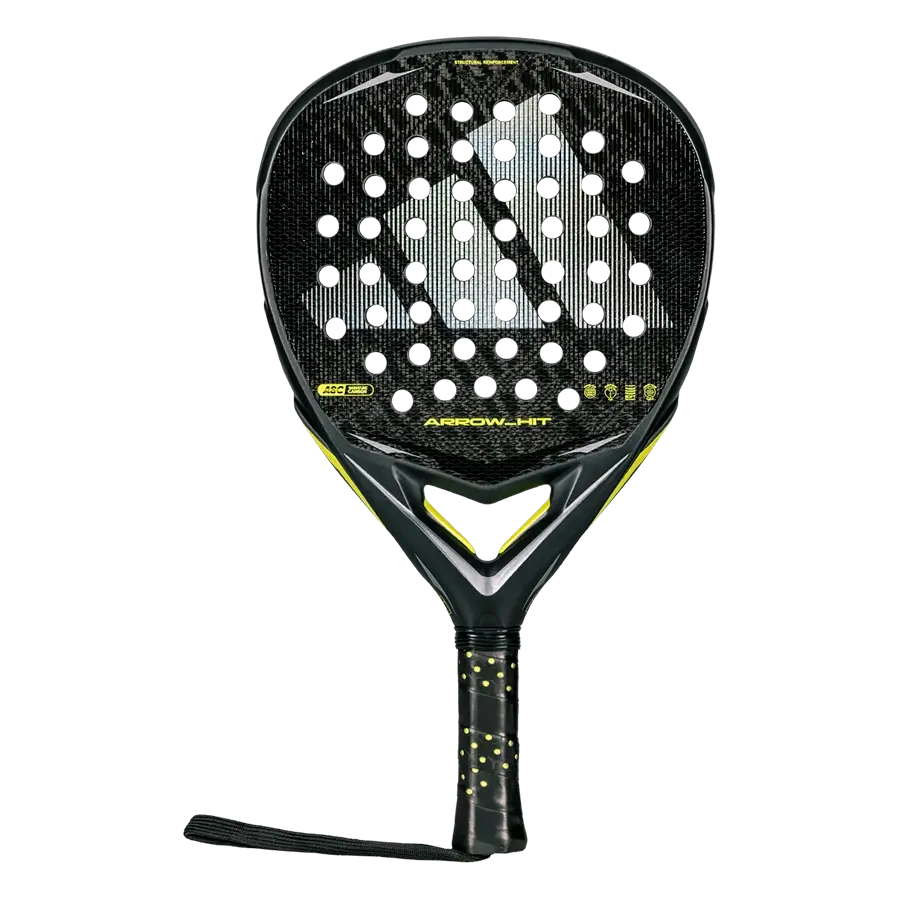
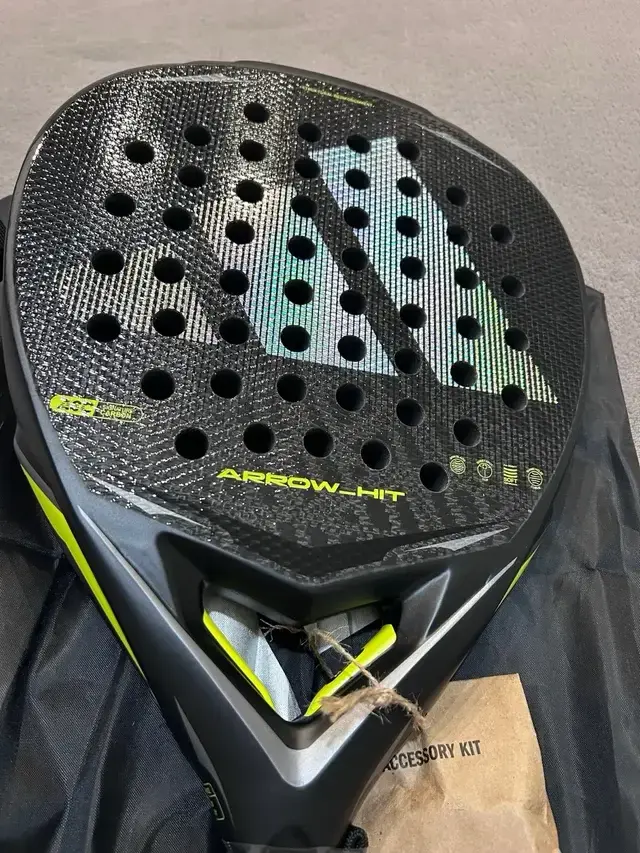
Version and lineup identification
The Arrow Hit 2026 belongs to Adidas’ mid-entry segment and sits below the Metalbone and Metalbone Carbon families in terms of stiffness, power ceiling, and structural complexity. It is designed as a more forgiving alternative for players who do not require the aggressive, physically demanding response of higher-end frames.
Within the Arrow Hit family, the standard Arrow Hit 2026 is the more versatile option, offering a balanced mix of control and accessible depth. It is complemented by the Arrow Hit CTRL, which shifts further toward stability and precision through a more control-oriented geometry and reduced offensive output. Both versions share the same design philosophy but target slightly different player profiles.
Technical specifications
| Spec | Value | What it means |
|---|---|---|
| Shape | Hybrid / teardrop-leaning geometry | Balanced power and control |
| Thickness | 38 mm | Thicker = more power and rebound |
| Weight range (claimed) | ~360–375 g | Heavier = more stability, lighter = more speed |
| Balance (estimated) | medium, slightly head-light to neutral | Versatile, suits all styles |
| Face material | Fiberglass composite | Softer feel, more forgiving |
| Core | Soft EVA | Comfort with retained punch |
| Frame | Carbon-reinforced construction | Structural rigidity and durability |
| Surface texture | Smooth to lightly textured | Determines feel and response |
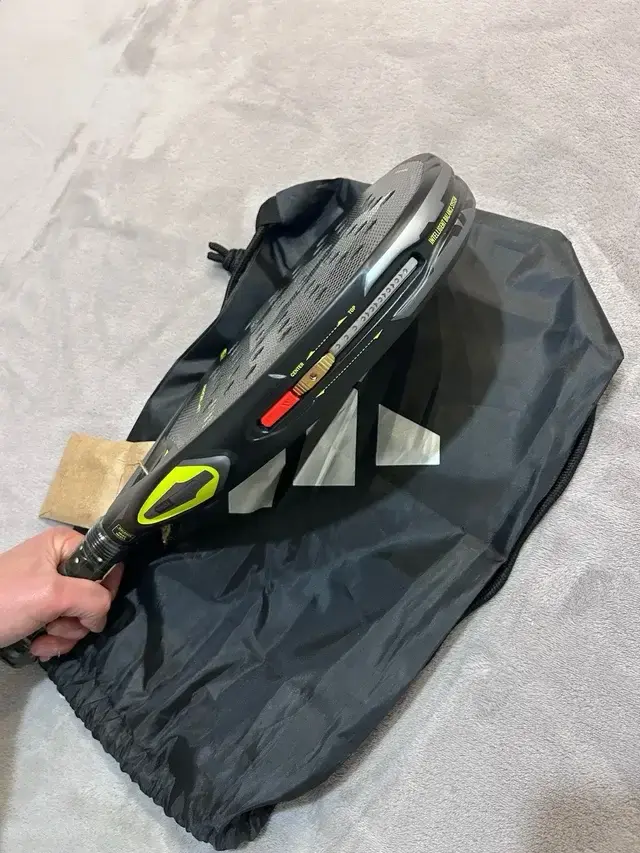
| Adjustable balance system | Yes — lateral sliding weight system (side-mounted balance slider) | Affects swing feel and power |
Construction and materials
The Adidas Arrow Hit 2026 is built around a comfort-oriented construction that prioritizes elasticity, vibration filtering, and predictable rebound over structural rigidity. The fiberglass composite face plays a central role in this behavior. Compared to carbon-based faces used in higher-tier Adidas models, fiberglass introduces longer dwell time and softer energy return, reducing shock and making ball contact feel smoother and more forgiving.
The Soft EVA core reinforces this character. It compresses easily under moderate swing speeds, allowing players to generate depth without full acceleration. Under higher impact, however, the core does not stiffen aggressively, which limits explosive output but helps maintain control and reduces fatigue over long sessions. This construction is particularly beneficial for players still refining timing and mechanics.
The frame uses carbon reinforcement rather than a full high-modulus carbon layup. This provides sufficient structural stability for normal rally pace while avoiding the harsh feedback often associated with stiffer frames. Overall, the material configuration favors comfort, consistency, and error tolerance rather than maximum performance under extreme load.
Shape and mould behavior
The Arrow Hit 2026 uses a hybrid, teardrop-leaning mould that places the sweet spot slightly above center while maintaining a broad effective hitting area. This geometry supports balanced play from the back of the court and stable net exchanges without pushing swing inertia too high.
Balance remains in the medium range, trending slightly toward neutral rather than head-heavy. This contributes to manageable swing weight and easy maneuverability, especially in defensive situations and quick transitions. Compared to attack-oriented shapes, the Arrow Hit allows faster preparation and smoother recovery between shots, reducing physical demand during extended rallies.
The mould does not attempt to artificially boost overhead dominance. Instead, it favors controlled trajectory and directional consistency. While smashes are possible with correct technique, the shape clearly prioritizes rally construction, placement, and steady tempo over point-ending aggression. This reinforces the racket’s positioning as a versatile, confidence-building option rather than a specialized offensive tool.
Stiffness, feel, and comfort
The Arrow Hit 2026 sits firmly on the softer end of the stiffness spectrum. The combination of a fiberglass face and Soft EVA core results in a noticeably flexible impact response, with extended dwell time and muted feedback. Compared to carbon-based Adidas models, the racket absorbs impact energy more gradually, reducing peak shock and making contact feel smooth rather than crisp.
Ball exit speed at low to medium swing speeds is easy to access, but the face does not “snap back” aggressively. This means the racket rarely feels abrupt or unpredictable, even on slightly mistimed contact. The trade-off is reduced sharpness and lower feedback clarity at high acceleration, where the racket can feel somewhat dampened rather than precise.
From a comfort perspective, this is one of the Arrow Hit’s strongest areas. Vibration transmission is low, and repeated impacts—especially from defensive positions—do not accumulate fatigue quickly. Players with arm sensitivity, lighter builds, or developing technique will generally find the Arrow Hit far more forgiving than stiffer alternatives in the Adidas lineup.
Sweet spot and forgiveness
The sweet spot on the Arrow Hit 2026 is broad and centrally positioned, extending both vertically and laterally across a large portion of the face. This is a direct result of the hybrid mould, fiberglass face, and softer core, which distribute impact energy evenly rather than concentrating performance in a narrow zone.
On off-center contact, performance degradation is gradual rather than abrupt. Ball depth decreases progressively, and directional control remains acceptable even when contact is slightly late or low on the face. Compared to carbon attack frames, the Arrow Hit penalizes errors far less, making it easier to sustain rallies under pressure.
Forgiveness is particularly noticeable in defensive situations. Lobs, blocks, and controlled resets remain playable without perfect timing, and the racket provides sufficient margin to recover position without forcing risky swings. This forgiving behavior reinforces the Arrow Hit’s role as a confidence-oriented racket designed to reduce unforced errors rather than amplify aggressive intent.
Power and smash behavior
Power generation on the Arrow Hit 2026 is intentionally moderated. The racket does not amplify ball speed aggressively and offers limited trampoline effect at higher swing speeds. Instead, power output scales smoothly with player input, making the response predictable but clearly capped.
On flat smashes, the Arrow Hit relies more on timing than on mass transfer. The balance is moderate, and swing inertia remains manageable, but the fiberglass face absorbs part of the energy that carbon-based frames would return more directly. As a result, flat finishing smashes require cleaner mechanics and higher swing commitment to achieve decisive depth.
Kick and topspin smashes are more accessible than flat power finishes. The softer face and longer dwell time help lift the ball and generate height, especially for players who rely on spin rather than brute force. However, the racket does not assist vertical launch aggressively, and it will not compensate for insufficient racket head speed.
Compared to Arrow Hit CTRL, the standard Arrow Hit offers slightly higher finishing potential due to its more neutral balance and marginally firmer response. Compared to Metalbone or Metalbone HRD models, overall smash ceiling is substantially lower. The Arrow Hit is designed to close points through consistency and placement rather than through raw power.
Net performance under pace
At the net, the Arrow Hit 2026 emphasizes control, stability, and forgiveness over speed-based aggression. Swing inertia is moderate, allowing relatively quick preparation, and the softer face provides additional dwell time that helps keep volleys low and controlled.
In controlled volley exchanges, the racket feels predictable and easy to manage. Directional accuracy is strong when the player sets early, and the fiberglass face reduces the tendency to overhit, especially on compact blocking volleys. This makes it easier to maintain depth control and avoid floating balls under pressure.
In fast hand battles, the Arrow Hit favors consistency rather than reflex-based punch. Acceleration is sufficient for redirections, but the racket does not add free pace. Late reactions are handled better than with stiff carbon frames, as the softer response absorbs pace instead of rebounding it abruptly. This results in fewer outright errors, but also limits the ability to counter-attack aggressively.
Compared to Arrow Hit CTRL, net behavior is very similar, though the standard Arrow Hit feels marginally more neutral and slightly more capable of pushing the ball through the court. Compared to Metalbone or Metalbone HRD models, the Arrow Hit is clearly slower in explosive exchanges but significantly easier to control over long sequences.
Off-center stability and torsional resistance
Off-center stability and torsional resistance is one of the Arrow Hit 2026’s defining strengths. Thanks to the softer materials and balanced mass distribution, torsional shock on mis-hits is well controlled, particularly in the central and lower portions of the face.
High-center impacts remain stable, though they lack the penetrating depth of stiffer frames. On lateral mis-hits, the racket resists twisting better than expected for a fiberglass construction, and directional loss is gradual rather than sudden. This behavior contrasts sharply with stiff attack rackets, where off-center contact often results in abrupt depth loss and harsher feedback.
Low-face contact, common in defensive digs and late blocks, remains playable. While ball speed drops, the racket maintains a usable trajectory, allowing players to reset the point instead of immediately conceding initiative. This forgiving stability makes the Arrow Hit particularly suitable for long rallies and transitional play.
Practical on-court takeaways
In match conditions, the Arrow Hit 2026 performs best in structured rallies where consistency, margin, and point construction matter more than immediate finishing. From the baseline, it encourages patient play, reliable depth, and controlled spin rather than outright winners.
Defensive phases are a clear strength. The racket absorbs pace effectively, allowing players to reset points with lobs and controlled blocks. Fatigue accumulation is lower than with stiffer, head-heavy frames, making it suitable for extended matches and frequent play.
Offensively, the Arrow Hit rewards placement and variation rather than force. Players who rely on flat winners or repeated power smashes will quickly encounter the racket’s ceiling. Those who build points through angles, spin, and tempo changes will find it cooperative and predictable.
Overall, the Arrow Hit 2026 is best suited for intermediate players, right-side players, and advanced amateurs who prioritize consistency and control. It is not designed to dominate points through power, but to reduce errors and maintain tactical stability across a wide range of match situations.
Comparison within the Adidas lineup
Within the 2026 Adidas padel lineup, the Arrow Hit sits clearly below the Metalbone family in terms of performance ceiling, but above entry-level recreational models in overall balance and playability. Its role is to provide a forgiving, accessible platform for players who want control-first behavior without the demands of stiff carbon constructions.
Relative to Arrow Hit CTRL, the standard Arrow Hit offers slightly more offensive reach and easier depth generation, while maintaining a forgiving response. Compared to Metalbone Carbon, the Arrow Hit is significantly softer, slower, and more error-tolerant, but lacks decisiveness in finishing phases. Against the full Metalbone and HRD models, the Arrow Hit trades almost all power ceiling for comfort, forgiveness, and consistency.
For a same-brand choice, compare Adidas Arrow Hit 2026 Review with Adidas Metalbone 2026 Review, Adidas Metalbone CTRL 3.5 2026 Review and Adidas Arrow Hit CTRL 2026 Review. The useful test is not the badge or score alone: check whether the alternative changes balance, face response, easy depth or comfort in a way that matches your normal rallies.
Comparison with other brands
When compared to similar control-oriented rackets from other manufacturers, the Adidas Arrow Hit 2026 positions itself as a comfort-first, consistency-driven option rather than a technical or performance-focused frame. Its defining advantage is error reduction and ease of play, not point-ending capability.
Against rackets such as the Babolat Reflex Control or Bullpadel Indiga Control, the Arrow Hit offers a more refined feel and better stability under pace, with less trampoline effect and fewer unpredictable rebounds. It feels calmer and more controlled in longer rallies, particularly for players transitioning from beginner to intermediate levels.
Compared to classic fiberglass-based control frames like the Head Evo Speed or Wilson Blade Team, the Arrow Hit provides similar forgiveness but slightly improved directional stability due to its hybrid shape and balanced mass distribution. However, it remains slower and less precise than carbon-based control rackets at higher swing speeds.
Versus softer carbon control options such as the StarVie Titania series, the Arrow Hit is more accessible and arm-friendly, but clearly lower in performance ceiling. Players capable of generating their own pace will outgrow the Arrow Hit faster than these carbon alternatives.
Overall, the Arrow Hit 2026 competes best in the segment of forgiving, low-fatigue rackets aimed at recreational and developing players. It does not attempt to challenge performance-oriented control rackets; instead, it focuses on playability, comfort, and reliability.
Technical positioning
The Adidas Arrow Hit 2026 is positioned as a comfort-oriented, control-first racket designed for recreational and developing players who prioritize consistency, ease of use, and low physical demand over performance ceiling. It is not engineered as a competitive or high-intensity frame, but rather as a stable platform that reduces errors and fatigue across long sessions.
Within the Adidas range, the Arrow Hit sits below the Metalbone Carbon and Metalbone CTRL lines in terms of stiffness, precision, and offensive potential. Its fiberglass face, moderate balance (~25.5–26.0 cm), and medium swing inertia create a forgiving response that favors rally tolerance and defensive reliability. This makes it particularly suitable for right-side players, beginners progressing into intermediate levels, and players who value comfort over acceleration.
Compared to the Arrow Hit CTRL, the standard Arrow Hit offers slightly more offensive reach due to its hybrid/teardrop geometry, but remains firmly control-oriented. Compared to carbon-based alternatives, its ceiling is limited, but its usability window is wide. The racket does not demand perfect mechanics or full acceleration to remain effective, which defines its technical role clearly.
Arrow Hit 2026 is a transitional racket: ideal for players building consistency and court awareness, but not intended for advanced players who rely on decisive finishing, fast net exchanges, or aggressive overhead patterns.
Technical performance score
Ten categories, each 0–10. Methodology →
- Maneuverability and handling7
- Net performance under pace6
- Control and placement precision7
- Defensive output and depth access7
- Off-center stability and torsional resistance7
- Sweet spot usability8
- Spin generation potential6
- Power ceiling5
- Power accessibility7
- Comfort and impact feedback8
Final verdict — Adidas Arrow Hit scores 68/100. A competent mid-range option with excellent comfort and arm-friendly feedback, well suited to developing and recreational players.
Common questions
The Arrow Hit 2026 is designed for beginner to intermediate players who prioritize consistency, comfort, and ease of play. It suits players who are still developing timing, positioning, and shot selection, and who benefit from a forgiving racket that minimizes unforced errors.
Not typically. Its soft construction and limited power ceiling make it less effective for players who rely on repeated overhead finishing, fast volleys, or high swing speeds. Aggressive left-side players will usually prefer carbon-based models with higher stiffness.
The Arrow Hit CTRL emphasizes maximum control and forgiveness with a rounder geometry and slightly lower offensive reach. The standard Arrow Hit offers marginally more power due to its hybrid/teardrop shape, while remaining firmly control-oriented.
Yes, intentionally. The fiberglass face increases dwell time and comfort but reduces precision and power at high acceleration. This trade-off favors consistency and accessibility rather than performance ceiling.
Very forgiving. The sweet spot is large and centrally positioned, and performance loss on off-center contact is gradual. This is one of the racket’s strongest characteristics.
Yes. Impact feedback is soft and filtered, with low vibration transmission. While comfort still depends on technique and setup, the Arrow Hit is generally arm-friendly for its category.
To a point. It supports progression from beginner to solid intermediate levels, but players who start demanding sharper control, faster reactions, or finishing power will eventually outgrow it.