NOX AT10 Genius Attack 12K Alum Xtrem 2026
Version and lineup identification
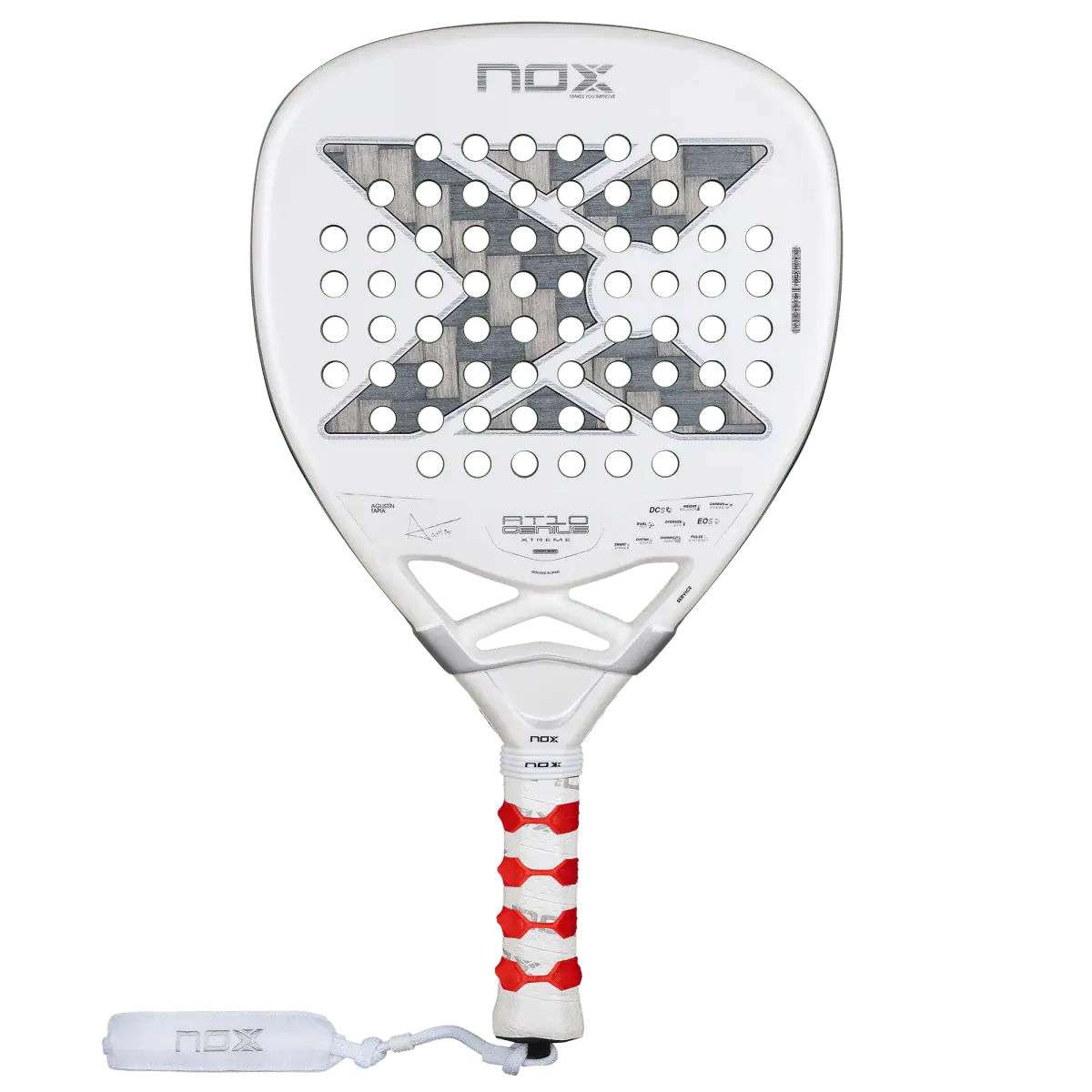
The AT10 Genius Attack 12K Alum Xtrem 2026 shares its DNA with the AT10 family but diverges sharply in geometry and balance. It uses a diamond mould with a higher balance point and an extended handle, designed to increase leverage and head inertia. The face material is 12K Alum Xtrem carbon, paired with an HR3 Black EVA core, positioning this racket as the stiffest and most explosive option in the AT10 lineup.
Within the 2026 AT10 range, the Attack 12K sits above the standard AT10 12K and AT10 18K in terms of power intent. It is not a refinement of the control platform, but a directional shift aimed at players who want maximum output on smashes and overheads, even at the cost of forgiveness and ease.
Technical specifications
| Spec | Value | What it means |
|---|---|---|
| Shape | Diamond (Attack mould) | High balance, power-oriented |
| Thickness | 38 mm | Thicker = more power and rebound |
| Weight range (claimed) | 360–375 g | Heavier = more stability, lighter = more speed |
| Typical playing weight (observed) | ~364–368 g depending on setup | Heavier = more stability, lighter = more speed |
| Balance (observed) | ~26.0–26.7 cm depending on overgrips and weights | Affects swing feel and power |
| Face material | Carbon Fiber 12K Alum Xtrem | Good stiffness and durability |
| Core | HR3 Black EVA | Good balance of control and feel |
| Surface finish | Dual Spin (sand + micro-3D texture) | Determines feel and response |
| Handle | Extended length | Listed spec to confirm during demo: Extended length. |
| Adjustable balance system | Yes (2 g / 4 g weights) | Affects swing feel and power |
Construction and materials
The construction of the AT10 Attack 12K 2026 prioritizes rigidity and energy transfer. The 12K Alum Xtrem carbon face is significantly stiffer than the 18K variants used elsewhere in the AT10 lineup. This stiffness reduces face deformation at impact, increasing rebound speed and making ball output more dependent on swing acceleration rather than elastic dwell.
The HR3 Black EVA core complements this by providing a relatively firm compression profile. Under high swing speeds, the core resists collapse and releases energy quickly, supporting explosive overhead shots. At lower swing speeds, however, the same firmness reduces assistance, making the racket less forgiving in defensive situations.
Structurally, this combination creates a racket that feels solid and direct, but also more demanding. The materials are not tuned to smooth out variability; they are tuned to maximize transfer efficiency when contact and timing are correct.
Shape and mould behavior
The diamond mould is the defining factor in how this racket plays. Mass is concentrated higher in the head, shifting effective balance upward compared to standard AT10 models. Observed balance values around 26.0–26.7 cm confirm this head-heavy tendency, especially when minimal counterweight is used in the handle.
In play, this mould increases rotational inertia, which benefits overhead shots and flat finishing. The racket naturally wants to stay on its swing path during smashes, producing heavier ball weight. The trade-off is reduced maneuverability in quick exchanges and a narrower margin for error on late or off-center contact.
The sweet spot is positioned higher than on teardrop AT10 versions, reinforcing the racket’s overhead bias. Players who strike the ball cleanly in this zone are rewarded with significant output; those who miss it experience a sharper drop-off than on neutral-shaped rackets.
12K versus 18K in the AT10 family
Within the AT10 family, the difference between 12K and 18K versions is amplified in the Attack configuration. The 12K Alum Xtrem face is clearly stiffer and faster, producing shorter dwell time and higher rebound speed than the 18K Alum alternatives.
In Attack form, this stiffness compounds with the diamond mould. Compared to an AT10 Attack 18K, the 12K version feels more explosive but also harsher and less tolerant. The 18K Attack offers slightly more dwell and comfort, while the 12K Attack maximizes output at the cost of control.
This distinction is critical: players who assume higher “K” always means stiffer will misinterpret the lineup. In NOX’s tuning, the 12K Attack is the hardest-hitting and least forgiving AT10 variant.
Stiffness, feel, and comfort
The AT10 Attack 12K 2026 sits firmly in the medium-high to high stiffness range. Impact feel is crisp and direct, with limited face flex. This results in excellent feedback on clean hits, but also transmits more vibration on mishits compared to standard AT10 versions.
Comfort is acceptable for players accustomed to firm rackets, but this is not an arm-friendly design. Compared to the AT10 18K, comfort is noticeably reduced. Players with elbow or wrist sensitivity should approach with caution and pay close attention to grip size and weight configuration.
Sweet spot and forgiveness
The sweet spot is compact and positioned high on the face. Forgiveness below center is limited, and defensive shots struck low on the face often result in short or unstable returns. This is a direct consequence of the diamond mould and stiff face combination.
Compared to standard AT10 rackets, the Attack 12K offers significantly less forgiveness. It rewards clean, assertive contact and penalizes hesitation or poor positioning.
Power and smash behavior
This is the racket’s defining strength. Smash output is among the highest in the NOX lineup. Flat smashes and por-3 attempts benefit from the head-heavy balance and stiff face, producing heavy ball speed and penetration.
Unlike control-oriented AT10 versions, the Attack 12K does not require exaggerated swing speed to generate power. However, it does require proper technique to keep shots in play. The power ceiling is high, but so is the risk of overhitting.
Net performance under pace
At the net, the racket feels slower and more demanding than standard AT10 models. The higher balance increases inertia, making rapid hand battles more challenging. Volleys require firmer hands and earlier preparation to maintain control.
Players who rely on reflex volleys and soft touch at the net may struggle. Those who prefer punch volleys and decisive finishes will find the racket effective once adapted.
Off-center stability and torsional resistance
Stability is strong on clean hits but drops quickly outside the sweet spot. The stiff face resists torsion well when contact is centered, but off-axis hits transmit more shock and produce less predictable trajectories.
Using the Weight Balance system to add counterweight in the handle can improve overall stability and reduce perceived head heaviness, but it does not fundamentally change the racket’s aggressive nature.
Practical on-court takeaways
In match play, the AT10 Attack 12K 2026 is a specialist tool. It excels in overhead-dominant games, aggressive transitions, and points finished early. Players who control rallies through power and decisive shots will benefit most.
In longer rallies, defensive scrambles, or matches requiring sustained consistency, the racket becomes physically and mentally demanding. It rewards confidence and punishes hesitation.
Comparison within the NOX lineup
Within the 2026 NOX lineup, the AT10 Genius Attack 12K Alum Xtrem occupies the most extreme position in terms of geometry and mass distribution. While it shares materials and technologies with other AT10 models, the physical configuration produces fundamentally different behavior.
AT10 Attack 12K 2026 vs AT10 12K 2026 (standard teardrop)
Both rackets use the same 12K Alum Xtrem carbon face, but the similarity largely ends there. The standard AT10 12K maintains a teardrop shape with observed balance typically around ~25.2–25.6 cm, while the Attack version shifts balance upward to approximately ~26.0–26.7 cm depending on setup.
This ~0.7–1.2 cm balance difference translates directly into higher rotational inertia. On court, the Attack version generates noticeably heavier overhead shots with less swing speed required. However, the standard AT10 12K is significantly more maneuverable at the net and more forgiving in defensive blocks due to its lower balance and wider usable contact area.
In practical terms, the Attack version amplifies power at the cost of consistency, while the standard AT10 12K offers a more neutral all-court profile.
AT10 Attack 12K 2026 vs AT10 Attack 12K 2025
The 2026 Attack 12K retains the same diamond mould philosophy but introduces subtle refinements. Surface grip is improved through the updated Dual Spin treatment, and rebound behavior is marginally more linear than the 2025 version.
Measured playing weights remain similar, typically ~365–370 g, but several testers report slightly improved stability in 2026, especially when adding small counterweights to the handle. The 2025 version felt more “raw” and less controlled during high-speed exchanges, whereas the 2026 model better contains its power output.
This makes the 2026 version a refinement rather than a reinvention, offering marginally improved control without changing the aggressive identity.
AT10 Attack 12K 2026 vs AT10 Attack 18K 2026
This comparison highlights how face material changes behavior even within the same Attack geometry. The 12K Attack is stiffer, faster, and more demanding. The 18K Attack, while still aggressive, introduces slightly longer dwell time and reduced shock.
In measured setups, both versions sit in similar weight and balance ranges, but the 18K version delivers marginally better forgiveness and comfort, especially on off-center hits. Players sensitive to vibration or who prefer a slightly smoother response may favor the 18K Attack, while maximum smash output clearly favors the 12K.
AT10 Attack 12K 2026 vs EA10 Hybrid
Compared to the EA10 Hybrid, the Attack 12K offers significantly higher smash output but far less forgiveness. The EA10’s balance sits lower, and its face-core interaction produces easier depth from defensive positions. The Attack 12K, by contrast, requires commitment and precision, offering little assistance outside clean contact zones.
This distinction is critical for player selection: EA10 supports consistency and recovery, while Attack 12K prioritizes point finishing.
For a same-brand choice, compare NOX AT10 Genius Attack 12K Alum Xtrem 2026 Review with NOX AT10 Luxury Genius 18K Alum 2026 Review, NOX AT10 Luxury Genius 12K Alum XTREM Lite 2026 Review and NOX EA10 Ventus Hybrid 12K XTREM 2026 Review. The useful test is not the badge or score alone: check whether the alternative changes balance, face response, easy depth or comfort in a way that matches your normal rallies.
Comparison with other brands
When positioned against leading attack-oriented rackets from other manufacturers, the NOX AT10 Genius Attack 12K Alum Xtrem 2026 occupies a very specific technical niche. It is not the most explosive or the stiffest option in absolute terms, but it delivers a more controlled and predictable attack profile than many traditional diamond-shaped power rackets.
AT10 Attack 12K 2026 vs Bullpadel Hack 04 2026
The Bullpadel Hack 04 2026 represents a more extreme power-first philosophy. With a typical weight range of 365–375 g and an observed balance close to ~27.0 cm, the Hack places more mass higher in the head. Combined with its 18K carbon face and MultiEVA core, this results in a higher rebound and a more aggressive launch on full swings.
Compared to that, the AT10 Attack 12K typically sits slightly lower in balance, around ~26.2–26.6 cm depending on weight setup, and uses a stiffer 12K Alum carbon with HR3 Black EVA. The result is lower trampoline effect and more linear ball output. On smash, the Hack generates more raw depth and power with less effort, but it also demands cleaner timing to avoid long balls. The AT10 Attack trades some ceiling power for better control of trajectory, especially on flat or semi-flat overheads and counter-smashes.
AT10 Attack 12K 2026 vs Adidas Metalbone HRD 2026
The Adidas Metalbone HRD 2026 is structurally stiffer and more customizable. Its 16K aluminized carbon face, High Memory EVA, and adjustable weight system allow it to be tuned well beyond 26.5 cm balance if desired. In its most aggressive setup, Metalbone HRD produces faster rebound and higher ball speed than the AT10 Attack.
However, this stiffness comes with a narrower margin for error. The Metalbone HRD’s sweet spot is more compact and higher on the face, while off-center contact below the center drops off more sharply. The AT10 Attack 12K, while still clearly an attack-biased diamond, offers a more forgiving central response and calmer rebound under defensive pressure. Players who value customization and maximum punch may prefer Metalbone HRD, while those seeking repeatability across long rallies will find the AT10 Attack easier to manage.
AT10 Attack 12K 2026 vs Babolat Technical Viper / Viper Lebrón 2026
Babolat’s Technical Viper line emphasizes elastic energy return. With 3K carbon faces and X-EVA multilayer cores, these rackets tend to produce higher rebound and more pronounced ball “kick” at medium swing speeds. Weight is typically 365–375 g, with a high effective balance around ~26.5–27.0 cm.
Against these models, the AT10 Attack 12K feels more restrained. The aluminized 12K face reduces dwell time and limits trampoline effect, which leads to less free power but greater predictability. On fast net exchanges and blocks, the AT10 Attack remains more stable and easier to keep low. The Viper offers more explosive smash potential, particularly for players who rely on elastic launch rather than full acceleration.
AT10 Attack 12K 2026 vs StarVie Triton Power+ 2026
The StarVie Triton Power+ 2026 is another high-balance diamond, typically in the 360–375 g range with a clearly head-heavy feel. Its construction focuses on elastic response and a larger upper sweet spot, favoring aggressive overhead play.
Compared to Triton Power+, the AT10 Attack 12K feels more structured and less elastic. The Triton provides easier depth and height on smash but sacrifices some control in flat exchanges and defensive blocks. The AT10 Attack, while less forgiving at the very top of the face, maintains better consistency in transitional shots and counter-attacks.
AT10 Attack 12K 2026 vs Head Extreme
Head’s Extreme-style attack rackets often sit in a similar weight range but tend to feel stiffer longitudinally, with more pronounced vibration feedback on off-center hits. While they can deliver comparable power, their rebound is often sharper and less damped.
The AT10 Attack 12K differentiates itself through its vibration control and calmer feedback. Although not a comfort-oriented racket, it avoids the harshness often associated with very stiff attack frames, making it more sustainable over longer sessions.
Technical positioning
The NOX AT10 Genius Attack 12K Alum Xtrem 2026 is designed for advanced players who want maximum attacking output and are willing to sacrifice forgiveness and comfort. It is not an all-court solution and not a natural upgrade from standard AT10 models unless the player’s style has shifted decisively toward offense.
Within the broader 2026 attack segment, the NOX AT10 Genius Attack 12K Alum Xtrem positions itself as a controlled power racket rather than a pure power amplifier. It sits below the absolute power ceiling of models like Hack 04 or Metalbone HRD, but it offers superior consistency, better defensive stability, and more predictable ball behavior across a wider range of match situations.
For the right player, it is a devastating weapon. For everyone else, it will feel unnecessarily demanding.
Final score: 65 / 100
This score reflects a specialist power tool, not a universal performer. The high power ceiling is offset by reduced forgiveness and versatility.
Technical performance score
Ten categories, each 0-10. Methodology →
- Maneuverability and handling7
- Net performance under pace7
- Control and placement precision7.5
- Defensive output and depth access6.5
- Off-center stability and torsional resistance6.5
- Sweet spot usability0
- Spin generation potential8
- Power ceiling9
- Power accessibility6.5
- Comfort and impact feedback6.5
Final verdict — NOX AT10 Genius Attack 12K Alum Xtrem scores 65/100. A strong performer with balanced performance across categories, a solid choice for intermediate to advanced players.
Common questions
Yes. The higher balance (~26.0–26.7 cm vs ~25.2–25.6 cm) and diamond shape reduce forgiveness and increase physical demands, especially in defense and net play.
The 12K Attack is stiffer and produces faster rebound. The 18K version offers slightly more dwell time and comfort, but lower maximum smash output.
Only for strong intermediates with an aggressive style. Most intermediates will struggle with consistency due to the compact sweet spot and reduced defensive assistance.
It allows tuning within a narrow range. Adding counterweight to the handle can slightly reduce perceived head heaviness, but it does not transform the racket into a forgiving or all-court option.
Yes for players who liked the aggressive profile but wanted more control and surface grip. The 2026 version is more refined without losing its attacking identity.
Power is easier than on standard AT10 models, but not “automatic.” Clean overhead technique is still required to control trajectory and avoid overhitting.
The two faces of NOX rackets are technically identical, with rare exceptions limited to certain LTD models. The “Service” marking does not indicate any difference in performance, materials, or playing characteristics of that side of the racket. It is used only before the match to determine which team serves first. Players can spin the racket on the court, and if the side with the “Service” marking ends up facing up, the guessing team starts the match with the serve.