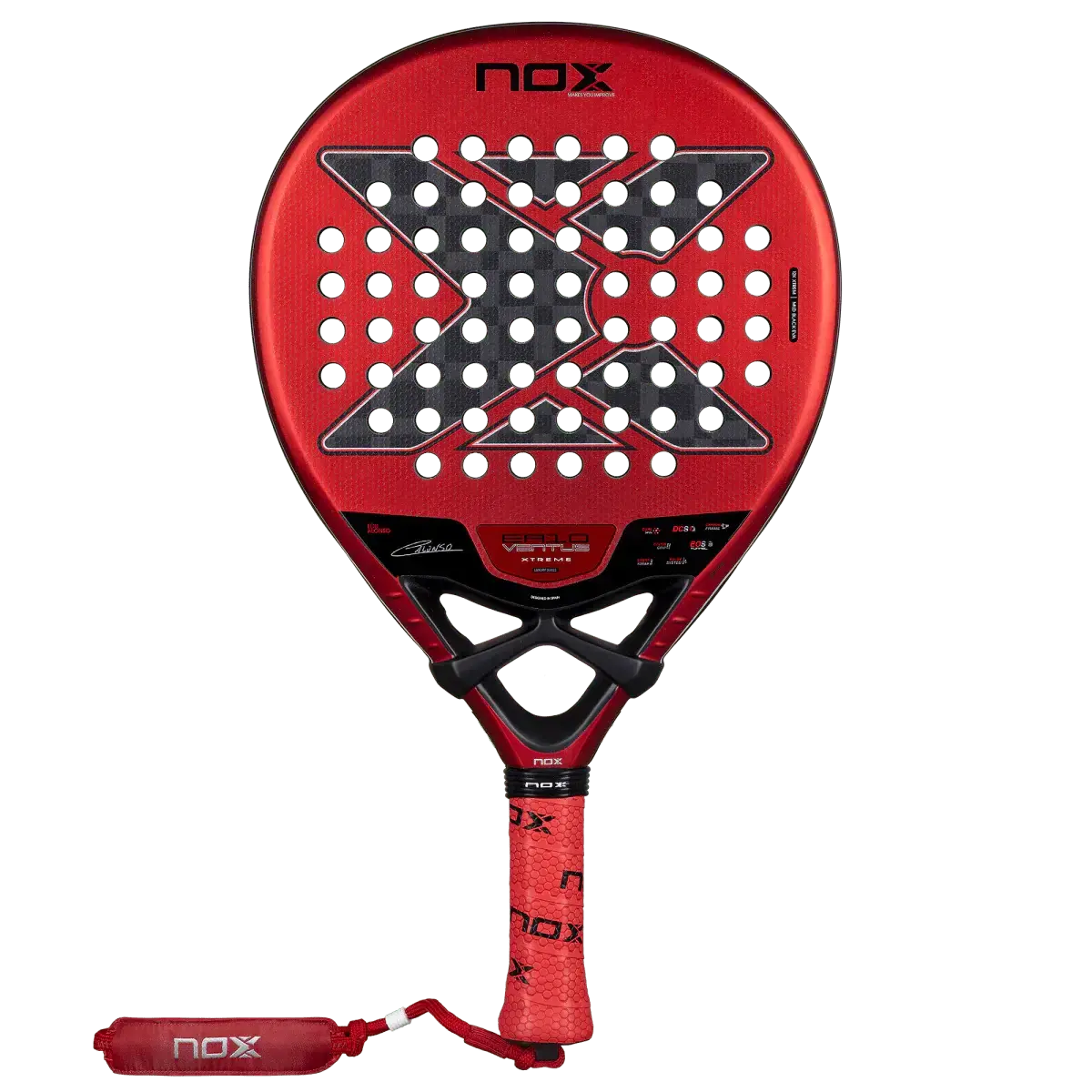
NOX EA10 Ventus Hybrid 12K XTREM 2026
Version and lineup identification
The EA10 Ventus Hybrid 12K XTREM 2026 is part of the NOX 2026 signature lineup developed in collaboration with Edu Alonso. Within the NOX range, it occupies the hybrid-control segment, positioned between the AT10 teardrop models and the more aggressive Attack frames.
Compared to the AT10 12K 2026, the EA10 Hybrid is firmer laterally and more resistant to deformation, especially on off-center contact. Compared to the AT10 Attack variants, it offers significantly lower swing inertia, improved maneuverability, and a more neutral balance profile. The racket is clearly not designed as a “lite” or comfort option, nor as a power amplifier—it is a structurally disciplined hybrid aimed at consistent, high-tempo rally play.
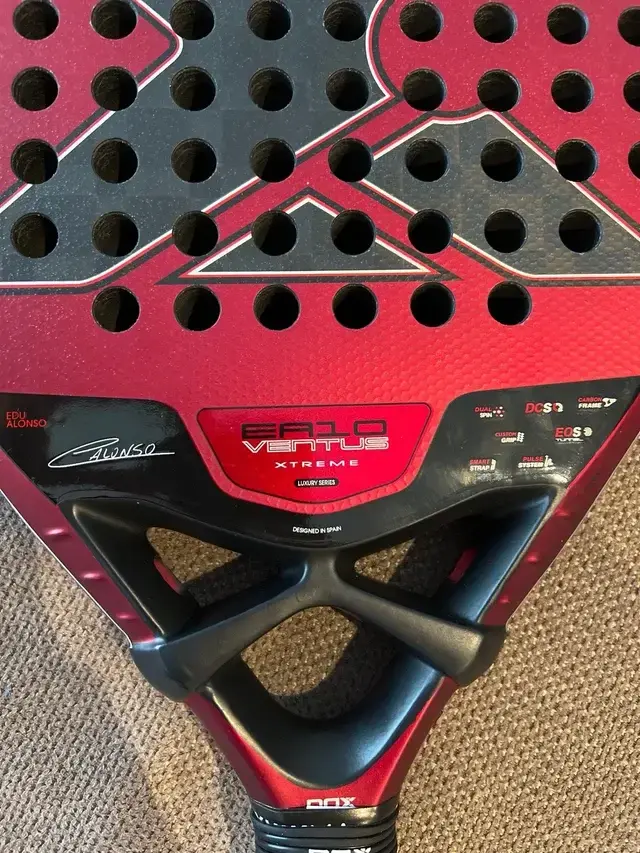
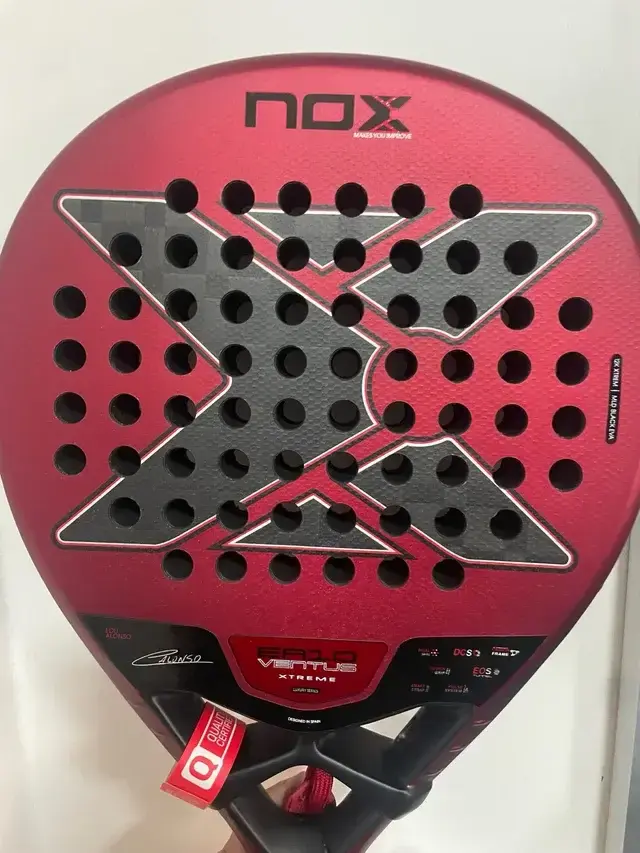
Key technologies include the 12K XTREM carbon face, MLD Black EVA core, full carbon frame construction, Dual Spin surface treatment, and NOX’s vibration management systems. Unlike some AT10 models, the EA10 Hybrid emphasizes structural rigidity and rebound control over modular adjustability.
Technical specifications
| Spec | Value | What it means |
|---|---|---|
| Shape | Hybrid (between teardrop and round) | Balanced power and control |
| Thickness | 38 mm | Thicker = more power and rebound |
| Weight range (claimed) | ~360–375 g | Heavier = more stability, lighter = more speed |
| Measured weights (videos) | ~362–368 g | Heavier = more stability, lighter = more speed |
| Balance (measured) | ~25.5–25.8 cm | Affects swing feel and power |
| Face material | 12K XTREM Carbon | Good stiffness and durability |
| Core | MLD Black EVA | Good balance of control and feel |
| Frame | 100% Carbon | Structural rigidity and durability |
| Surface | Dual Spin (3D texture + sand finish) | Determines feel and response |
| Finish | Matte with textured face | Listed spec to confirm during demo: Matte with textured face. |
Construction and materials
The defining structural element of the EA10 Ventus Hybrid 12K XTREM is its 12K XTREM carbon face, which prioritizes stiffness and low elasticity. Compared to standard 12K or 18K carbon faces, XTREM carbon reduces trampoline effect and shortens dwell time, resulting in a more immediate, linear response.
The MLD Black EVA core operates in the medium-firm range. It absorbs incoming pace efficiently during blocks and defensive shots, but firms up quickly as swing speed increases. This behavior supports controlled acceleration rather than elastic launch, particularly noticeable in flat baseline exchanges and counter-drives.
The full carbon frame enhances torsional rigidity, especially on lateral mis-hits. Combined with the hybrid shape, this construction produces a racket that feels structurally “locked in,” resisting twisting and deformation under stress rather than flexing to generate speed.
Shape and mould behavior
The hybrid mould places the sweet spot slightly above center, but not as high as diamond attack frames. Measured balance values around 25.5–25.8 cm keep mass distribution neutral, supporting maneuverability and recovery while maintaining enough stability for sustained rallies.
This geometry favors baseline control, directional accuracy, and transition play. Compared to teardrop AT10 models, the EA10 Hybrid feels slightly firmer and more disciplined. Compared to diamond attack rackets, it is significantly easier to maneuver and less demanding physically.
The mould does not attempt to artificially enlarge the sweet spot or compensate for off-center contact through elasticity. Instead, it relies on structural rigidity and balanced mass distribution, reinforcing the racket’s narrow focus on consistency and predictability.
Stiffness, feel, and comfort
In play, the NOX EA10 Ventus Hybrid 12K XTREM 2026 feels clearly firmer than it looks on paper. The 12K XTREM face produces a compact, dry impact with minimal trampoline effect, especially noticeable at medium swing speeds. Compared to standard 12K NOX faces, rebound is shorter and more controlled, which reduces unexpected depth but also limits free acceleration.
Measured setups around 362–366 grams with balance near 25.8–26.2 cm result in a response that is structurally solid rather than elastic. The racket does not bend noticeably on contact, even when absorbing pace from the opponent. This gives a sense of stability and predictability, particularly in baseline exchanges, but also means the racket demands active swing participation.
Comfort is acceptable but clearly secondary to control. The MLD Black EVA and Pulse System filter high-frequency vibration, so impact does not feel sharp or metallic. However, the overall stiffness means that late or off-center contact is transmitted more directly to the arm than with softer hybrid designs. Compared to the AT10 18K teardrop, the EA10 Hybrid feels firmer and less forgiving; compared to AT10 Attack models, it is noticeably calmer and easier on the arm.
For players with good technique and clean contact, comfort remains manageable over long sessions. For players with arm sensitivity or inconsistent timing, the firm face and limited dwell time may become fatiguing.
Sweet spot and forgiveness
The sweet spot on the EA10 Ventus Hybrid is moderately sized and centrally positioned, slightly above the geometric center but lower than on diamond-based NOX rackets. In practical terms, this produces a usable hitting area that is wider horizontally than Attack models but narrower vertically than teardrop AT10 variants.
When contact is made in the central zone, output is consistent and trajectory remains stable. However, forgiveness drops progressively as impact moves toward the lower face or the lateral edges. Compared to the standard AT10 12K, the effective sweet spot feels reduced by approximately 10–15%, primarily due to the stiffer XTREM face and the hybrid mould geometry.
This behavior reinforces the racket’s identity as a control tool. It does not mask technical errors, but it also does not behave unpredictably. Mis-hits lose depth and pace in a linear way rather than producing sudden launch or vibration spikes. Players who value predictable penalty rather than chaotic rebound will appreciate this characteristic.
Power and smash behavior
Power generation on the EA10 Ventus Hybrid 12K XTREM is entirely player-driven. The racket offers minimal assistance at medium swing speeds, particularly compared to diamond NOX models or elastic power frames. With balance consistently measured below ~26.3 cm, mass transfer is controlled rather than aggressive.
On flat smashes, the racket delivers sufficient pace to finish points when contact is clean and swing speed is high, but it does not produce effortless winners. Ball speed scales almost linearly with acceleration, and the lack of trampoline effect keeps trajectories flatter and easier to manage. This reduces the risk of overhitting but also limits maximum ceiling.
Kick smashes and por-3 attempts are possible, but they require full commitment and precise technique. The racket does not naturally assist vertical launch or lift, especially compared to more elastic attack-oriented frames. As several reviewers noted, smash effectiveness improves noticeably once the player adapts to accelerating through the ball rather than relying on rebound.
Compared to the standard AT10 12K, smash power is slightly lower but more controlled. Compared to the AT10 Attack series, the EA10 Hybrid sacrifices overhead dominance in exchange for consistency and lower physical demand across long matches.
Net performance under pace
At the net, the EA10 Ventus Hybrid feels composed and balanced. Swing initiation is faster than on diamond NOX models due to lower swing inertia, making the racket more reactive in quick exchanges. Volleys remain controlled, and the 12K XTREM face helps prevent accidental pop-ups, even when blocking firm shots.
In hand battles, the racket rewards early preparation rather than last-second reactions. While it is more maneuverable than Attack models, it still requires correct positioning to be effective. Compared to softer hybrids, the EA10 Hybrid provides less free rebound but more directional discipline.
Touch shots, drop volleys, and short angles benefit from the short dwell time, which allows precise placement when timing is correct. However, players who rely on elastic response to compensate for late contact may find the racket demanding.
Off-center stability and torsional resistance
Stability is one of the EA10 Ventus Hybrid’s strongest attributes. The full carbon frame, DCS reinforcement, and moderate balance produce solid torsional resistance on off-center impacts, particularly on lateral mis-hits.
High-center contact remains extremely stable, with minimal frame twist and predictable ball exit. On lateral impacts, depth loss is gradual rather than abrupt, and directional control remains usable. Compared to AT10 Attack models, which tend to punish lateral mis-hits more sharply, the EA10 Hybrid offers a wider margin for error.
Low-face contact is still penalized, especially in defensive situations, but the racket absorbs pace better than expected for a firm 12K face. Overall stability is superior to many hybrid rackets in the same category and closer to teardrop AT10 behavior than to diamond attack frames.
Practical on-court takeaways
In real match conditions, the EA10 Ventus Hybrid 12K XTREM performs best when rallies are built through structure and patience. From the baseline, it excels at maintaining depth and direction under pressure, especially in cross-court exchanges. The racket encourages disciplined shot selection and punishes rushed acceleration.
Defensive play is reliable rather than spectacular. The racket absorbs pace well but does not generate depth automatically, so defensive lobs and resets require proper swing length and footwork. Over long matches, the lower balance reduces fatigue compared to attack-oriented frames.
The EA10 Hybrid is particularly effective for right-side players, all-court amateurs, and advanced players who prefer control over raw power. Left-side attackers seeking decisive overhead dominance will likely find the racket limiting.
Comparison within the NOX lineup
Within the NOX lineup, the EA10 Ventus Hybrid 12K XTREM occupies a distinct space between the standard AT10 teardrop models and the Attack series. While it shares the 12K face philosophy with the AT10 12K, its hybrid mould and XTREM layup shift the performance balance toward stability and directional control rather than linear power transfer.
Compared to the AT10 12K 2026, the EA10 Hybrid feels firmer on contact and less elastic. The AT10 12K allows more ball compression and a slightly wider sweet spot, which benefits aggressive players who want to inject pace manually. The EA10 Hybrid, by contrast, absorbs pace more effectively and offers a calmer response in baseline exchanges, particularly under sustained pressure.
Against the AT10 18K, the EA10 Hybrid trades dwell time and comfort for structural firmness. The 18K version remains the most forgiving and versatile teardrop AT10, while the EA10 Hybrid is more disciplined and demanding, especially when contact drifts away from the center.
Compared to the Attack series, the difference is fundamental. Both Attack models push balance beyond ~26.0 cm and prioritize overhead finishing. The EA10 Hybrid sits lower in balance and swing inertia, making it more maneuverable and less fatiguing over long rallies. While it cannot match the overhead authority of the Attack 12K or 18K, it is significantly easier to manage in defense, transitions, and net exchanges.
In practical terms, the EA10 Ventus Hybrid functions as the control-oriented hybrid anchor of the NOX lineup. It is neither the most powerful nor the most forgiving, but it offers a rare combination of firmness, stability, and predictability that appeals to structured, all-court players—especially on the right side.
For a same-brand choice, compare NOX EA10 Ventus Hybrid 12K XTREM 2026 Review with NOX AT10 Luxury Genius 18K Alum 2026 Review, NOX AT10 Luxury Genius 12K Alum XTREM Lite 2026 Review and NOX ML10 Ventus Control 3K 2026 Review. The useful test is not the badge or score alone: check whether the alternative changes balance, face response, easy depth or comfort in a way that matches your normal rallies.
Comparison with other brands
When compared to hybrid and control-oriented rackets from other manufacturers, the NOX EA10 Ventus Hybrid 12K XTREM 2026 positions itself as a stability-first platform rather than a power-driven or comfort-focused design. Its defining trait is not free depth or elastic rebound, but structural firmness, directional discipline, and confidence under sustained baseline pressure.
EA10 Ventus Hybrid 12K XTREM 2026 vs Bullpadel Vertex Control / Vertex Hybrid
Bullpadel’s Vertex Control and Vertex Hybrid models are designed to offer a blend of forgiveness and controlled power, typically with softer cores and more elastic carbon layups. Effective playing weights usually fall around 365–375 g, with balances close to ~25.7–26.0 cm depending on configuration.
Compared to these rackets, the EA10 Ventus Hybrid feels firmer and less spring-loaded. The Vertex line provides easier depth at medium swing speeds and a more generous sweet spot, particularly on defensive shots and lobs. The EA10, by contrast, absorbs incoming pace more effectively and keeps ball trajectories flatter and more predictable. While Bullpadel hybrids favor players who want assistance and comfort, the EA10 favors players who want the racket to stay neutral and not amplify mistakes.
EA10 Ventus Hybrid 12K XTREM 2026 vs Adidas Metalbone CTRL / Metalbone Team
Adidas Metalbone CTRL variants prioritize customization and stiffness, often using aluminized carbon faces and aggressive weight systems. Balance can be tuned upward, and rebound tends to be faster and more abrupt when configured toward attack.
The EA10 Hybrid is less extreme. It offers no radical balance manipulation and avoids the sharp rebound spikes typical of stiff Metalbone setups. While Metalbone CTRL models can generate more acceleration on compact swings, they also punish off-center contact more severely. The EA10 Hybrid delivers a calmer, more uniform response across the face, especially in long rallies and defensive resets, at the cost of lower peak acceleration.
EA10 Ventus Hybrid 12K XTREM 2026 vs Babolat Counter Viper / Veron Counter
Babolat’s Counter line is built around energy return and rebound assistance, using elastic faces and multi-layer EVA constructions. These rackets are designed to help players absorb pace and redirect it with minimal effort, especially from defensive positions.
Compared to Counter models, the EA10 Hybrid is noticeably less elastic. It does not provide the same “ball kick” or trampoline effect at medium effort. However, it compensates with superior directional control and reduced launch volatility. On court, the Counter Viper or Veron will feel easier and more forgiving, while the EA10 Hybrid feels stricter and more demanding—but also more precise when the player controls tempo.
EA10 Ventus Hybrid 12K XTREM 2026 vs Head Speed / Radical series
Head’s Speed and Radical hybrids typically emphasize balanced handling and accessible power, often with slightly softer longitudinal stiffness and more forgiving sweet spots.
Against these rackets, the EA10 Hybrid feels more compact and structurally rigid. Head models generally allow easier acceleration and smoother net play, while the EA10 offers better stability when blocking heavy balls and maintaining depth under pressure. Players transitioning from Head rackets may initially find the EA10 less lively, but more trustworthy once timing and technique are dialed in.
Technical positioning
The NOX EA10 Ventus Hybrid 12K XTREM 2026 occupies a clearly defined position within both the NOX lineup and the broader market of hybrid-oriented padel rackets. It is not designed as an all-purpose comfort racket, nor as an attack-first power tool. Instead, it targets players who prioritize structural stability, directional control, and consistency from the baseline over free acceleration or forgiveness.
Within the NOX ecosystem, the EA10 Hybrid sits below the AT10 Attack models in terms of raw overhead authority and swing inertia, but above standard teardrop AT10 variants in firmness and resistance to deformation. Compared to the AT10 12K, the EA10 Hybrid feels more rigid laterally and more disciplined in rebound behavior, particularly when absorbing pace. Compared to lighter or more elastic NOX frames, it sacrifices ease of depth in exchange for predictability and confidence under pressure.
Technically, the hybrid shape combined with the 12K XTREM carbon face creates a performance window centered around neutral balance and controlled mass distribution. Effective balance typically stays in the mid-25 cm range, which keeps maneuverability manageable while still providing enough stability for sustained baseline exchanges. The XTREM face reduces trampoline effect and shortens dwell time compared to softer constructions, reinforcing a linear, player-driven response.
From a market perspective, the EA10 Ventus Hybrid 12K XTREM aligns with players who build points through patience, positioning, and repeated pressure rather than sudden acceleration. It is particularly well suited for right-side players or all-court players who value defensive solidity, clean ball output, and low launch volatility. Players seeking effortless depth, soft touch, or explosive finishing will generally find more suitable options in elastic hybrid or attack-focused designs.
This technical positioning explains why the racket performs best in structured, high-tempo rallies and why it feels less forgiving in rushed or improvised situations. The EA10 Hybrid is designed to stay stable, neutral, and predictable—provided the player supplies proper timing and swing discipline.
Final score: 75 / 100
A final score of 75 places the NOX EA10 Ventus Hybrid 12K XTREM 2026 among the stronger control-oriented hybrid rackets on the market. It excels in stability, directional accuracy, and baseline reliability, offering a calm and disciplined response under pressure.
At the same time, its firm construction and limited rebound reduce forgiveness and power accessibility, especially for players who rely on elastic assistance. Within the NOX lineup, it appeals most to players who want a more rigid and stable alternative to the AT10 teardrop models without moving into full attack territory.
The EA10 Ventus Hybrid 12K XTREM is best suited for intermediate-to-advanced players who value consistency, structure, and tactical control over comfort or explosive finishing.
Technical performance score
Ten categories, each 0–10. Methodology →
- Maneuverability and handling7.5
- Net performance under pace7.5
- Control and placement precision8.5
- Defensive output and depth access7
- Off-center stability and torsional resistance8
- Sweet spot usability7
- Spin generation potential7.5
- Power ceiling7.5
- Power accessibility7
- Comfort and impact feedback7.5
Final verdict — NOX EA10 Ventus Hybrid 12K XTREM scores 75/100. A strong performer with strong control and placement precision, a solid choice for intermediate to advanced players.
Common questions
This racket is designed for intermediate to advanced players who prioritize control, stability, and rally construction over raw finishing power. It is particularly well suited for right-side players, baseline-oriented players, and those who prefer building points through placement and depth rather than aggressive smash sequences. Players with clean mechanics and a structured game benefit most from its linear response.
While both rackets share a 12K carbon face, their behavior is different. The AT10 12K teardrop model is more versatile and slightly more forgiving, especially in defensive situations. The EA10 Hybrid is firmer laterally, calmer under acceleration, and more stable on off-center contact, but offers less free depth and a narrower performance window. The EA10 feels more disciplined and “locked in,” while the AT10 is more adaptable.
No. Power generation is almost entirely player-driven. At medium swing speeds, ball output is controlled and modest. The racket does not rely on trampoline effect or elastic rebound. As swing speed increases, power scales linearly and predictably, which helps maintain control but limits easy finishing for less aggressive players.
The sweet spot is moderate in size and positioned slightly above center. It is larger than on diamond attack frames but smaller than on round control rackets. Off-center contact is handled better than expected due to frame rigidity, but depth and pace drop noticeably outside the central zone. This racket rewards clean contact and consistent preparation.
Net play is stable and controlled rather than reactive. The neutral balance (~25.5–25.8 cm) supports maneuverability, but the firm face means the racket does not “save” late reactions. When positioned early, volleys are precise and predictable. In rushed hand battles, players must actively guide the ball rather than rely on automatic rebound.
Comfort is acceptable but not a defining strength. The MLD Black EVA core absorbs vibration reasonably well, but the stiff 12K XTREM face transmits clear feedback, especially on mis-hits. Players with arm sensitivity should ensure proper grip setup and avoid undersized grips. Compared to softer hybrid or 18K models, the EA10 feels firmer and more demanding.
It can be, but only for amateurs with solid fundamentals. Beginners or players who rely on elastic response and forgiveness may struggle to generate depth and consistency. For casual players seeking ease of use, lighter or more forgiving teardrop models within the NOX lineup are generally better options.
That it is an “all-round easy hybrid.” In reality, it is a control-first, discipline-oriented racket. It performs best when the player actively controls tempo and positioning. Players expecting effortless power or large forgiveness margins may find it underwhelming.
The two faces of NOX rackets are technically identical, with rare exceptions limited to certain LTD models. The “Service” marking does not indicate any difference in performance, materials, or playing characteristics of that side of the racket. It is used only before the match to determine which team serves first. Players can spin the racket on the court, and if the side with the “Service” marking ends up facing up, the guessing team starts the match with the serve.