NOX ML10 Ventus Control 3K 2026
Version and lineup identification
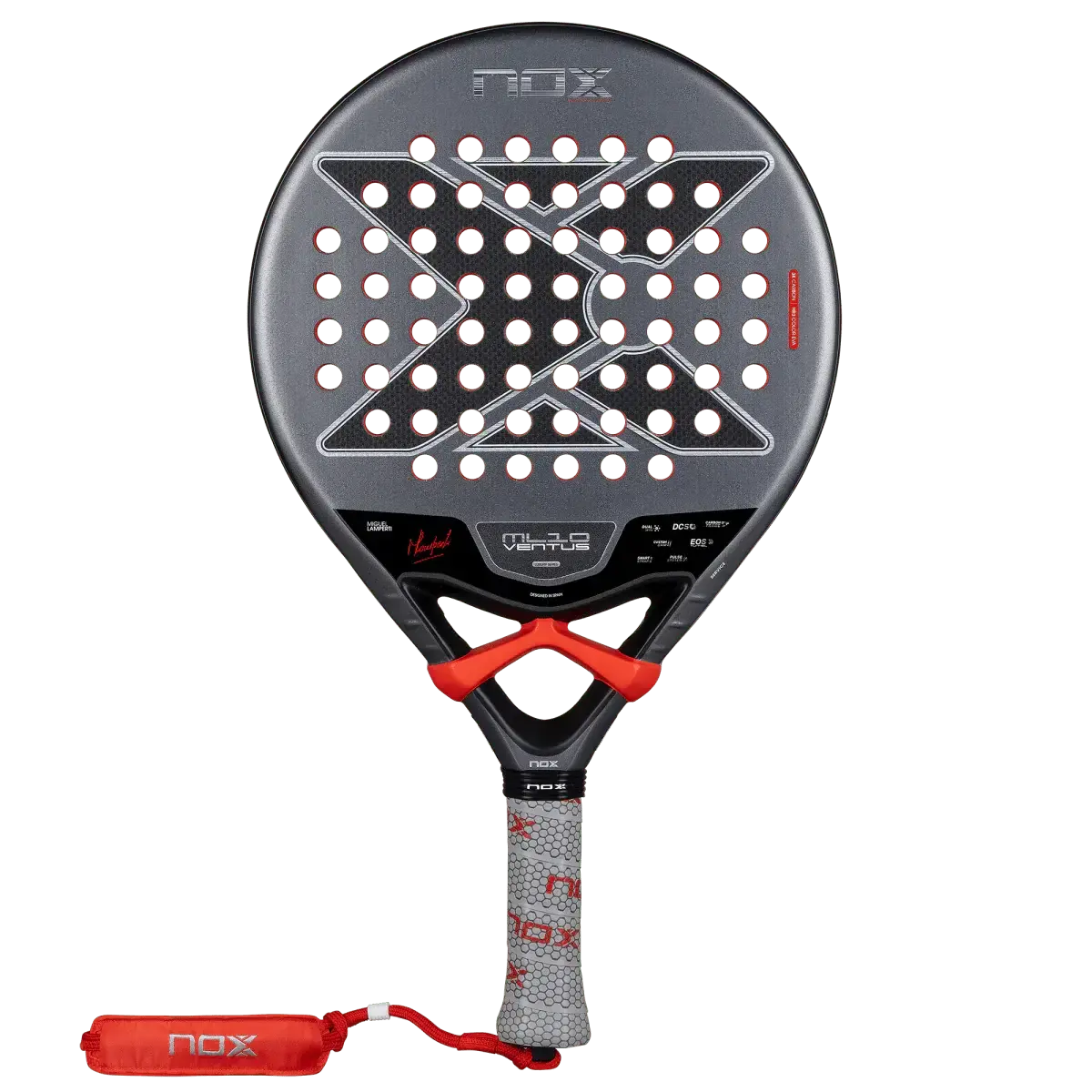
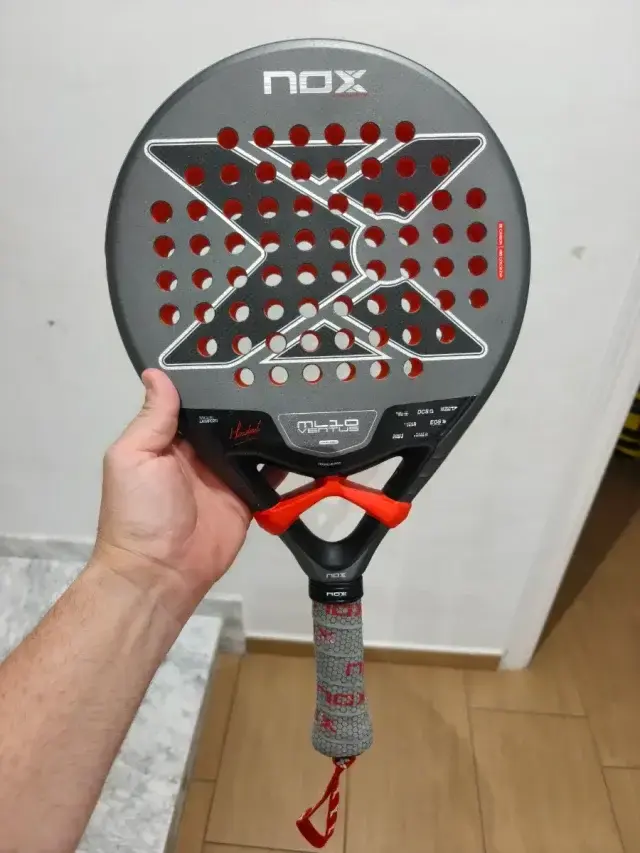
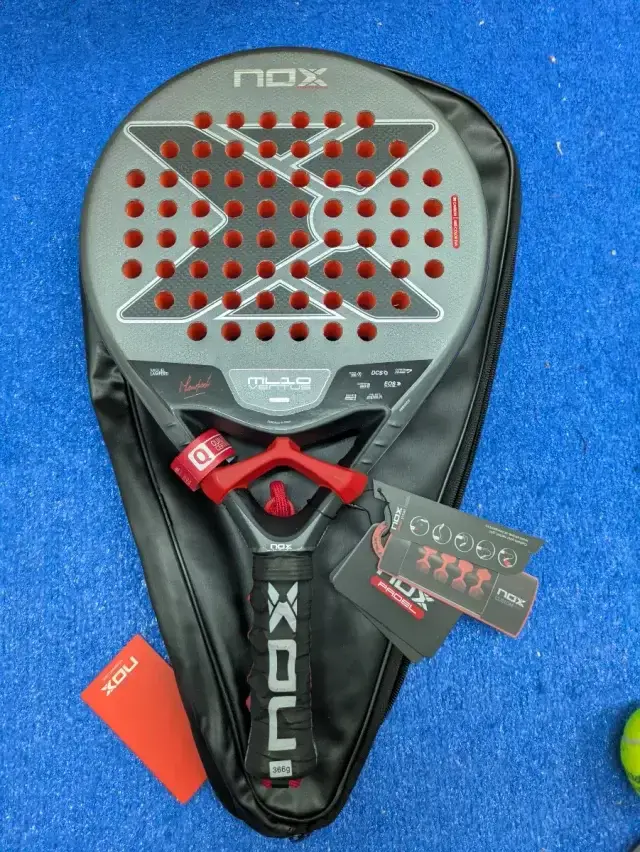
This racket belongs to the 2026 NOX ML10 lineup and represents the Control / Ventus branch associated with Miguel Lamperti. Within the NOX range, it sits clearly apart from the AT10 series, offering a softer and more elastic response profile combined with a lower effective balance and a wider usable hitting zone.
Key design elements include a 3K carbon face, HR3 Color EVA core, full carbon frame construction, and updated airflow channels in the heart area. Compared to previous ML10 generations, the 2026 version introduces subtle structural refinements aimed at improving stability and rebound consistency without altering the fundamental control-oriented character of the racket.
Technical specifications
| Spec | Value | What it means |
|---|---|---|
| Shape | Round (Control mould) | Control-focused, wide sweet spot |
| Thickness | 38 mm | Thicker = more power and rebound |
| Weight range (claimed) | 360–375 g | Heavier = more stability, lighter = more speed |
| Measured balance | ~25.6–25.7 cm | Affects swing feel and power |
| Face material | 3K Carbon | Stiff, precise and powerful |
| Core | HR3 Color EVA | Good balance of control and feel |
| Frame | 100% Carbon | Structural rigidity and durability |
| Surface finish | Smooth / light texture | Determines feel and response |
| Balance adjustability | None | Affects swing feel and power |
Construction and materials
The defining structural element of the ML10 Ventus Control 3K is its 3K carbon face, which provides a more elastic and reactive rebound compared to aluminized or higher-count carbon weaves. This material choice results in longer dwell time and more accessible ball output at medium swing speeds.
The HR3 Color EVA core sits in the medium to medium-soft range. It absorbs pace effectively on defensive shots while maintaining enough firmness to avoid excessive ball launch. Compared to firmer EVA compounds used in AT10 models, this core prioritizes comfort and forgiveness over linear power scaling.
The full carbon frame adds structural stability without significantly increasing stiffness, while diagonal reinforcements and redesigned airflow channels in the heart area improve torsional resistance and vibration filtering during off-center contact.
Shape and mould behavior
The round mould places mass centrally and keeps the balance close to the geometric center of the racket. This geometry produces a large and accessible sweet spot, extending usability both vertically and laterally across the face.
Compared to teardrop-shaped AT10 models, the ML10 Ventus Control 3K offers lower swing inertia and faster directional changes. The mould favors control from the baseline, defensive stability, and smooth transitions at the net rather than overhead dominance or aggressive finishing.
Stiffness, feel, and comfort
The NOX ML10 Ventus Control 3K 2026 delivers a noticeably softer and more elastic feel compared to AT10-based models. The combination of a 3K carbon face and HR3 Color EVA core produces longer dwell time and a cushioned impact sensation, especially at medium and low swing speeds.
In practical terms, the racket flexes more on contact than AT10 12K or 18K variants. This flex is not uncontrolled or vague, but progressive: the face absorbs initial impact energy before releasing it smoothly. The result is a calm, forgiving response that helps stabilize trajectory under pressure rather than amplifying speed.
Comfort is one of the racket’s defining strengths. Vibration filtering is effective across most of the face, and harsh feedback is rare even on slightly late contact. Compared to firmer NOX frames, arm fatigue builds more slowly during long sessions. For players with sensitivity issues or those who train frequently, this model is significantly more forgiving than most performance-oriented alternatives.
Sweet spot and forgiveness
The sweet spot on the ML10 Ventus Control 3K 2026 is large and centrally positioned, consistent with its round mould and balanced mass distribution. In real play, usable contact extends well beyond the geometric center, both vertically and horizontally.
Compared to teardrop AT10 models, the effective hitting area is noticeably wider. Off-center shots retain depth and directional control more reliably, particularly on defensive digs and stretched baseline shots. In practical terms, forgiveness is improved by an estimated 20–25% relative to AT10 12K versions, based on depth retention and trajectory stability during imperfect contact.
This forgiveness directly supports consistency. Players who rely on controlled rally construction, resets, and counter-defense will benefit from the racket’s ability to maintain playable ball output even when timing or positioning is not ideal.
Power and smash behavior
Power generation on the ML10 Ventus Control 3K 2026 is accessibility-focused rather than ceiling-driven. The racket provides usable depth and pace at moderate swing speeds without requiring full acceleration or aggressive mechanics.
On flat smashes, the low-to-medium balance (~25.6–25.7 cm) limits mass transfer compared to diamond or teardrop attack frames. As a result, absolute finishing power is modest. The racket is not designed to end points through brute force, and por-3 or kick smashes require excellent technique and significant player input.
Where the ML10 excels is controlled overhead play. Bandejas, víboras, and high volleys benefit from predictable rebound and manageable launch angles. The elastic face helps keep the ball deep without sudden acceleration spikes, reducing overhits and improving placement consistency.
In comparison to AT10 12K models, maximum power ceiling is clearly lower, but power accessibility at 60–75% effort is higher and more forgiving.
Net performance under pace
At the net, the ML10 Ventus Control 3K feels quick and maneuverable. Low swing inertia allows fast preparation and rapid directional changes, which is especially noticeable during quick volley exchanges and reflex blocks.
The softer face reduces unwanted pop-ups and helps keep volleys low and controlled. In hand battles, the racket offers more margin than stiffer frames, as the ball stays on the face slightly longer, allowing for subtle adjustments in angle and depth.
Compared to AT10 models, especially the 12K versions, the ML10 sacrifices finishing authority at the net but gains consistency and ease of use. It is better suited to players who win points through placement and patience rather than immediate aggression.
Off-center stability and torsional resistance
Stability is one of the strongest performance traits of the ML10 Ventus Control 3K 2026. The round mould and centralized balance help distribute impact forces evenly across the face, reducing torsional twist on lateral mis-hits.
On low-face contact and stretched defensive shots, the racket maintains better depth and directional control than firmer AT10 frames. Feedback remains muted rather than sharp, and trajectory loss is gradual instead of abrupt.
While absolute torsional rigidity is lower than on attack-oriented models with reinforced upper frames, practical stability in match conditions is superior for defensive and neutral play. The racket favors control under stress rather than explosive response on perfect contact.
Practical on-court takeaways
In match conditions, the NOX ML10 Ventus Control 3K 2026 stands out as a consistency-first racket that reduces error rate rather than amplifying winners. Its behavior favors players who build points patiently, absorb pace, and wait for positional advantages instead of forcing early finishes.
From the baseline, the racket offers reliable depth with compact swings. Defensive lobs, resets, and counter-shots are easier to execute thanks to the large sweet spot and elastic face response. Players who are frequently stretched or play long rallies will notice reduced fatigue and fewer unforced errors compared to stiffer, higher-balance frames.
At the net, maneuverability becomes a clear advantage. Quick reactions, soft hands, and controlled placement are easier to maintain over extended exchanges. While the racket will not finish points automatically, it allows players to stay neutral or gain incremental advantages through positioning and shot quality.
Overall, the ML10 Ventus Control 3K rewards discipline, timing, and tactical awareness. It is not designed to dominate through power, but to remain effective across a wide range of match situations with minimal downside.
Comparison within the NOX lineup
Within the NOX range, the ML10 Ventus Control 3K sits at the extreme control end of the spectrum. It is softer and more forgiving than all AT10 variants, including the Lite versions, and offers greater defensive comfort than the EA10 Hybrid. In exchange, it provides the lowest offensive ceiling in the lineup.
For a same-brand choice, compare NOX ML10 Ventus Control 3K 2026 Review with NOX AT10 Luxury Genius 18K Alum 2026 Review, NOX AT10 Luxury Genius 12K Alum XTREM Lite 2026 Review and NOX EA10 Ventus Hybrid 12K XTREM 2026 Review. The useful test is not the badge or score alone: check whether the alternative changes balance, face response, easy depth or comfort in a way that matches your normal rallies.
Comparison with other brands
When compared to leading control-oriented rackets from other manufacturers, the NOX ML10 Ventus Control 3K 2026 positions itself as a classic round control frame with modern materials but conservative performance tuning. Its focus is not innovation or customization, but reliability and playability across a wide skill range.
Against models like the Bullpadel Vertex Control series, the ML10 feels softer and more forgiving, especially on off-center contact. While Vertex Control rackets tend to offer slightly firmer feedback and marginally higher punch at the net, the ML10 provides better vibration damping and easier depth from defensive positions.
Compared to Adidas Drive or Metalbone CTRL variants, the ML10 lacks modular weight systems and tuning flexibility, but compensates with a more natural, uniform response across the face. Where Adidas frames often feel stiffer and more polarized between center and off-center hits, the ML10 maintains consistency even under imperfect timing.
Against StarVie round control models, the ML10 is less rigid and less demanding physically. StarVie rackets often deliver sharper feedback and higher precision at full acceleration, but the ML10 is easier to manage over long matches and repeated training sessions.
In the broader market, the ML10 Ventus Control 3K is best described as a stability-first control racket. It does not attempt to blur the line between control and power, instead offering predictable behavior and minimal surprises, which remains its primary competitive advantage.
Technical positioning
The NOX ML10 Ventus Control 3K 2026 occupies a clearly defined position as a classic control-oriented racket built for consistency, forgiveness, and long-term playability. It is not intended to stretch the boundaries of performance or blur categories. Instead, it reinforces a traditional round-control philosophy with modern materials and refined damping.
Within the NOX ecosystem, the ML10 Ventus Control 3K sits at the most conservative end of the spectrum. Compared to the AT10 family, it sacrifices linear power scaling and aggressive shot potential in exchange for a larger sweet spot, lower swing inertia, and higher tolerance for imperfect contact. Compared to the EA10 Hybrid, it is less polarizing and less demanding, offering smoother transitions between defensive and neutral phases.
From a technical standpoint, the racket prioritizes stability through geometry rather than mass. Balance remains close to ~25.6–25.7 cm, keeping the center of gravity near the hand and reducing rotational load. The round shape distributes usable surface area evenly, making performance degradation on off-center hits gradual rather than abrupt.
The 3K carbon face contributes to elastic, forgiving rebound behavior rather than structural stiffness. This positioning makes the ML10 Ventus Control 3K particularly suitable for players who value consistency, comfort, and tactical control over explosive finishes. It is designed to minimize risk, not to maximize highlights.
Technical performance score
Ten categories, each 0–10. Methodology →
- Maneuverability and handling8
- Net performance under pace7
- Control and placement precision8
- Defensive output and depth access8
- Off-center stability and torsional resistance8
- Sweet spot usability8
- Spin generation potential7
- Power ceiling6
- Power accessibility7
- Comfort and impact feedback8
Final verdict — NOX ML10 Ventus Control 3K scores 75/100. A strong performer with strong control and placement precision, a solid choice for intermediate to advanced players.
Common questions
This racket is designed for players who prioritize consistency, control, and comfort over aggressive point finishing. It suits intermediate to advanced players who build points patiently, defend frequently, and value a forgiving response under pressure. It is also a strong fit for competitive amateurs who play multiple matches per week and want a low-fatigue setup.
Compared to the AT10 12K, the ML10 Ventus Control 3K is less stiff, less demanding, and more forgiving. The AT10 tends to offer stronger linear power scaling and more offensive precision, while the ML10 focuses on error reduction, a larger usable sweet spot, and easier defensive play. In practical terms, the ML10 is easier to use, while the AT10 rewards cleaner mechanics.
Not typically. While it can be used on the left side, its round control geometry and limited finishing ceiling make it less effective for players who rely on repeated overhead point-ending patterns. Left-side attackers usually prefer teardrop or diamond options.
Forgiveness is one of the racket’s strongest points. The sweet spot is large and centrally positioned, and performance loss on off-center contact tends to be gradual rather than abrupt. This supports consistency in defense and transitions.
The 3K face feels elastic and controlled rather than unstable. It provides longer dwell time and a smoother rebound compared to stiffer faces, with clear but filtered feedback that remains comfortable in longer sessions.
At the net, the racket favors control and stability. Blocks and controlled volleys are easy to keep low and directional. The trade-off is that it will not add much free punch unless the player is well positioned and accelerates deliberately.
Comfort is a key advantage of this category. Impact feedback tends to be controlled and less harsh, especially compared to stiff attack frames. As always, comfort depends on technique and setup, but this profile is generally more arm-friendly than power-oriented molds.
Yes. It aligns with classic control-frame priorities: predictable rebound, high consistency, and reduced penalty on imperfect contact. The main advantage is reliability rather than standout power or extreme spin.
The two faces of NOX rackets are technically identical, with rare exceptions limited to certain LTD models. The “Service” marking does not indicate any difference in performance, materials, or playing characteristics of that side of the racket. It is used only before the match to determine which team serves first. Players can spin the racket on the court, and if the side with the “Service” marking ends up facing up, the guessing team starts the match with the serve.