LOK Maxx Hype Gen 2 2026 Review
 Methodology
Version and lineup identification
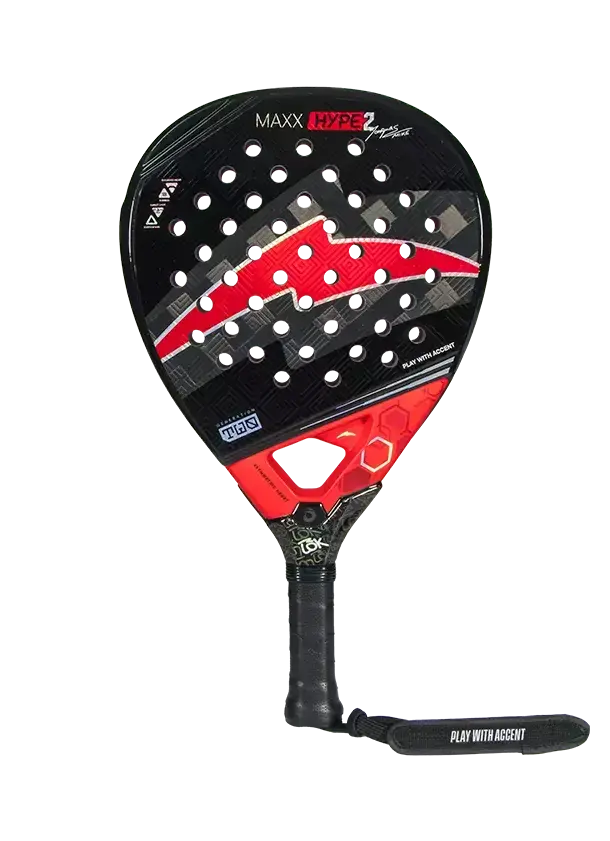
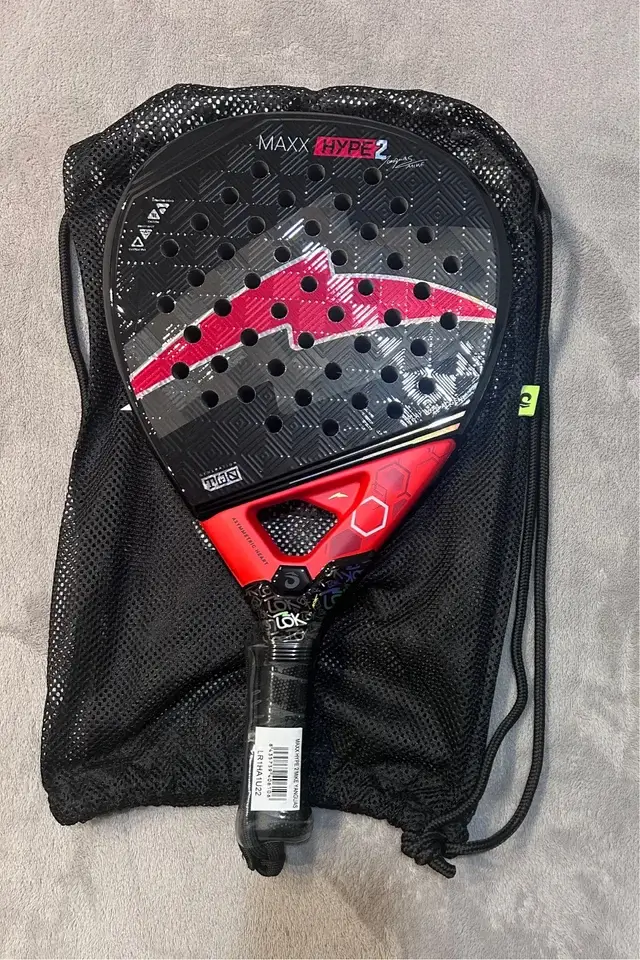
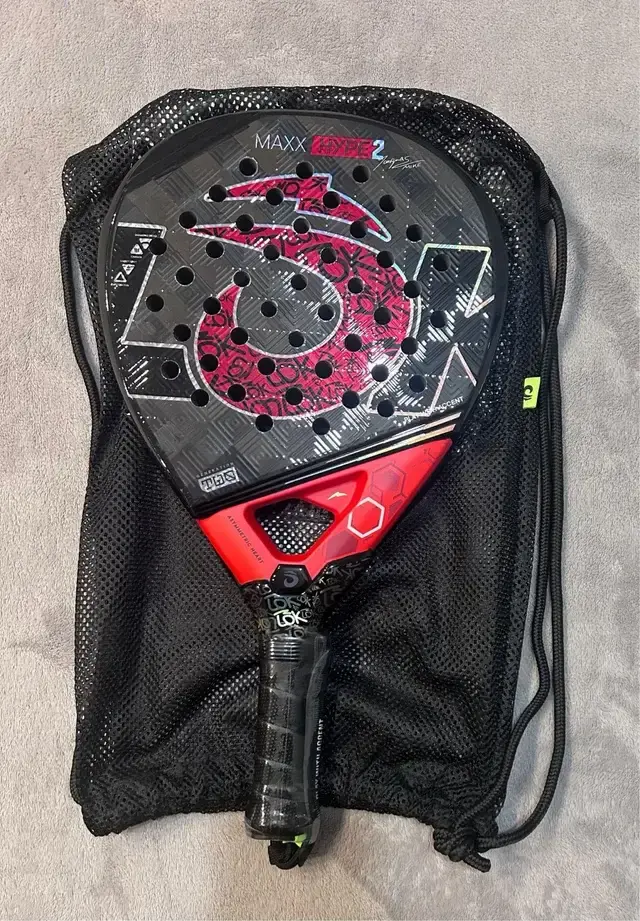
Maxx Hype Gen 2 is the Mike Yanguas-associated flagship of LOK’s second-generation Maxx range. The 2026 model is the attacking counterpart to Maxx Flow: a diamond-format choice for advanced players who want finishing power while retaining useful control.
The point of the recommendation is that balance between attack and usability. It is not a beginner’s route to the same output simply by choosing the professional player’s model.
LOK Maxx Hype Gen 2 2026 — Technical specifications
Construction and materials
The C18 carbon face has the listed three-directional weave, paired with Custom EVA and a reinforced carbon frame. The complete contact is medium-hard rather than an extreme competition-hard response.
Asymmetric Heart is the stepped bridge structure. Gradual Face adds relief at the upper and lower face, while Vibration Groove is a frame rail with a PU finish. They are distinct construction elements, intended to support the racket and manage vibration.
The surface uses 3D Spin Lines, and the Dynamic Holes layout includes 10 mm and 11 mm holes. These details describe what is present; the actual case for the racket remains its strong overhead and net response, not a guarantee of identical behavior at every point on the face.
How heavy the racket feels and where the mass sits.
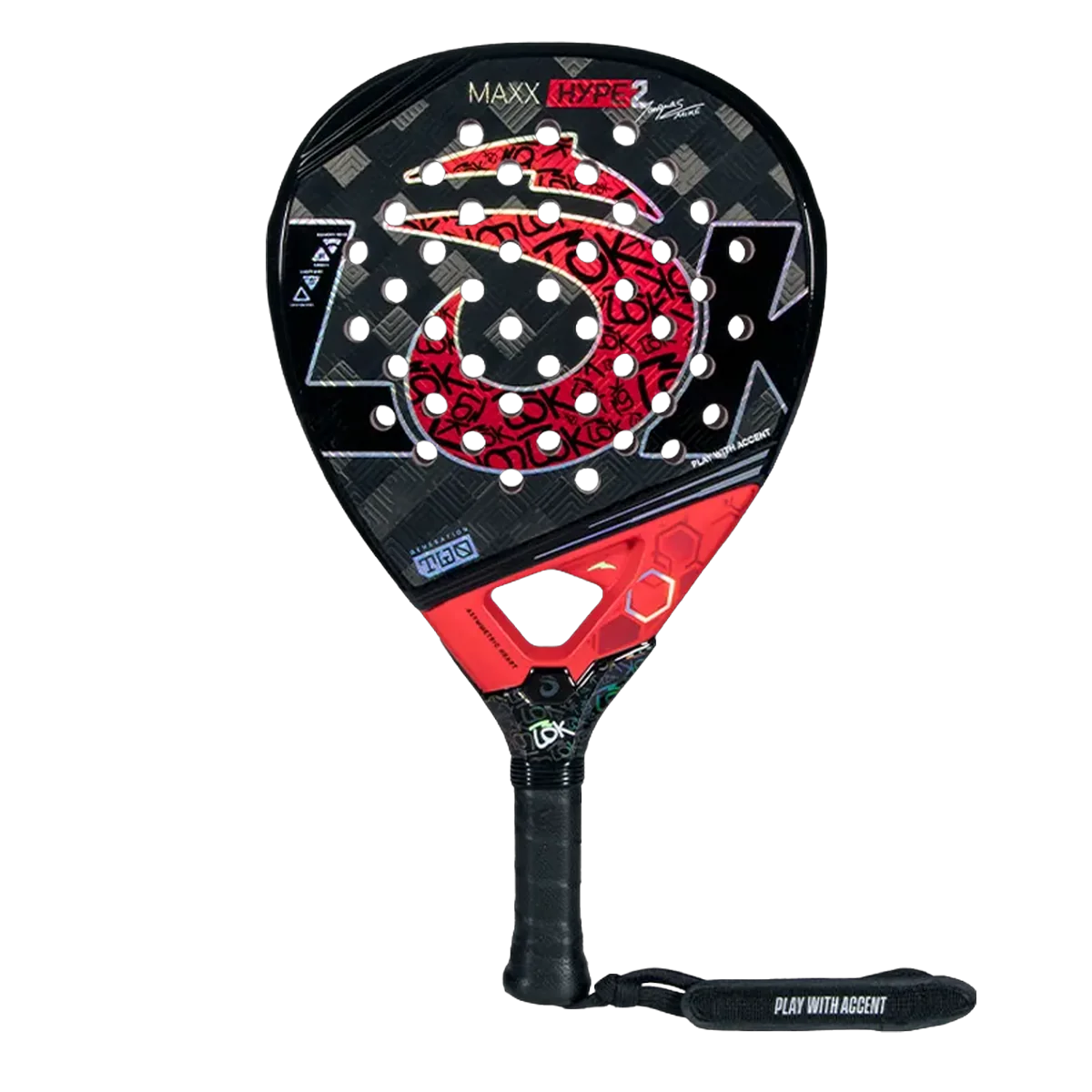
Balance point is shown from the available source evidence.
- Balance point≈26.3 cm24.5 cmavg 26 cm27.5 cmNeutral balance
- Static weight360–375 g340 gavg 365 g390 g
- Swing weight132.1 kg·cm² estimated110typical 128150
- Twist weight15.3 kg·cm² estimated11typical 1416
Shape and mould behavior
The diamond shape and balance listed at approximately 26.3 cm give Hype an attacking emphasis. The 360–375 g range also makes the actual sample worth considering, rather than treating every racket as the same setup.
The useful contact zone sits higher on the face, and good overhead timing matters. Early preparation and a committed swing make more sense than relying on last-second corrections.
Handling is better than the most demanding diamond stereotype suggests, but fast changes of direction still require more organization than a neutral-balance control choice. That is the practical compromise behind the attacking leverage, not a direct calculation of smash speed from balance.
Where this racket sits for stiffness and how easily the face gives power.
Maxx Hype Gen 2 2026Stiffness, feel, and comfort
The response is medium-hard and direct, with impact location communicated clearly to the hand. It is firmer than a soft comfort racket without reaching the most rigid end of the attacking category.
There is enough hold for controlled placement, but the emphasis is on a defined release rather than plush absorption. Passive defensive lobs still need more help from the player’s footwork and stroke, especially when conditions make depth harder to obtain.
The Custom EVA gives the C18-carbon package enough cushioning to remain reasonably comfortable within its attacking role. It still suits a player who prefers a defined release, not one choosing primarily for plush impact. The vibration features are not evidence of suitability for an existing elbow or shoulder problem.
Our scores against every racket we have reviewed.
- Comfort7 /100avg 7.3110Below average
- Spin8.5 /100avg 7.2210Above average
Sweet spot and forgiveness
The sweet spot is generous for the attacking diamond format. Slightly off-centre contacts retain useful response, which helps when fast net exchanges leave little time to find the face perfectly.
That tolerance is not unlimited. Low contact near the throat and strikes close to the outer frame lose more quality, with reduced ball speed particularly noticeable below the best contact area.
The practical advantage is a wider margin than a very unforgiving diamond, not an exact geometric boundary. I would still organize the strike around the cleaner central-to-upper contact that best uses the racket’s output.
Sweet spot- Core zone 8/10
- Shape Diamond
- Stability 7.5/10
Approximate high-tolerance zone for this mould and core.
Power and smash behavior
Power is the clearest strength: the diamond setup and direct C18-carbon/Custom EVA response offer substantial output on full, well-timed overheads. Smashes and por tres attempts are genuine reasons to consider Hype when the player has the timing and mechanics to use them.
The help available from a short stroke is more moderate. The racket is not especially helpful on slow, passive swings, and a high balance does not create racket-head speed for the player. The response becomes more rewarding as the swing is organized and accelerated.
That is why I would recommend it to an attacker rather than to someone looking for automatic depth from compromised positions. Clean timing can make the finish feel straightforward; early or late contact exposes the demand behind the ceiling.
Net performance under pace
The defined carbon-face response makes prepared attacking volleys a clear strength. Volleys carry useful authority when the racket is prepared, and the combination of a defined response with a workable contact area suits offensive pressure.
Bandejas and viboras are particularly relevant. Low, penetrating placement is a strong part of the character, while the textured face supports the cut stroke when there is time to organize the brushing contact.
Quick volley exchanges are manageable rather than effortless. Earlier preparation works better than relying on a late wrist correction, and the racket’s stability does not mean every hurried block will retain the same depth. I would choose it for a deliberate, attacking net game.
Off-center stability and torsional resistance
The frame gives useful support through a moderately imperfect strike. Moderate departures from the best contact area tend to cost pace before they cause a large directional loss, which is useful for keeping an imperfectly struck ball in play.
The boundary remains visible at very low or extreme-edge contacts, where twist and loss of response become more noticeable. Good usable margin does not make the whole face equivalent.
I would regard this as practical support for an advanced attacking game, rather than a measured tolerance radius or proof of the isolated benefit of one frame technology.
Practical on-court takeaways
Hype rewards an active game. From the baseline, full preparation and footwork are important for depth; passive or abbreviated strokes reveal the more demanding side of the response.
The case becomes stronger as the player moves into offensive positions. Authoritative volleys, penetrating bandejas, useful cut and a high smash ceiling make it a convincing tool for an attacker who can create the right contact.
I would choose it for that complete offensive purpose, while accepting that it is not a shortcut for tentative stroke production. Its usable sweet spot makes the power easier to live with than an extreme diamond, not effortless from every part of the court.
Comparison within the Lok lineup
Maxx Flow Gen 2 is the control-oriented counterpart. The useful choice is finishing versus point construction: Hype puts more emphasis on the overhead and net game, while Flow favors a calmer control-led purpose.
The Carbon branch uses the C6 specification rather than the Maxx C18 face and is the more accessible alternative described in this lineup. I would still choose by the complete response and format, not assume the carbon number alone determines firmness or speed.
Lineup comparison
LOK Maxx Hype Gen 2 2026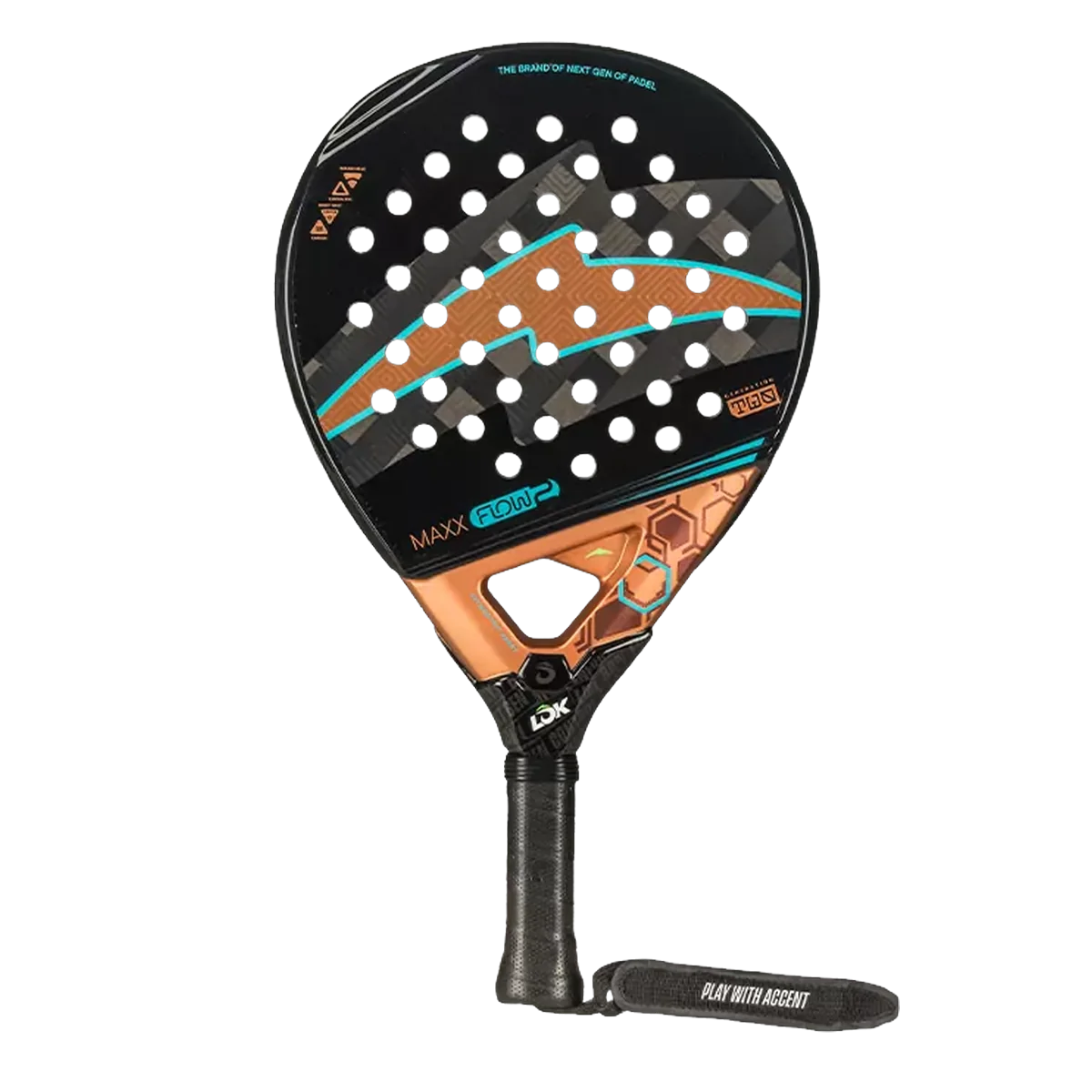 LOK Maxx Flow Gen 2 2026
Comparison with other brands
The Metalbone HRD+ and Vertex 05 GEO are relevant alternatives when attacking commitment matters more than easy recovery. I would keep the Hype in that comparison for its usable control alongside a strong finish, rather than reduce the decision to which racket has the hardest face. On the Adidas, the installed weights are also part of the choice; a heavily configured frame is not the same comparison as its base setup.
The NOX AT10 Attack 18K combines an aluminized-carbon face with MLD Black EVA, while the Hype uses C18 and LOK's EVA construction. The Hype's direct feedback and manageable preparation are the reasons to consider it. The shared 18K designation does not establish which is more comfortable, and a softer contact on one racket would not automatically make it quicker in defense.
Against the HEAD Extreme Pro, the practical question is how much attacking head presence you can sustain through a whole point. I would choose the Hype for its balance of finishing and usable control, not promise it a fixed power deficit or a guaranteed defensive advantage. It remains an attacking diamond that needs active acceleration; its versatility does not turn it into a forgiving control racket.
79LokLOK Maxx Hype Gen 2 2026DiamondShape360–375 gWeight range≈26.3 cmBalance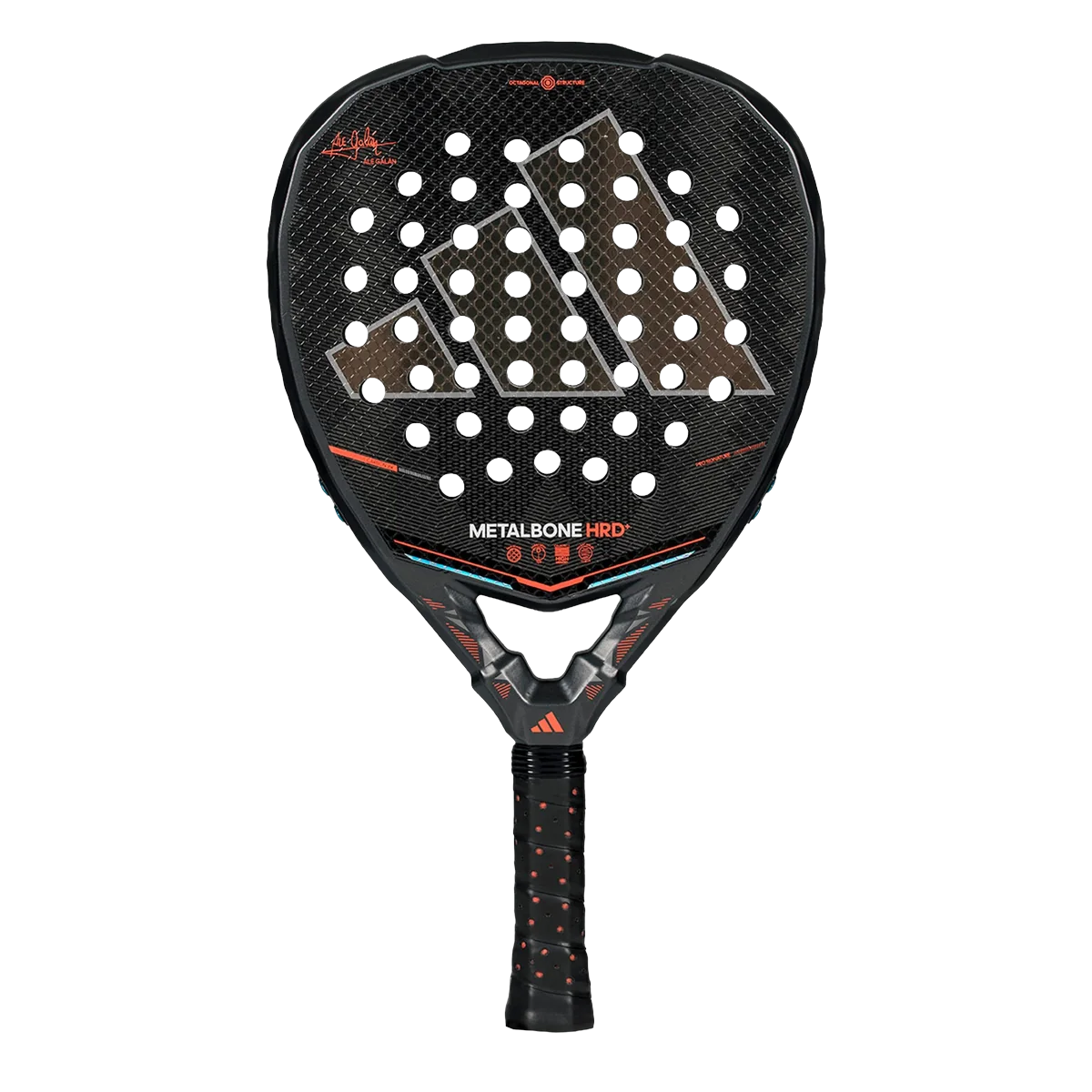 70AdidasAdidas Metalbone HRD+ 2026DiamondShape345–360 gWeight range≈27 cmBalance
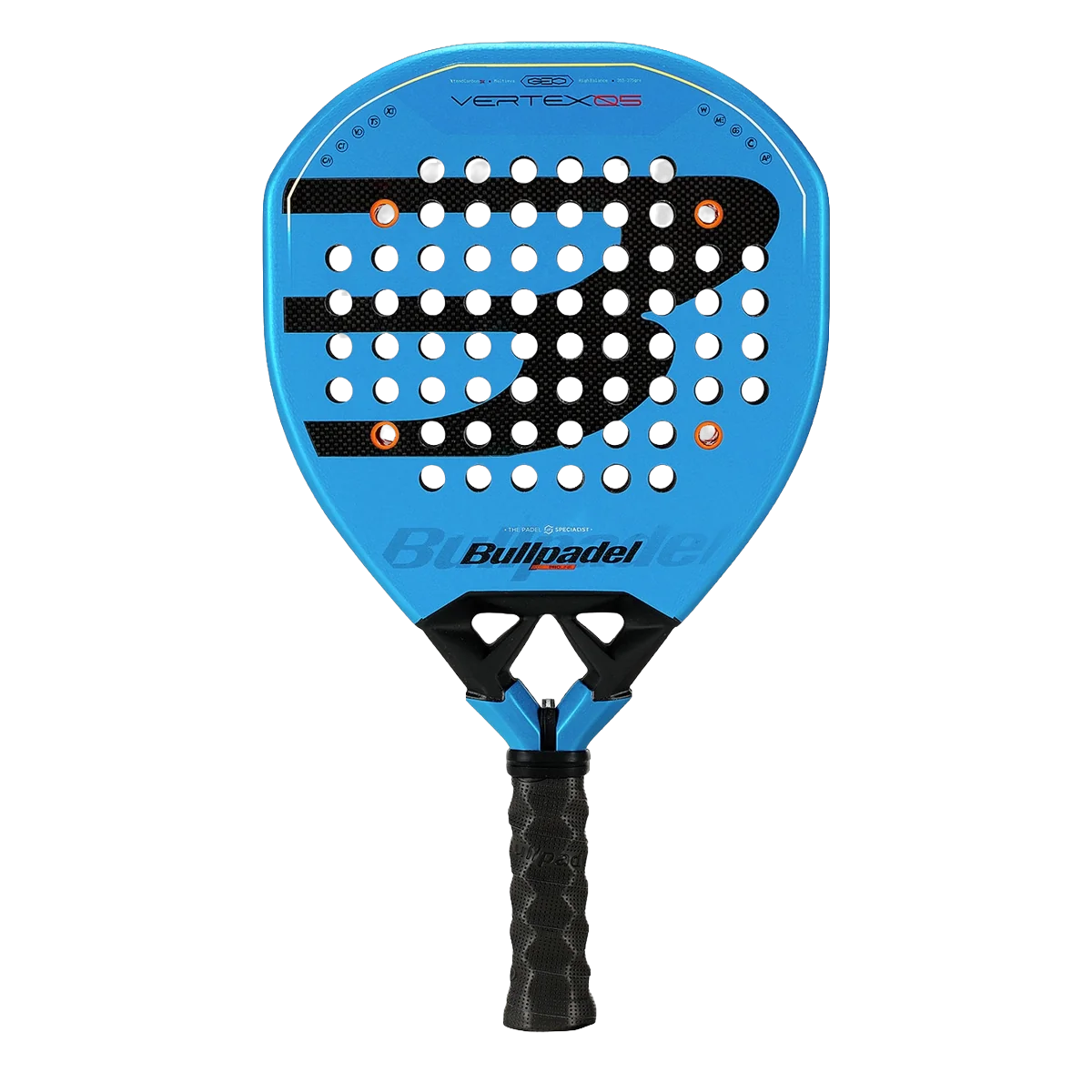 78BullpadelBullpadel Vertex 05 GEO 2026DiamondShape365–375 gWeight range26–26.5 cmBalance
Technical positioning
The diamond configuration, C18 carbon, Custom EVA and moulded 3D Spin Lines place Hype firmly in the modern attacking category: a very high ceiling, strong net and spin performance, and enough control and forgiveness to support point construction rather than only the final smash.
Its medium-hard feel and head-heavy diamond format still require an organized player. The useful margin makes it suitable for a strong intermediate with sound mechanics as well as an advanced attacker, but not for someone seeking maximum defensive ease.
The 38 mm profile, C18 face, Custom EVA and molded texture describe the build. My recommendation rests on the complete playing balance, not on treating each named technology as an independently measured improvement or a guarantee of durability.
Who should choose it, avoid it, and compare it with
Quick fit notes
- Choose it if you are among players who want attacking leverage, heavier overheads, and enough technique to manage a more demanding swing. • Avoid it if you are among players who defend for long stretches, need maximum maneuverability, or are still learning stable contact. • On court, stress-test defensive depth and impact comfort during a realistic demo.
Court test notes
### Court test notes
A demo should test both sides of the attacking recommendation. Use full overheads, bandejas and volleys to judge the strengths, then include glass recovery and pressured defensive lobs to see whether you can still obtain depth with the required active preparation. Comfort on those less organized contacts matters more than one easy finishing ball.
Compare with
Solid shape = this racket.Dashed outline = average of every racket we have reviewed.
LOK Maxx Hype Gen 2 2026
Specifications
- Weight range
- 360–375 g
- Balance
- ≈26.3 cm
- Thickness
- 38 mm
- Shape
- Diamond
- Face material
- 18K carbon (C18 carbon fiber, three-directional weave)
- Core
- Custom EVA (medium-density, performance-tuned)
Common questions
The retail model shares the Maxx Hype Gen2 identity associated with Mike Yanguas, but that does not document his exact match weight, balance, grip or internal construction. I would not assume particular lead-tape additions or a different foam density without confirmation. The relevant buying choice is whether the retail racket’s direct, attacking response suits your own game.
It can suit a strong intermediate with sound footwork, a repeatable contact point and a developing attacking game. The usable sweet spot helps, but the racket still asks for active defensive strokes and adequate preparation. Carbon Hype Gen2 and Easy Hype Gen2 remain the alternatives to consider when a less demanding response is more important than keeping the Maxx’s finishing ceiling.
The surface uses molded 3D Spin Lines rather than a loose sand finish. That describes the construction, not a guaranteed one- or two-year period of unchanged spin. I would monitor the actual texture and face condition instead of assigning a universal lifespan in hours or years, and I would not treat a carbon weave name as proof against cracking.
When conditions make the response feel firmer and depth harder to obtain, Hype’s active-stroke requirement becomes more noticeable. I would pay particular attention to defensive lobs and pressured control shots. The practical question is whether the complete racket-and-ball response remains manageable in the conditions you play.
The 2026 Gen2 keeps the diamond attacking platform and the familiar direct purpose. The current model has the square-pattern 3D Spin Lines and C18 face, with a firm, reactive response. I regard the change as evolutionary rather than a new category of racket; I would not quantify a foam-density or durability improvement from the generation name alone.
Yes. Hype makes sense for an offensive player on either side who can use its smash, vibora and net strengths. The deciding factor is the role and stroke quality, not the side label. A player whose game is built mainly around defensive depth and baseline consistency should compare Maxx Flow Gen2 instead.
Price alert
We check prices when we update our offers. Get one email when a verified price is below your threshold.
Player feedback
Player feedback is separate from our editorial review. Individual votes stay private — only the aggregate is published.
Thank you — your feedback is saved. You can revise it any time with Vote.
No player votes yet.
Questions & answers
No questions yet.