Bullpadel XPLO 2026 Review
Version and lineup identification
The Bullpadel XPLO 2026 represents a continuity model within the brand's signature lineup, maintaining the core specifications introduced in 2025 while incorporating minor updates to dampening technologies. This marks the platform's position as Di Nenno's weapon of choice following his transition from earlier Bullpadel attack models, though the player's on-court setup reportedly includes custom modifications including 12K carbon layering rather than the retail specification. The 2026 version introduces Easi Vibes dampening inserts and refined Custom Weight system integration, but preserves the 12K Xtend Carbon face and MultiEVA core architecture that defined the 2025 release.
Within Bullpadel's 2026 attack category, the XPLO occupies the maximum power position alongside the Hack 04, both targeting advanced players prioritizing finishing capability. The geometric diamond mold distinguishes it from the Hack's traditional diamond geometry, offering 535 cm² versus the Hack's 522 cm² playing surface. The XPLO Comfort variant provides a softer alternative through Fibrix face construction, reducing rigidity for players seeking similar geometry with improved arm tolerance. The standard XPLO remains the stiffer, more powerful configuration designed for physically conditioned attackers.
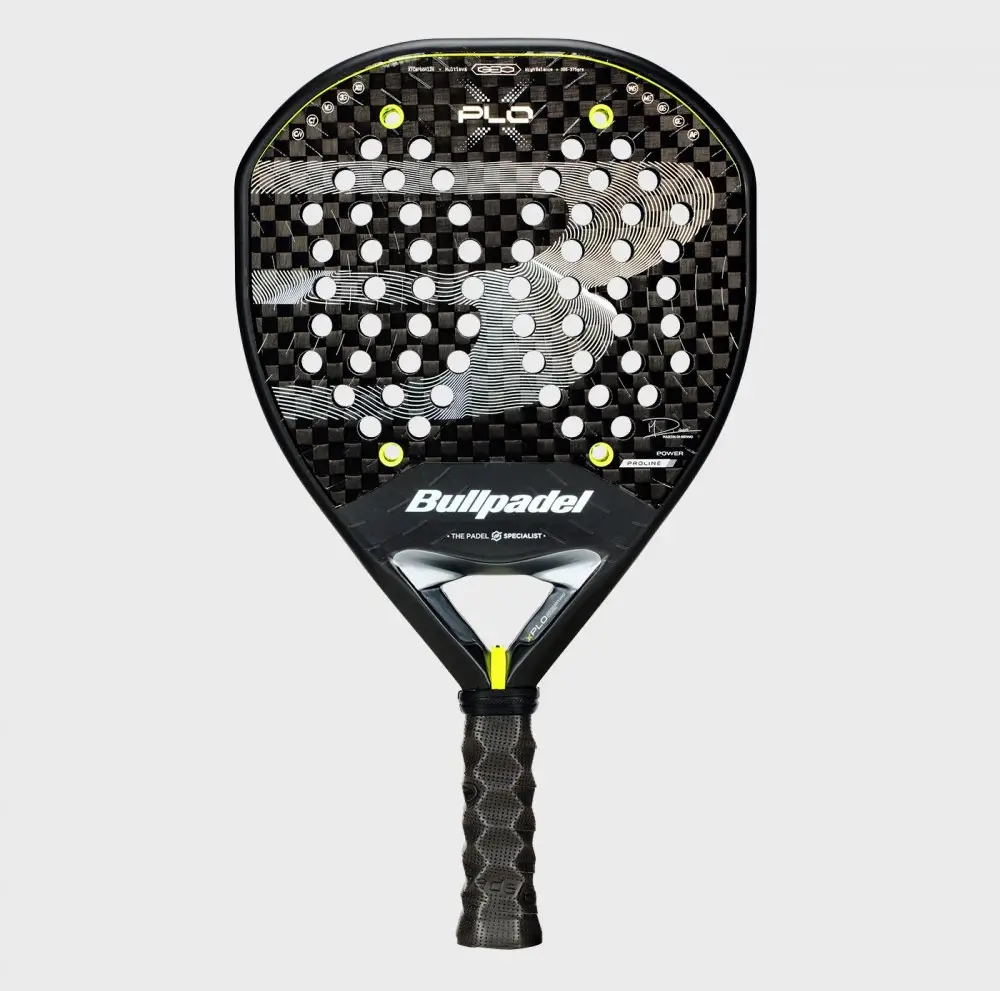
The model's specifications align precisely with Bullpadel's pro-level platforms: 365-375 g claimed weight range, high balance point approximating 27.0 cm, and 38 mm profile thickness. The geometric diamond shape represents Bullpadel's response to sweet spot limitations in traditional diamond platforms, widening the effective contact zone while maintaining head-heavy mass distribution. This places the XPLO in direct competition with the Vertex 05 GEO (541 cm², 3K carbon) and positions it as marginally less extreme than the Hack 04 (18K carbon, traditional diamond) within the brand's attack hierarchy.
Technical specifications
| Spec | Value | What it means |
|---|---|---|
| Shape | Geometric diamond (535 cm² playing surface) | High balance, power-oriented |
| Thickness | 38 mm | Thicker = more power and rebound |
| Weight claimed | 365–375 g (including Hesacore grip) | Heavier = more stability, lighter = more speed |
| Weight measured | Approximately 355–365 g without Hesacore, 370+ g with factory grip configuration | Heavier = more stability, lighter = more speed |
| Balance | High, approximately 27.0 cm (head-heavy) | More power, less maneuverability |
| Face | Xtend Carbon 12K | Good stiffness and durability |
| Core | MultiEVA (dual-density EVA, hard-soft configuration) | Good balance of control and feel |
| Surface | 3D textured (light texture, minimal tactile roughness) | Determines feel and response |
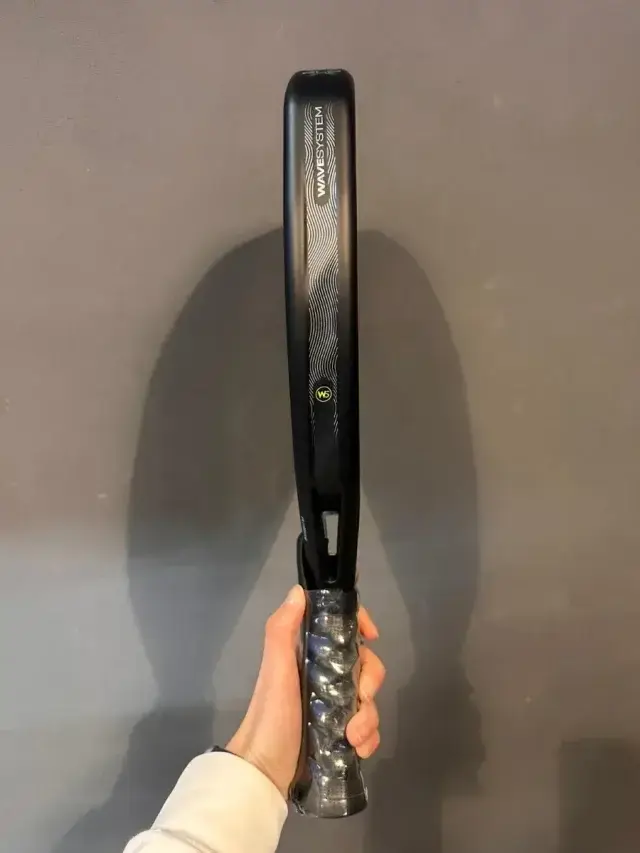
| Frame | Carbon tubular with geometric reinforcement patterns | Structural rigidity and durability |
| Technologies | Metalshield protector, Vibradrive system, Hesacore grip, Custom Weight system, Easi Vibes dampeners, Air React Channel, Nerve system | Brand systems that tune feel, spin, stability or comfort. |
| Grip length | 12.5 cm | Listed spec to confirm during demo: 12.5 cm. |
| Hole pattern | Distinctive geometric arrangement with reduced density in upper impact zone | Listed spec to confirm during demo: Distinctive geometric arrangement with reduced density in upper impact zone. |
Construction and materials
The Bullpadel XPLO 2026 employs Xtend Carbon 12K face construction, positioning it in the middle range of Bullpadel's carbon hierarchy between the 18K specification (Hack 04) and 3K configuration (Vertex 05 GEO, Neuron Edge). The 12K weave delivers balanced characteristics: sufficient stiffness for power generation without reaching the harsh feedback levels associated with 18K carbon, while maintaining more direct energy return than softer carbon grades. This material selection targets players requiring aggressive output without demanding the absolute maximum rigidity that characterizes the Hack platform.
MultiEVA core architecture implements dual-density foam layering, though the XPLO utilizes a hard-soft configuration rather than the soft-hard format found in the Neuron Edge. This arrangement places firmer EVA toward the striking surface, promoting immediate energy return and reducing dwell time during high-velocity impacts. The harder outer layer responds aggressively to powerful swings, maximizing smash velocity for players generating substantial racket head speed. The softer inner layer provides limited cushioning for off-center contacts, though this configuration prioritizes power output over forgiveness characteristics compared to platforms using soft-hard EVA sequencing.
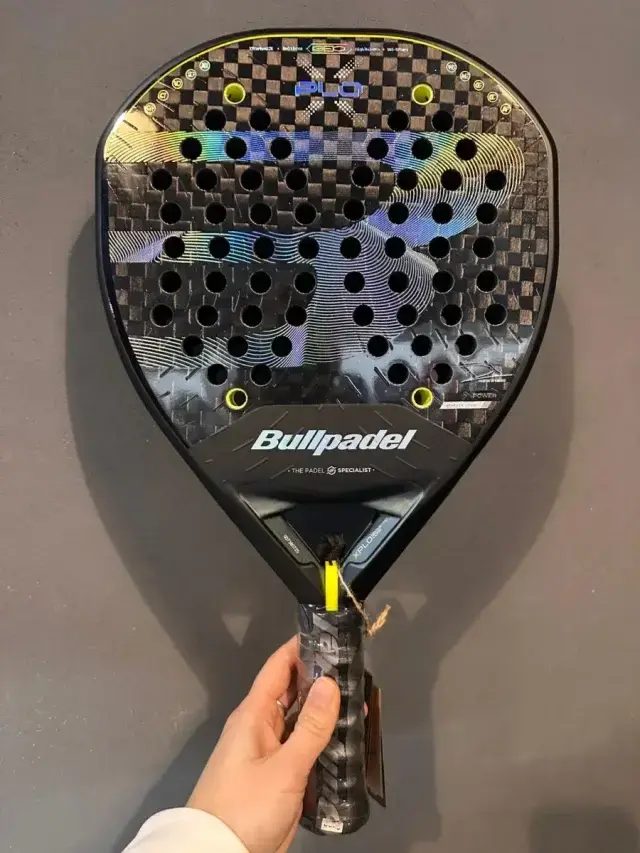
The geometric diamond mold incorporates triangular frame reinforcements throughout the tubular structure, applying engineering principles from architecture to enhance torsional rigidity. These geometric patterns strengthen frame stability against twisting forces, particularly important given the platform's extended head dimensions and high balance point. The 535 cm² playing surface exceeds traditional diamond specifications while maintaining the power-oriented mass distribution that defines attack geometry. The distinctive hole pattern reduces perforation density in the upper impact zone—where aggressive players typically contact smashes—creating a denser striking area that Bullpadel claims enhances power output when contact occurs in the elevated sweet spot.
Surface treatment applies 3D texturing across the face, though multiple testers noted minimal tactile roughness compared to aggressive finishes. The glossy coating reduces friction against the ball, limiting spin generation potential relative to sandpaper-style surfaces found on platforms like the Vertex 05 GEO. Frame technologies include the Metalshield protector for edge durability, Vibradrive dampening embedded in the grip, Hesacore ergonomic grip base, and Easi Vibes inserts positioned in the frame's upper section to absorb impact vibrations. The Custom Weight system enables balance adjustment, though this feature appeals primarily to advanced players fine-tuning specifications rather than recreational users.
Shape and mould behavior
The geometric diamond configuration delivers 535 cm² of playing surface through widened head dimensions and angular frame contours, positioning the XPLO between traditional diamond platforms (typically 520-525 cm²) and the Vertex 05 GEO's 541 cm² specification. This expanded surface area addresses the primary limitation of diamond geometry—restricted sweet spot dimensions—while preserving the head-heavy mass distribution essential for power generation. The geometric approach utilizes straighter edges and pronounced angles rather than curved transitions, creating distinct impact characteristics compared to organic diamond shapes like the Hack 04.
Balance point measurement approximates 27.0 cm in standard configuration, concentrating substantial mass in the racket's upper third to optimize swing momentum during overhead motions. This distribution creates noticeable swing inertia that benefits aggressive finishing strokes while imposing handling penalties during rapid directional changes. Players accustomed to teardrop or hybrid platforms report adjustment periods managing the XPLO's momentum, particularly evident during defensive scrambling and fast net exchanges. The geometric reinforcements in the frame's upper section further concentrate mass toward the head, enhancing stability during powerful contact while amplifying the platform's head-heavy characteristics.
The elevated sweet spot position—located higher on the face than round or teardrop platforms—aligns with overhead contact zones for attacking players. Field testing confirms optimal performance when impact occurs in the upper-middle section of the playing surface, where the reduced hole density and geometric frame support converge. Contact below this zone produces diminished power output and less predictable directional control, though the expanded surface area provides improved tolerance compared to traditional diamond platforms. Testers noted a distinct "power zone" within the broader sweet spot, where clean strikes generate maximum velocity while peripheral contact delivers functional but reduced output.
The mold's angular transitions and geometric frame design create a rigid structural platform that resists flexion during impact. This stiffness translates to immediate energy return and explosive ball output when swing speed is sufficient, rewarding players who generate substantial racket head velocity through full stroke mechanics. The geometric reinforcements effectively eliminate the "trampoline" effect present in softer platforms, requiring users to supply power through technique rather than relying on elastic rebound behavior. This characteristic benefits advanced attackers seeking control over power delivery while challenging intermediate players who depend on racket assistance for baseline depth and finishing velocity.
Stiffness, feel, and comfort
The Bullpadel XPLO 2026 registers in the firm-to-stiff range within Bullpadel's 2026 portfolio, positioned between the Vertex 05 GEO and Hack 04 in terms of absolute rigidity. The 12K Xtend Carbon face combined with hard-soft MultiEVA core configuration produces limited flexion during impact, creating a direct, boardlike sensation that transmits ball contact clearly to the player's hand. Field testing confirms substantially reduced dwell time compared to platforms using soft-hard EVA sequencing or fiberglass-composite faces, resulting in a crisp, immediate rebound characteristic that defines stiff carbon platforms.
Impact feedback arrives sharply defined with minimal cushioning, particularly evident during high-velocity exchanges and off-center contacts. Players accustomed to forgiving platforms or softer carbon grades report a noticeable adjustment period managing the XPLO's direct transmission of impact forces. Clean contact within the elevated sweet spot produces satisfying feedback with acceptable vibration control, attributable to the Vibradrive system and Easi Vibes dampeners integrated throughout the frame. Mis-hits generate harsh feedback that testers described as uncomfortable, with limited dampening once contact occurs outside the primary impact zone.
Comfort characteristics vary significantly based on swing mechanics and contact consistency. Advanced players maintaining clean contact patterns reported acceptable arm tolerance during standard playing sessions, though extended tournaments or high-volume training revealed cumulative stress compared to softer alternatives like the XPLO Comfort or Vertex Hybrid. The Hesacore grip contributes approximately 15 g of weight while providing ergonomic contouring, though multiple testers removed this component citing excessive grip thickness and preference for traditional cylindrical profiles. Without the Hesacore, overall comfort levels decrease slightly due to increased direct vibration transmission, though handling responsiveness improves through weight reduction.
The platform's stiffness becomes pronounced during cold conditions, with testers noting diminished feel and increased harshness when temperatures drop below 15°C. The hard-soft EVA configuration amplifies this temperature sensitivity compared to softer core densities, reducing touch precision and control margins during winter play. Warmer conditions improve feel characteristics moderately, though the XPLO remains fundamentally positioned as a stiff, power-oriented platform across temperature ranges. Players prioritizing comfort, arm health, or forgiving feel characteristics will find superior options within Bullpadel's lineup, particularly the Neuron 02, Vertex Hybrid, or XPLO Comfort variant.
Sweet spot and forgiveness
The geometric diamond mold delivers measurably improved forgiveness boundaries compared to traditional diamond platforms, expanding the effective contact zone through increased playing surface dimensions and widened head geometry. The 535 cm² specification provides approximately 5-7% more surface area than conventional diamond rackets, translating to functional benefits when contact occurs slightly peripheral to the optimal impact location. Field testing confirms playable results across a broader vertical range than platforms like the Hack 04, with the elevated sweet spot positioned higher on the face to align with overhead striking zones.
However, absolute forgiveness remains limited relative to teardrop and hybrid configurations. Off-center contacts produce noticeable degradation in power output, directional control, and feedback quality, with lateral mis-hits generating particularly harsh sensations and unpredictable trajectories. The sweet spot's vertical elongation provides improved tolerance for high/low contact variance during smashes and volleys, but horizontal dispersion—common during rapid exchanges and defensive stretching—exposes the platform's forgiveness limitations. Testers described a distinct "power zone" within the broader sweet spot where optimal performance occurs, estimating this prime contact area at 60-65% of the total playing surface.
The reduced hole density in the upper impact zone creates a denser striking area that enhances power output when contact occurs within the elevated sweet spot, but this design choice narrows forgiveness margins in peripheral regions. The glossy surface finish and minimal tactile texture further reduce the platform's error tolerance during spin-generation attempts, with the ball prone to slipping during angled brushing motions. The geometric frame reinforcements provide improved stability against twisting forces compared to traditional diamond platforms, partially offsetting forgiveness limitations through enhanced directional predictability even on mis-hits.
Comparative assessment within Bullpadel's 2026 range positions the XPLO's forgiveness between the Hack 04 (most demanding) and Vertex 05 (most tolerant among diamond platforms). The Neuron Edge and Vertex Hybrid deliver substantially improved forgiveness through teardrop and near-round geometries, while the XPLO Comfort variant enhances error tolerance through softer face materials despite identical mold specifications. Players transitioning from teardrop or hybrid platforms report extended adjustment periods managing the XPLO's reduced sweet spot dimensions, with consistent clean contact essential for extracting the platform's performance potential. Recreational and intermediate players seeking forgiveness will find superior options elsewhere in Bullpadel's lineup; the XPLO's sweet spot characteristics demand advanced technique and consistent swing mechanics.
Power and smash behavior
The Bullpadel XPLO 2026 delivers exceptional power ceiling when contact occurs within the elevated sweet spot, generating explosive ball velocity that positions this platform at the upper extreme of Bullpadel's 2026 output range. The geometric diamond mold's high balance point concentrates swing momentum during overhead motions, while the stiff 12K carbon face and hard-outer-layer EVA configuration promote immediate energy return without elastic delay. Field testing confirms accelerated smash velocity compared to the Vertex 05 and Neuron Edge, with several testers positioning the XPLO's maximum output slightly below the Hack 04 but notably above all other Bullpadel platforms.
The platform's power accessibility requires qualification: maximum output demands precise contact within the power zone and sufficient swing speed to activate the stiff construction. Players generating aggressive racket head velocity through full stroke mechanics extract devastating finishing capability, with clean smashes producing penetrating trajectory and difficult returns. However, intermediate players or those using abbreviated swing patterns report difficulty generating comparable output, with the platform's limited dwell time and direct rebound characteristics providing minimal assistance for underpowered technique. This creates a steep performance curve where advanced attackers access elite power levels while less developed players struggle to match output achievable with more forgiving platforms.
The distinctive hole pattern—featuring reduced perforation density in the upper striking zone—contributes measurably to power generation when contact occurs in the elevated sweet spot. Testers noted enhanced ball velocity specifically during high contact smashes, where the denser face construction concentrates energy transfer without dispersion through excessive perforations. This design choice proves most effective for players who consistently contact overhead strikes in the racket's upper third, though it provides minimal benefit for peripheral impacts or contact occurring lower on the face.
Comparative power assessment positions the XPLO as the most aggressive platform within Bullpadel's geometric diamond category, exceeding the Vertex 05 GEO despite that model's stiffer 3K carbon specification. The XPLO's larger playing surface and optimized weight distribution create superior swing momentum compared to the more compact Vertex GEO, while the hard-soft EVA configuration delivers slightly more explosive output than the Vertex's standard MultiEVA setup. Against the Hack 04, testers reported fractionally reduced maximum ceiling but improved power accessibility through the geometric mold's expanded sweet spot. The XPLO positions itself as the optimal choice for attackers prioritizing finishing capability while accepting meaningful forgiveness compromises.
Net performance under pace
The Bullpadel XPLO 2026 presents contrasting net performance characteristics depending on volley category and player positioning. Aggressive finishing volleys benefit substantially from the platform's stiff construction and immediate rebound behavior, with the high balance point contributing momentum for penetrating drives and sharp angles. Testers praised power output during offensive volleys, noting the platform's capacity to generate pace from compact swings when contact occurs cleanly. The elevated sweet spot aligns effectively with forward contact zones during aggressive net positioning, enabling confident finishing on short balls and weak replies.
However, defensive volleying and rapid exchanges expose the platform's handling limitations. The geometric diamond's swing inertia creates noticeable resistance during directional transitions, with several testers reporting delayed responses compared to the Neuron Edge and Vertex Hybrid during fast body volleys. The reduced dwell time and stiff feel limit touch precision for delicate net play, making controlled drop volleys and angled placements more demanding than with softer platforms. Off-center contacts produce harsh feedback and unpredictable trajectories, particularly problematic during scrambling situations where clean contact proves difficult.
The platform's weight distribution—approximately 355-365 g without Hesacore—positions it among the lighter attack options within Bullpadel's range, though the high balance point creates swing weight that exceeds actual mass specifications. Players accustomed to neutrally balanced or head-light platforms report fatigue during extended net exchanges, with the concentrated upper-section mass requiring sustained muscular engagement to maintain racket positioning. The geometric frame reinforcements provide improved stability against opponent power compared to traditional diamond platforms, enabling more confident blocking without excessive racket deflection.
Blocking volleys against pace receive mixed assessments. The stiff construction transmits opponent power clearly, requiring active control inputs rather than passive absorption. Advanced players appreciated the direct feedback for precise placement, while intermediate testers struggled managing incoming velocity without excess rebound. The limited dwell time proves particularly challenging during defensive situations where absorption and redirection are required, with the ball prone to sailing beyond control margins when technique proves insufficient. The XPLO performs optimally at the net for attackers who maintain forward positioning and generate their own pace, while struggling in defensive scenarios requiring touch, absorption, and rapid maneuverability.
Off-center stability and torsional resistance
The Bullpadel XPLO 2026 demonstrates improved torsional stability compared to traditional diamond platforms, attributable to the geometric frame reinforcements and triangular structural elements integrated throughout the tubular construction. These engineering-derived design features enhance resistance against twisting forces during off-center impacts, providing measurably improved directional predictability when contact occurs peripheral to the sweet spot. Field testing confirms reduced racket deflection during lateral mis-hits compared to the Hack 04 and earlier XPLO generations, with the geometric mold's widened dimensions contributing to enhanced stability margins.
However, absolute stability performance remains constrained by the platform's diamond geometry and high balance point. The concentrated upper-section mass creates substantial rotational inertia during off-center contacts, with lateral impacts generating pronounced twisting sensations that transmit clearly to the player's hand. The 12K carbon face provides moderate flex tolerance that partially absorbs torsional stress, positioning stability characteristics between the extremely rigid Hack 04 (18K carbon) and more forgiving Vertex Hybrid (12K carbon, near-round geometry). Vertical off-center contacts—high or low on the face—produce better stability outcomes than horizontal dispersion, reflecting the sweet spot's elongated vertical dimensions.
The reduced hole density in the upper impact zone contributes to localized stability improvements when contact occurs in that region, though this design choice provides minimal benefit for lower or lateral mis-hits. The Custom Weight system enables minor stability adjustments through balance modification, with added head weight improving torsional resistance at the cost of increased swing inertia and handling penalties. Advanced players report acceptable stability characteristics when maintaining consistent contact patterns, while intermediate testers noted frequent deflection issues during defensive scrambling and rapid exchanges where clean contact proves elusive.
Comparative stability assessment positions the XPLO between the Neuron Edge (superior through teardrop geometry and lower balance) and Hack 04 (inferior through traditional diamond mold despite stiffer carbon). The Vertex 05 GEO delivers comparable stability through different mechanisms: that platform's 3K carbon provides enhanced rigidity but narrower sweet spot dimensions, while the XPLO's 12K carbon and expanded surface area create a more balanced stability-forgiveness compromise. Players prioritizing maximum stability will find superior options in round or hybrid platforms within Bullpadel's lineup, though the XPLO represents meaningful improvement over first-generation geometric diamond configurations.
Practical on-court takeaways
The Bullpadel XPLO 2026 functions optimally as a specialized finishing tool for physically conditioned attackers who maintain aggressive court positioning and generate substantial swing speed through complete stroke mechanics. The platform rewards clean contact with explosive power output and precise directional control, delivering elite finishing capability when technique aligns with the demanding specifications. Advanced right-side players seeking maximum overhead velocity will find the XPLO's performance envelope compelling, particularly those comfortable managing stiff platforms and accepting forgiveness compromises for power ceiling gains.
The racket's practical limitations become evident during extended defensive sequences and mixed-pace rally construction. Limited dwell time and direct rebound behavior provide minimal assistance for depth generation from compromised positions, requiring users to supply power through technique rather than relying on racket assistance. Players employing abbreviated defensive swings or struggling with consistent contact patterns will find the XPLO frustrating, with off-center impacts producing harsh feedback and unpredictable trajectories. The platform demands continuous clean contact across shot categories, imposing technical requirements that exceed recreational and intermediate skill levels.
Physical conditioning requirements deserve emphasis: the high balance point and geometric diamond mold create swing inertia that accumulates fatigue during extended play. Players lacking shoulder strength and rotational power will struggle maintaining optimal swing speed as matches progress, with diminished racket head velocity exposing the platform's limited power accessibility for underpowered technique. The concentrated upper-section mass requires sustained muscular engagement during rapid exchanges, potentially compromising technique execution when fatigue develops.
The XPLO proves most effective for players who dominate through aggressive positioning and finishing rather than tactical versatility and rally construction. Attackers who establish net position quickly, generate frequent overhead opportunities, and finish points decisively will maximize the platform's strengths while minimizing exposure to its weaknesses. The racket struggles in defensive scenarios, extended baseline exchanges, and touch-oriented situations where forgiveness and feel sensitivity prove essential. Players seeking all-court versatility, defensive reliability, or forgiving performance characteristics will find superior options within Bullpadel's 2026 range—the Vertex Hybrid, Neuron 02, or XPLO Comfort represent better-balanced alternatives.
Comparison within the brand lineup
The XPLO occupies the maximum power position within Bullpadel's geometric diamond category, positioned between the Hack 04's absolute rigidity and the Vertex 05 GEO's expanded forgiveness boundaries. The standard XPLO delivers superior power accessibility compared to the Hack through its larger playing surface and 12K carbon specification, while the Hack maintains fractionally higher maximum ceiling through 18K carbon stiffness and traditional diamond geometry. Against the Vertex 05 GEO, the XPLO trades that model's largest-in-class sweet spot (541 cm²) for marginally improved power output through optimized weight distribution and hard-soft EVA configuration.
The XPLO Comfort variant provides meaningful differentiation for players seeking geometric diamond geometry without extreme stiffness demands. The Fibrix face construction—combining carbon and fiberglass—substantially reduces rigidity compared to the standard XPLO's 12K carbon specification, delivering improved comfort and forgiveness at the cost of power ceiling and directional precision. Testers positioned the Comfort variant as more accessible for intermediate players while noting that advanced attackers typically prefer the standard XPLO's aggressive performance characteristics.
The Neuron 02 Edge represents a contrasting approach to attack-oriented specifications: that platform's geometric teardrop shape and 10-15 g lighter weight create superior maneuverability and defensive versatility while sacrificing maximum overhead power. The Neuron Edge suits players prioritizing rapid exchanges, control precision, and all-court effectiveness, while the XPLO targets specialists seeking finishing capability above versatility. Within Bullpadel's 2026 attack hierarchy, the progression extends from Neuron Edge (most maneuverable) through Vertex 05 GEO and XPLO (balanced power-forgiveness) to Hack 04 (maximum output, minimum tolerance).
Comparison with other brands
The Bullpadel XPLO's geometric diamond configuration distinguishes it from traditional diamond platforms across competing brands, offering expanded sweet spot dimensions while maintaining aggressive power characteristics. Against the NOX AT10 Genius Attack, the XPLO delivers comparable power ceiling through similar 12K carbon specifications, while the geometric mold provides improved forgiveness boundaries that the NOX's traditional diamond geometry cannot match. The NOX platform offers superior spin generation potential through its Dual Spin surface treatment, while the XPLO's glossy finish and minimal texture limit friction-based effects.
Compared to the HEAD Extreme Pro, the XPLO positions itself as marginally more accessible through its expanded playing surface and 12K carbon versus the HEAD's unidirectional carbon specification. The Extreme Pro delivers fractionally higher maximum power ceiling through its UD carbon stiffness and Power Foam core reactivity, while the XPLO provides better forgiveness margins and improved stability through geometric frame reinforcements. Both platforms target advanced attackers prioritizing finishing capability, though the HEAD's construction proves more demanding for consistent execution.
The Adidas Metalbone represents a similar weight class and target demographic, though that platform's aluminized carbon construction creates different feel characteristics despite comparable power output. The Metalbone's adjustable weight system provides customization options that the XPLO's simpler Custom Weight setup cannot match, while the XPLO's MultiEVA core delivers more progressive response characteristics compared to the Metalbone's High Memory EVA. The geometric diamond mold gives the XPLO forgiveness advantages over the Metalbone's traditional diamond geometry, though the Adidas platform maintains superior spin generation potential through its Spin Blade Decal surface treatment.
Against the Babolat Technical Viper 3.0, the XPLO delivers substantially higher power ceiling and directional precision through its full-carbon construction versus the Babolat's Carbon Flex composite. The Technical Viper provides superior comfort and arm tolerance through fiberglass integration, making it more accessible for players with arm sensitivity or those seeking softer rebound characteristics. The XPLO's geometric diamond offers improved sweet spot dimensions compared to the Technical Viper's traditional diamond mold, while the Babolat's lighter weight and composite construction create better maneuverability during rapid exchanges.
Technical positioning
The Bullpadel XPLO 2026 occupies the specialized attack-platform position within the contemporary padel market, targeting advanced right-side players who prioritize finishing capability and overhead dominance over all-court versatility. The geometric diamond mold with 535 cm² playing surface represents Bullpadel's response to traditional diamond limitations—restricted sweet spot dimensions and harsh off-center feedback—while preserving the head-heavy mass distribution essential for power generation. This positioning places the XPLO between maximally demanding platforms like the Hack 04 and more accessible attack options such as the Vertex 05, creating a performance envelope that rewards technical precision without reaching the extreme specifications that limit market accessibility.
The 12K Xtend Carbon face specification balances stiffness requirements with moderate flex tolerance, positioning the platform in the firm-to-stiff range without reaching the boardlike rigidity of 18K carbon platforms. This material choice targets players requiring aggressive output characteristics while accepting slightly reduced maximum ceiling compared to the stiffest available options. The hard-soft MultiEVA core configuration prioritizes immediate energy return over cushioning, emphasizing explosive power delivery for high-velocity impacts rather than forgiving response for varied contact quality. These construction choices define the XPLO as a power-first platform with limited accommodation for defensive play or touch-oriented shotmaking.
The geometric frame reinforcements and triangular structural elements represent meaningful engineering advancement over first-generation geometric diamond platforms, improving torsional stability and directional predictability during off-center contacts. However, absolute forgiveness remains constrained by diamond geometry fundamentals, with lateral mis-hits producing noticeable degradation in output quality and control precision. The distinctive hole pattern—reducing perforation density in the upper striking zone—enhances power output specifically for high-contact smashes while providing minimal benefit for peripheral impacts or contact occurring lower on the face.
Within competitive professional context, the XPLO serves as Martín Di Nenno's signature platform, though player-specific modifications including custom 12K carbon layering differentiate retail specifications from actual tour setups. The platform's positioning within Bullpadel's 2026 lineup establishes it as the maximum-power option outside the Hack 04, targeting players who accept meaningful forgiveness compromises for finishing capability gains. Market positioning emphasizes the XPLO as a specialized tool for aggressive attackers rather than a versatile platform suitable across playing styles, distinguishing it from hybrid or teardrop offerings that prioritize balanced performance characteristics. The platform's technical specifications and construction choices reward advanced technique and physical conditioning while imposing performance penalties on inconsistent contact patterns and underpowered swing mechanics.
Technical performance score
Ten categories, each 0-10. Methodology →
- Maneuverability and handling6.5
- Net performance under pace7.5
- Control and placement precision7.5
- Defensive output and depth access6
- Off-center stability and torsional resistance7
- Sweet spot usability6.5
- Spin generation potential7
- Power ceiling8.5
- Power accessibility6.5
- Comfort and impact feedback6.5
Final verdict — Bullpadel XPLO scores 70/100. A competent mid-range option with balanced performance across categories, well suited to developing and recreational players.
Who should choose it, avoid it, and compare it with
- Choose it if you are among players who want attacking leverage, heavier overheads, and enough technique to manage a more demanding swing.
- Avoid it if you are among players who defend for long stretches, need maximum maneuverability, or are still learning stable contact.
- On court, stress-test defensive depth and handling speed before trusting the total 70/100 score.
Court test notes
The review scorecard points to top-end power and net exchanges as the main strengths. During a demo, test those strengths with real match patterns: return pressure, glass recovery, volleys under pace, and one full service game where fatigue starts to show.
Compare with
Common questions
The XPLO demands advanced technique and physical conditioning that typically exceed intermediate skill levels. The stiff 12K carbon construction, limited dwell time, and high balance point create a steep performance curve where inconsistent contact produces harsh feedback and diminished output. Intermediate players report difficulty generating adequate power without aggressive swing mechanics, while off-center impacts occur too frequently to maintain consistent performance. The platform performs optimally for advanced attackers (level 6+ in European classification) who maintain clean contact patterns and possess shoulder strength for managing swing inertia. Intermediate players seeking geometric diamond geometry will find the XPLO Comfort variant more accessible through softer Fibrix face construction, while the Vertex Hybrid or Neuron 02 provide better-balanced specifications for skill development.
The 2026 iteration introduces minor updates while preserving core specifications from the 2025 release. Updated technologies include Easi Vibes dampening inserts positioned in the frame's upper section and refined Custom Weight system integration, though these modifications produce subtle rather than transformative performance changes. The 12K Xtend Carbon face, MultiEVA core architecture, and geometric diamond mold remain unchanged, maintaining the aggressive power characteristics and demanding technical requirements that defined the 2025 platform. Multiple testers noted comparable on-court performance between generations, with the dampening updates providing marginally improved vibration control without substantially altering feel characteristics. Players satisfied with the 2025 XPLO will find minimal justification for upgrading based on performance gains, while those seeking the latest specifications can expect consistent behavior patterns across model years.
The primary differentiation occurs through face construction materials: the standard XPLO utilizes 12K Xtend Carbon for maximum stiffness and power output, while the Comfort variant employs Fibrix—a carbon-fiberglass composite—for substantially softer feel characteristics. This material change reduces power ceiling approximately 10-15% while improving comfort, forgiveness, and arm tolerance significantly. The Comfort variant proves more accessible for intermediate players and those with arm sensitivity, delivering functional attack-oriented geometry without extreme stiffness demands. However, advanced players typically prefer the standard XPLO's aggressive performance characteristics, superior directional precision, and higher maximum output. Both models share identical geometric diamond mold specifications (535 cm²), weight ranges (365-375 g), and balance points (~27.0 cm), with feel and power delivery representing the decisive performance differences.
The XPLO delivers functional spin generation adequate for power-based topspin drives and aggressive passing shots, though surface characteristics constrain maximum spin potential compared to platforms with aggressive texture treatments. The 3D surface pattern provides raised elements across the face, but the glossy coating and minimal tactile roughness limit friction against the ball. The reduced hole density in the upper striking zone further constrains spin generation in that region, with the ball prone to slipping during angled brushing motions. Players employing vertical swing paths and aggressive racket head acceleration generate adequate topspin for modern baseline play, with the stiff construction supporting rapid acceleration. However, heavy spin specialists seeking maximum rotation for defensive lobs and extreme-angle passing shots will find superior spin characteristics in platforms featuring sandpaper-style surfaces like the Vertex 05 GEO or aggressive texture treatments found in NOX models with Dual Spin technology.
Temperature sensitivity proves pronounced, with multiple testers reporting diminished feel and increased harshness when temperatures drop below 15°C. The hard-soft MultiEVA core configuration amplifies this sensitivity compared to softer core densities, with the firmer outer layer becoming noticeably more rigid in cold conditions. Control margins narrow during winter play, requiring more precise contact to maintain directional accuracy and power output. Touch sensitivity decreases substantially, making delicate placements and soft hands more challenging. The stiff 12K carbon face compounds these effects, with cold-weather play producing boardlike sensations that limit feel-based adjustments. Players in temperate climates will encounter reduced performance during winter months, while those in warmer regions experience more consistent behavior year-round. Platforms using softer EVA densities or composite face materials—like the XPLO Comfort or Vertex Hybrid—maintain better playability across temperature ranges for cold-weather users.
The Hesacore ergonomic grip contributes approximately 15 g of weight while providing contoured surfaces designed to reduce vibration transmission and improve hand positioning. However, multiple advanced testers removed this component citing excessive grip thickness that constrains natural hand placement and wrist mobility. Without the Hesacore, playing weight decreases to approximately 355-365 g (from 370+ g factory specification), improving maneuverability and handling responsiveness. Direct vibration transmission increases slightly when using standard cylindrical overgrips, though dampening from Vibradrive and Easi Vibes systems remains functional. Advanced players accustomed to traditional grip profiles typically prefer the Hesacore removed, while recreational users may appreciate the ergonomic contouring and vibration reduction. The component proves entirely optional based on personal preference rather than necessary for performance optimization, with handling benefits (reduced weight, improved wrist freedom) generally outweighing dampening advantages for advanced technique levels.