Babolat Technical Viper 3.0 Review
Version and lineup identification
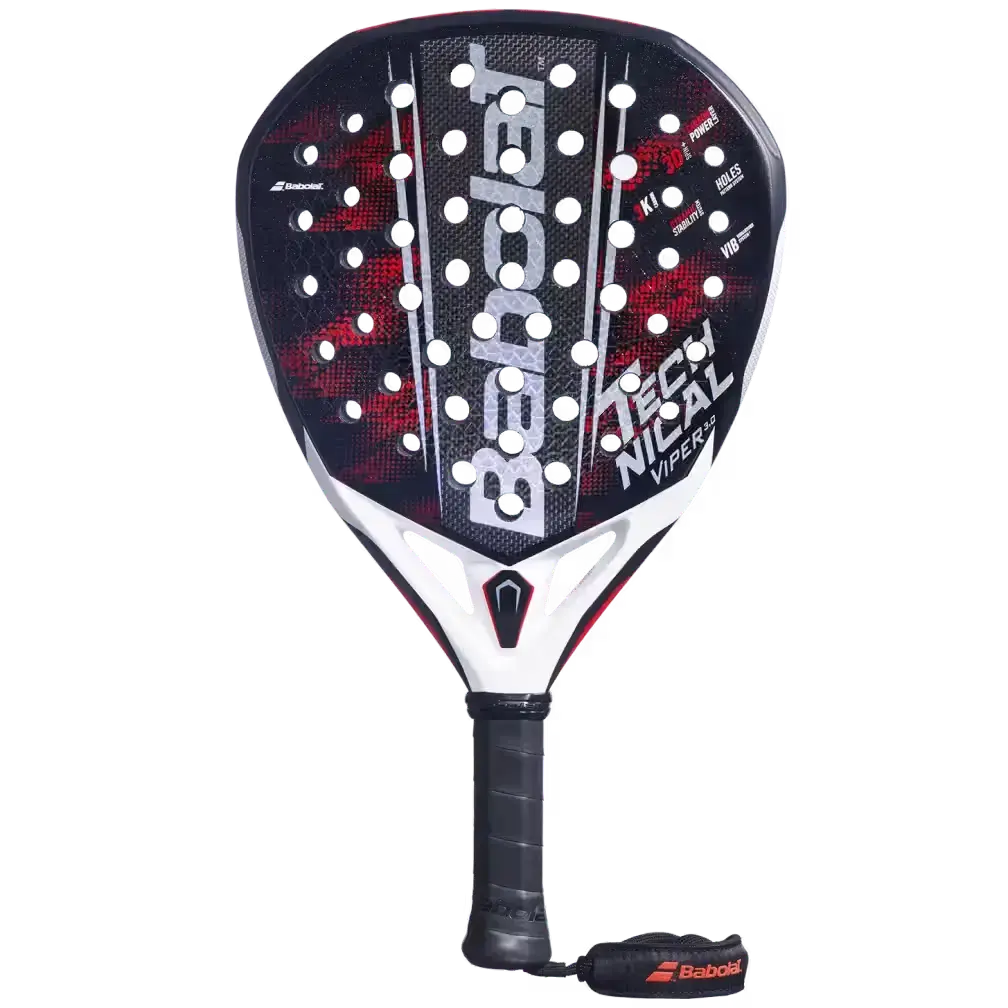
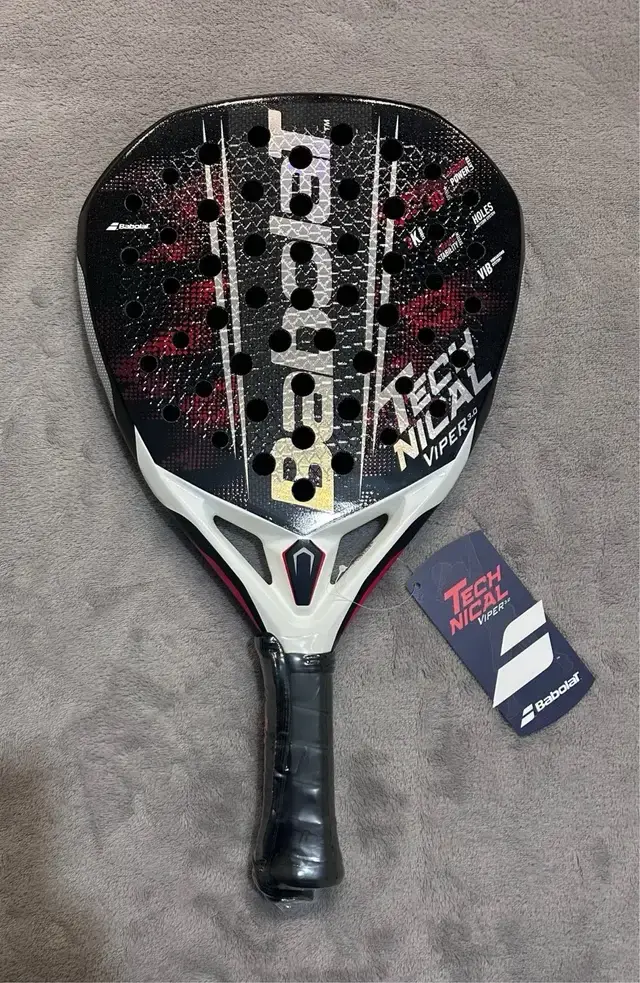
The Babolat Technical Viper 3.0 represents the most extreme power-oriented option within the Viper lineup and is clearly positioned above the Air and Counter variants in terms of offensive intent. While the Air Viper focuses on speed and aerial play and the Counter Viper emphasizes tolerance and defensive depth, the Technical Viper is engineered for direct point finishing, especially through overhead shots.
Compared to the Air Viper 2024, the Technical Viper 3.0 feels less elastic and less forgiving, with a noticeably smaller usable hitting area. Compared to the Counter Viper, it sacrifices stability and defensive output for higher peak power and faster acceleration in attacking situations.
This makes the Technical Viper 3.0 a niche tool aimed squarely at high-intermediate to advanced players who actively seek to end points and are comfortable trading forgiveness for raw offensive potential.
Technical specifications
| Spec | Value | What it means |
|---|---|---|
| Shape | Diamond | High balance, power-oriented |
| Weight | ~365–370 g (unstrung, without overgrip) | Heavier = more stability, lighter = more speed |
| Balance | Head-heavy (≈ 270–275 mm unstrung, depending on unit) | Affects swing feel and power |
| Frame thickness | 38 mm | Thicker = more power and rebound |
| Face material | Carbon Flex (carbon + fiberglass composite) | Softer feel, more forgiving |
| Core | X-EVA (multi-density EVA foam) | Good balance of control and feel |
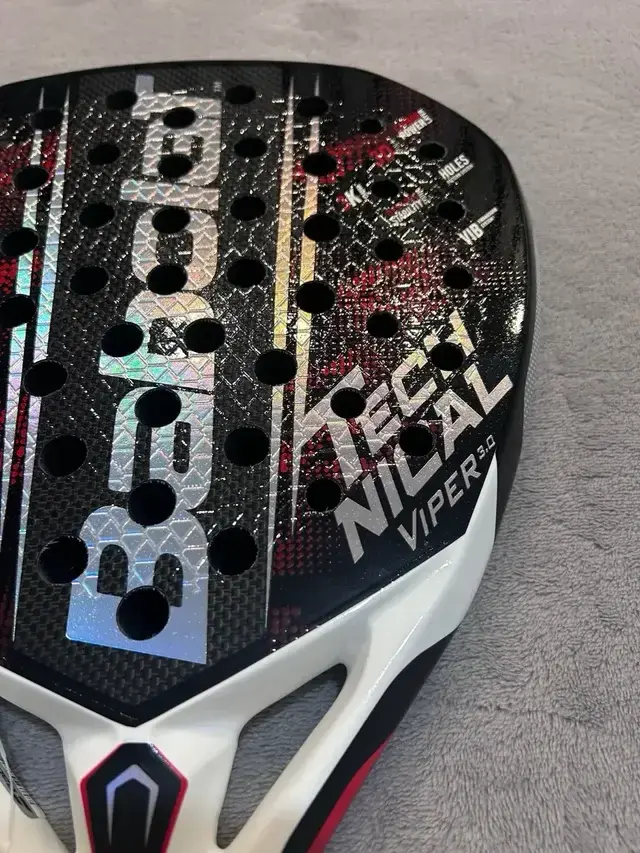
| Surface texture | 3D Spin+ (raised decal, not sanded) | Determines feel and response |
| Drilling system | Holes Pattern System | Listed spec to confirm during demo: Holes Pattern System. |
| Target player level | High intermediate → Advanced | Ideal skill level for this racket |
| Playing style | Overhead-oriented aggressive attacking play | Listed spec to confirm during demo: Overhead-oriented aggressive attacking play. |
Construction and materials
The Babolat Technical Viper 3.0 uses a construction that prioritizes instantaneous energy transfer over dwell time and impact tolerance. The face is built around Carbon Flex, combining carbon fiber with woven aramid strands. In practice, this hybrid layup does not behave like a classic elastic composite. Instead, it delivers a fast, abrupt rebound with limited ball pocketing, especially noticeable on medium-speed exchanges and defensive shots. The core density is tuned firmly, reinforcing the racket’s direct response and reducing energy absorption during impact.
Frame rigidity is high across both the hoop and throat, contributing to excellent structural stability on clean hits but also amplifying the consequences of off-center contact. Unlike more progressive constructions where mis-hits gradually lose depth, the Technical Viper 3.0 tends to drop output suddenly once contact moves outside the effective zone. This behavior suggests a design optimized for maximum efficiency in a narrow performance window rather than broad usability.
Vibration filtering is present but clearly secondary to response sharpness. While high-frequency vibrations are controlled adequately, the racket transmits enough residual feedback to make mis-hits immediately apparent. Over long sessions, this construction rewards consistent mechanics but can become demanding for players who rely on the racket to compensate for timing errors or late preparation.text
Shape and mould behavior
The diamond-shaped mould of the Technical Viper 3.0 is aggressively oriented toward overhead dominance, with the balance and mass distribution clearly favoring upper-face engagement. The effective sweet spot is positioned high and relatively compact, concentrating power production in a narrow vertical band. When contact occurs within this zone, ball speed increases sharply and trajectories remain flat and penetrating. However, lateral deviation from the center results in a steep loss of efficiency.
Compared to more forgiving diamond moulds, the Technical Viper does not offer a gradual transition between optimal and suboptimal contact. Instead, performance changes abruptly, which explains the frequent reports of unpredictable ball exit during pressured exchanges. This mould behavior places a premium on precise spacing and consistent timing, especially during fast overhead sequences where preparation margins are small.
In baseline rallies and defensive play, the mould offers limited assistance in generating depth. Players must actively accelerate through the ball to maintain length, as passive shots tend to die early. This reinforces the racket’s identity as a finishing-oriented tool rather than an all-court platform, with clear advantages overhead but notable constraints when defending or resetting points.
Stiffness, feel, and comfort
The overall stiffness profile of the Technical Viper 3.0 is firmly on the high side, both torsionally and longitudinally. Impact feel is dry and muted, with minimal dwell time and a short contact sensation. This produces a very clean response on centered hits but offers little margin for adjustment mid-swing. The muted acoustic feedback, often described as dull, reduces the player’s ability to judge contact quality by sound alone, increasing reliance on visual and tactile cues.
Comfort is acceptable for its category but limited by design priorities. While the racket does not produce excessive shock on clean impacts, repeated off-center hits generate noticeable feedback that can accumulate fatigue over longer sessions. The stiffness does not adapt dynamically across different impact zones, meaning the racket feels consistently firm regardless of contact location.
For advanced players with stable mechanics, this stiffness profile supports aggressive play and precise finishing. For high-intermediate players, however, the combination of firm response, compact sweet spot, and limited dwell time makes the racket demanding to control consistently, especially under match pressure and in extended rallies.
Sweet spot and forgiveness
The sweet spot of the Babolat Technical Viper 3.0 is compact and clearly defined, both vertically and laterally. Effective contact is concentrated in the upper-central portion of the face, consistent with the racket’s diamond geometry and offensive intent. When the ball meets this zone cleanly, response is crisp and predictable. However, even small deviations — especially toward the sides of the face — lead to an immediate reduction in depth, pace, and stability.
Forgiveness is limited and does not scale progressively. Instead of a gradual loss of performance as contact moves away from center, the Technical Viper exhibits an abrupt drop-off. This creates a perception of unpredictability, not because the racket behaves inconsistently, but because the performance window is narrow. Players accustomed to rackets with broader usable hitting areas may struggle to maintain consistent shot quality under pressure, particularly during defensive transitions and late-contact situations.
Compared to the Air Viper 2024, the sweet spot size is similarly compact, but the Technical Viper feels even less tolerant laterally. This places high demands on footwork precision and preparation timing. In match conditions, especially during fast rallies or recovery shots, the racket offers minimal assistance in stabilizing imperfect contact, reinforcing its classification as a specialist tool rather than a forgiving performance platform.
Power and smash behavior
The power ceiling of the Technical Viper 3.0 is high, but accessing it consistently requires precise mechanics and clean contact. On fully committed overhead swings with centered impact, the racket delivers strong, flat ball trajectories and excellent finishing potential. The rigid frame and firm core translate swing speed directly into output, making the racket effective for players who generate their own pace and rely on decisive overheads to close points.
Power accessibility, however, is clearly below average for its category. Partial swings, late preparation, or off-balance overheads produce noticeably weaker results. The racket does not amplify medium effort into meaningful depth or speed, which limits its effectiveness in extended rallies where repeated high-intensity swings are not always possible. This distinction between maximum output and accessible power is central to understanding its demanding nature.
Kick smashes and topspin-based overheads are functional but not dominant. The surface texture supports spin generation, but the limited dwell time reduces the margin for shaping the ball under pressure. Players who rely on heavy spin to control power may find the response too direct, while those favoring flat, decisive finishes will extract more value from the design.
Net performance under pace
At the net, the Technical Viper 3.0 performs well when exchanges are proactive and contact quality remains high. The racket’s stiffness and direct response allow for fast punch volleys and aggressive counter-volleying, provided the ball is met cleanly in front of the body. Directional output is stable on centered contact, and the racket rewards assertive net positioning.
In rapid exchanges, however, the limited forgiveness becomes more apparent. Reaction volleys and blocks taken slightly off-center lose depth quickly, reducing the ability to neutralize pace. The racket does not absorb or redistribute incoming energy efficiently, meaning players must actively control each shot rather than relying on passive stability.
This behavior reinforces the Technical Viper’s identity as a racket for players who dictate play at the net rather than absorb pressure. Advanced players with fast hands and precise timing can exploit its speed and responsiveness, while others may find it unforgiving during chaotic exchanges or defensive scrambles close to the net.
Off-center stability and torsional resistance
Off-center stability is a defining limitation of the Babolat Technical Viper 3.0 and one of the main reasons this racket feels “technical” in real match play. The frame remains structurally firm, but the racket does not preserve ball output well when contact moves away from the central impact zone, especially laterally. Instead of a progressive degradation in depth and pace, the response changes abruptly once you leave the effective hitting area, which is why many players experience inconsistent outcomes under pressure.
In defensive situations—late blocks, stretched volleys, or shots taken while recovering—this behavior becomes more pronounced. When the ball hits slightly toward the sides, the racket tends to lose depth quickly and the rebound becomes less repeatable. Rather than stabilizing the ball path, it can produce short or “dead” balls that sit up. This is not a question of vibration harshness; it’s primarily a matter of torsional effectiveness and how narrowly the racket concentrates its best response around the center.
For players with consistent spacing and early preparation, off-center events will be less frequent and the racket will feel much more stable overall. For high-intermediate players still developing contact consistency, the penalty on mis-hits is large enough to change rally outcomes, particularly at the net and during fast transitions.
Practical on-court takeaways
In real match conditions, the Technical Viper 3.0 rewards clarity of intent and disciplined execution. When footwork, spacing, and swing mechanics align, the racket delivers sharp, aggressive output with excellent responsiveness. It feels quick through the air and easy to accelerate, making it suitable for players who build points through initiative rather than attrition.
However, the racket offers little forgiveness when timing breaks down. Long rallies, defensive recoveries, and transitional shots expose its narrow usability window. The muted, low-feedback sound and short dwell time can make it harder to judge marginal contact, particularly for players transitioning from more elastic or forgiving platforms.
As a result, the Technical Viper 3.0 is best viewed as a specialist attacking racket rather than an all-round competitive tool. It suits high intermediate to advanced players who already generate pace, strike the ball cleanly, and prefer decisive point-ending patterns. For players still developing consistency or seeking stability over aggression, the learning curve can be steep.
Comparison within the Babolat lineup
Within the Babolat range, the Technical Viper 3.0 occupies the most demanding and precision-oriented position. It prioritizes maximum intent and clean execution over accessibility, clearly differentiating it from the Air and Counter lines.
Compared to the Air Viper, the Technical Viper delivers higher peak power but demands cleaner contact and offers less usability in extended rallies. Against the Counter Viper, the contrast is even sharper: the Counter prioritizes tolerance, depth control, and defensive consistency, while the Technical Viper sacrifices those qualities in favor of aggressive shot-making.
This internal positioning makes the Technical Viper 3.0 the most “pure” attacking option in the Babolat lineup, but also the least forgiving. It is not designed to suit a wide audience, and that exclusivity is reflected directly in its on-court behavior and final score.
For a same-brand choice, compare Babolat Technical Viper 3.0 Review with Babolat x Lamborghini BL002 Review, Babolat Viper Juan Lebrón 3.0 Review and Babolat Viper Soft Juan Lebrón 3.0 2026 Review. The useful test is not the badge or score alone: check whether the alternative changes balance, face response, easy depth or comfort in a way that matches your normal rallies.
Comparison with other brands
In cross-brand comparisons, the Babolat Technical Viper 3.0 holds a distinctive place as a specialized attacking instrument rather than a broadly versatile racket. When contrasted with aggressive rackets from other manufacturers, its behavior and performance window reveal clear trade-offs. Against models like the HEAD Extreme Pro, the overall power potential of the Technical Viper can feel comparable, but the Extreme Pro tends to offer a slightly broader usable range thanks to a larger effective sweet spot and more predictable off-center behavior. This makes the Extreme Pro more forgiving during fast exchanges and defensive transitions, whereas the Technical Viper is sharper and more precise when contact is clean but drops off quickly outside that narrow zone.
When compared to premium diamond rackets from NOX or Bullpadel — such as the AT10 Attack or Vertex Attack variants — the Technical Viper’s compact sweet spot and firm rebound stand out as more demanding. Those competitor models often combine higher stability with slightly broader usable areas, allowing players to extract more depth and consistency on imperfect shots. The Technical Viper, by contrast, emphasizes decisive finishes and aggressive overhead output at the cost of defensive flexibility.
Against lighter, faster rackets like Siux Electra Pro or hybrid-oriented attack frames from Oxdog, the Technical Viper feels heavier in impact and less forgiving. The Electra Pro and similar models typically offer easier power accessibility and more manageable responses across all phases of play, whereas the Technical Viper’s strength resides in its peak offensive performance rather than broad match adaptability.
This cross-brand perspective underscores that the Technical Viper 3.0 is not merely a “power racket” in generic terms, but rather a precision-dependent attacking tool. Its highest value appears when paired with players who generate their own tempo and rely on controlled aggression, rather than expecting the racket itself to compensate for inconsistencies in contact or timing.
Technical positioning
The Babolat Technical Viper 3.0 is technically positioned as a high-demand offensive racket that prioritizes direct output and decisive finishing potential over forgiveness or match tolerance. Its design philosophy centers on converting player-generated pace into ball speed with minimal energy absorption, leveraging a firm core and robust face to maximize penetration and responsiveness.
Unlike hybrid or defensive-leaning rackets, which often emphasize dwell time, spin support, or progressive energy transfer, the Technical Viper’s stiffness profile and compact sweet spot focus on precision and execution. This placement inherently narrows the performance window: the racket rewards clean contact with high ball speed and stable direction, but it provides little “assist” when mechanics falter under pressure.
From a materials and geometry standpoint, its diamond mould, head-heavy balance, and firm core establish its identity as an attacking all-court racket for advanced play. This technical positioning means it excels in structured point closure — where overheads, volleys, and finishing drives dominate — and is less suited for extended defensive exchanges or transitional play requiring forgiveness.
In terms of playstyle archetype, the Technical Viper 3.0 best aligns with players who have consistent contact, early preparation, and the ability to sustain swing acceleration. Its power ceiling and direct feedback support aggressive tactics, while its narrow tolerance and demand for precision distinguish it from more accessible models. This deliberate focus on controlled aggression underlies its technical identity and informs how players should integrate it into their competitive approach.
Technical performance score
Ten categories, each 0-10. Methodology →
- Maneuverability and handling8
- Net performance under pace7
- Control and placement precision6.5
- Defensive output and depth access6.5
- Off-center stability and torsional resistance6
- Sweet spot usability6
- Spin generation potential7
- Power ceiling7.5
- Power accessibility6.5
- Comfort and impact feedback6
Final verdict — Babolat Technical Viper 3.0 scores 67/100. A competent mid-range option with balanced performance across categories, well suited to developing and recreational players.
Common questions
Only selectively. High-intermediate players with clean mechanics, early preparation, and reliable contact may benefit from its maneuverability and direct response. However, for most players at this level, the compact sweet spot and low tolerance will result in inconsistent depth and confidence loss under pressure. It is better suited to advanced players who already control contact quality.
The sweet spot is compact and comparable to the Air Viper 2024. Central contact produces strong, predictable output, but lateral or low-face hits lose pace abruptly. Compared to Counter Viper or even Technical Viper Soft, the usable hitting area is noticeably smaller.
It is not a comfort-focused racket. While vibration damping is acceptable, the stiff response, muted feedback, and harsh punishment on mis-hits can be fatiguing over time. Players with elbow sensitivity are generally better served by more forgiving frames with longer dwell time and broader sweet spots.
The Soft version retains the same attacking DNA but offers a slightly softer impact feel and marginally better tolerance on off-center contact. It does not fundamentally change the sweet spot size, but it is more sustainable over long sessions and slightly easier to manage.
No. Power is conditional. When contact is clean and acceleration is present, output is strong. On medium or defensive swings, the racket does not generate depth automatically, which reduces repeatability in long rallies.
Players who prioritize speed, aggressive overhead play, and precision over forgiveness. The Counter Viper is significantly more tolerant, more stable defensively, and easier to use under pressure, while the Technical Viper rewards cleaner, faster execution.