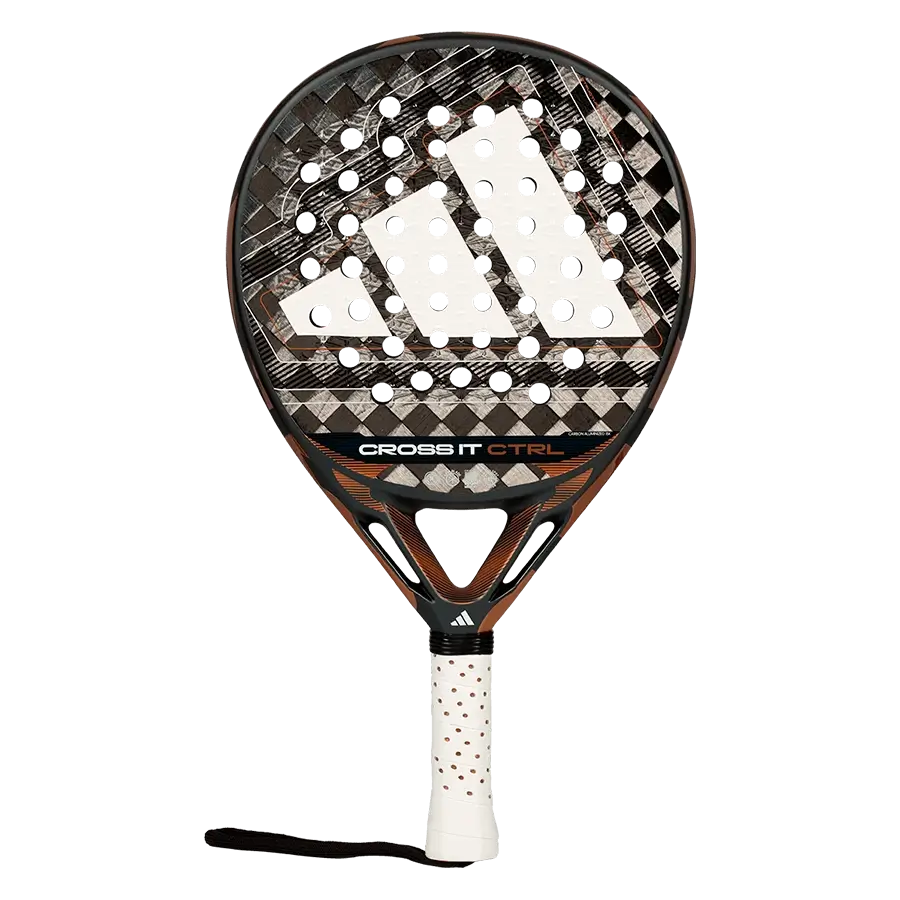
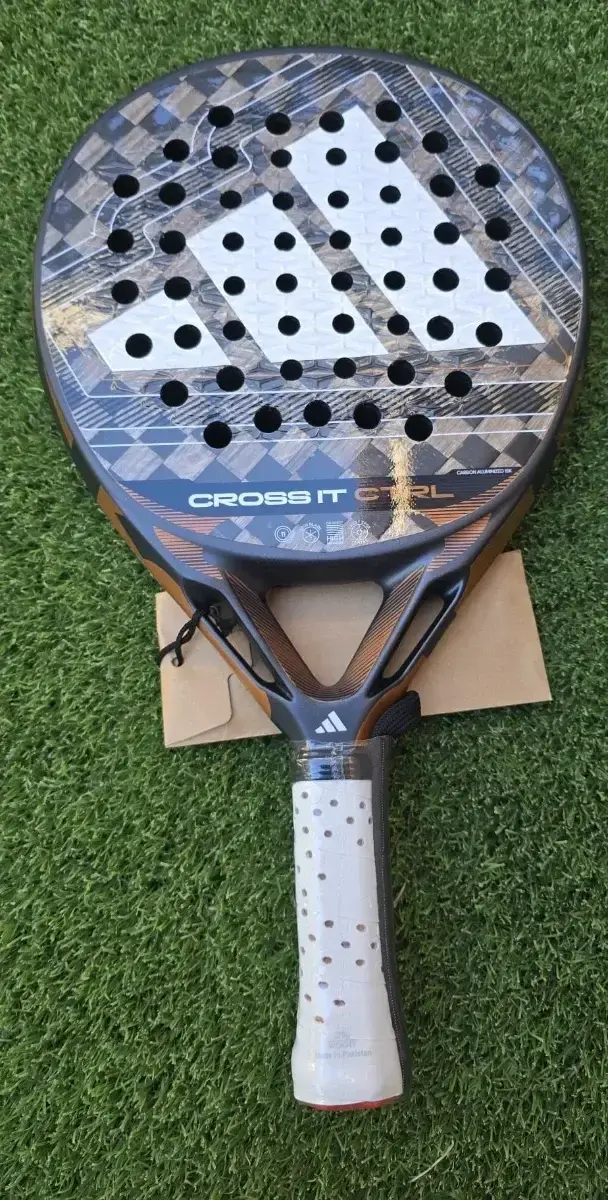
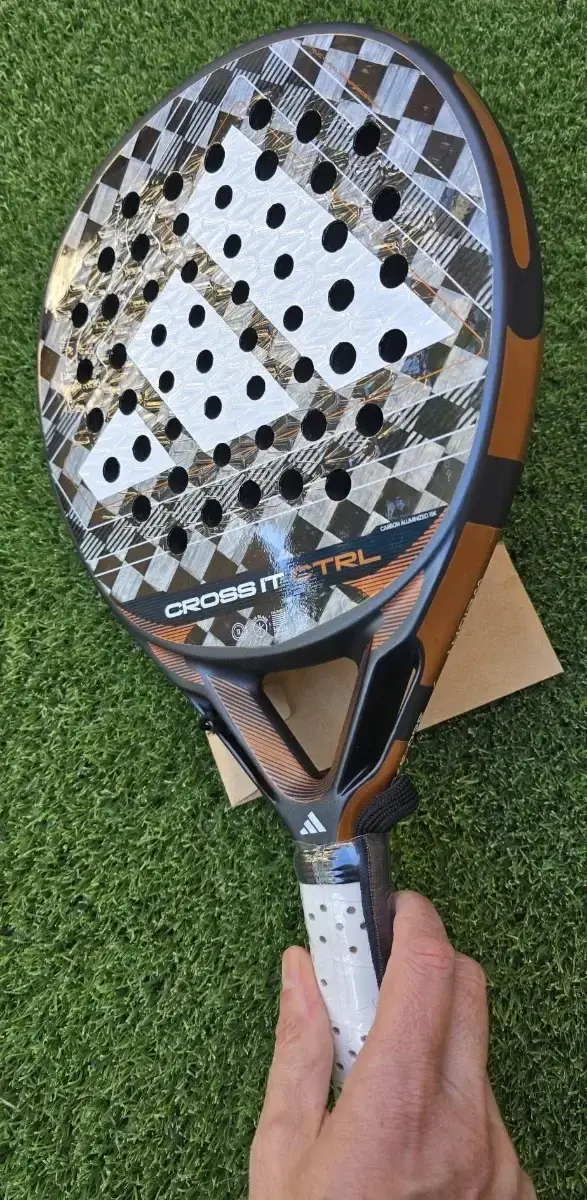
Adidas Cross IT Ctrl 2026
Version and lineup identification
The Cross IT Ctrl 2026 belongs to adidas’ Cross IT line, which sits between the Metalbone and Arrow Hit families in the 2026 range. Within the Cross IT lineup, the Ctrl version represents the most control-focused and structurally stable option, positioned below the Cross IT Carbon in power output and above the Cross IT Light in rigidity and mass.
Compared to the Cross IT Carbon Control, the Ctrl 2026 introduces a stiffer face construction and slightly higher effective balance, improving stability and directional control at the cost of some comfort. Compared to the Cross IT Light (Martita Ortega), it is clearly heavier, less forgiving, and more demanding, but also significantly more stable when pace increases.
This model is designed for players who actively build points, maintain net positioning, and prefer to control exchanges through placement rather than acceleration-assisted depth.
Technical specifications
| Spec | Value | What it means |
|---|---|---|
| Shape | Control-oriented round / rounded hybrid | Control-focused, wide sweet spot |
| Thickness | 38 mm | Thicker = more power and rebound |
| Weight range (claimed) | 360–375 g | Heavier = more stability, lighter = more speed |
| Balance (measured/estimated) | ~26.2–26.4 cm | Affects swing feel and power |
| Face material | 15K aluminized carbon | Stiff, precise and powerful |
| Core | High Memory EVA | Good balance of control and feel |
| Frame | Carbon construction with Dynamic Airflow system | Structural rigidity and durability |
| Surface texture | Integrated 3D roughness (moulded) | Determines feel and response |
| Adjustable balance system | No | Affects swing feel and power |
Construction and materials
The defining element of the Cross IT Ctrl 2026 is its 15K aluminized carbon face. This material choice produces a firmer and more immediate response than fiberglass or lower-K carbon, shortening dwell time and reducing trampoline effect. The aluminized weave adds structural stiffness, which helps stabilize the face during fast, flat impacts and aggressive volleys.
The High Memory EVA core further reinforces this behavior. It compresses minimally at low to medium swing speeds and firms up quickly under load, limiting unexpected depth and keeping ball trajectories predictable. This combination favors players who generate their own pace and want the racket to act as a neutral transmitter rather than an amplifier.
The Dynamic Airflow system in the throat improves structural efficiency and slightly reduces air resistance, but its primary contribution is stability rather than maneuverability. Overall, the construction prioritizes control through rigidity and balance rather than comfort or elasticity.
Shape and mould behavior
The Cross IT Ctrl uses a rounded control-oriented geometry with a centrally positioned sweet spot. Balance measurements around ~26.3 cm place it slightly above neutral, which improves stability without pushing the racket into head-heavy territory.
This mould favors compact swings, flat ball trajectories, and controlled net play. Unlike diamond or aggressive teardrop shapes, it does not elevate the sweet spot or encourage overhead dominance. Instead, it maintains a wide, usable central zone that supports consistency during prolonged rallies.
Compared to more elastic control frames, the mould does not compensate for late contact or incomplete swings. The benefit is a clear, disciplined response that remains stable as rally speed increases, but the trade-off is reduced forgiveness when technique breaks down.
Stiffness, feel, and comfort
Despite its control-oriented positioning and 15K aluminized carbon face, the Cross IT Ctrl 2026 does not feel truly stiff in play. The face itself provides structural firmness and limits excessive rebound, but the High Memory EVA core introduces a noticeably soft compression phase at low and medium swing speeds.
This combination results in a mixed tactile profile. On clean, accelerated contact, the racket firms up and delivers a controlled, muted response. However, during compact swings, blocks, and defensive shots, the ball sinks deeper into the core than expected for a racket marketed as “Ctrl.” The feel becomes softer and less defined, especially compared to Metalbone Control or AT10-style control frames.
Comfort is relatively high for a racket in this category. Vibrations are well filtered, and impact feedback remains smooth even on extended sessions. While this makes the racket accessible and arm-friendly, it also reduces clarity of feedback for advanced players who rely on precise tactile information to manage depth and trajectory.
Overall, stiffness is moderate rather than high. The racket feels comfortable and forgiving, but lacks the crispness typically associated with higher-level control frames.
Sweet spot and forgiveness
The sweet spot on the Cross IT Ctrl 2026 is large and centrally positioned, which aligns with its rounded geometry and slightly above-neutral balance. Performance loss on off-center contact is gradual, particularly on lateral mis-hits, making the racket forgiving in messy rallies and defensive scenarios.
This forgiveness is reinforced by the soft-to-medium EVA behavior at lower swing speeds. Balls contacted slightly late or low on the face still produce usable depth, albeit with reduced precision. Compared to stiffer control rackets, the penalty for imperfect contact is clearly lower.
However, this forgiving sweet spot comes with a trade-off. The racket does not clearly differentiate between clean and slightly imperfect contact in terms of feel and output. Advanced players may find it harder to “feel” the exact quality of contact, especially when trying to control short balls or apply subtle variations at the net.
In practical terms, the sweet spot favors consistency over precision. It supports players who value rally tolerance and error reduction more than sharp, exact shot execution.
Power and smash behavior
Power delivery on the adidas Cross IT Ctrl 2026 is intentionally restrained and primarily player-driven. The racket does not behave like a natural power amplifier, and its control-first geometry keeps mass distribution closer to center than the Metalbone or HRD-type frames. As a result, ball speed scales with swing commitment rather than appearing automatically through trampoline effect.
On overheads, the racket’s ceiling is clearly limited by design. Flat smashes can be effective when contact is clean and high, but the output is more “controlled finish” than point-ending explosiveness. The soft-to-medium compression phase from the core reduces immediate rebound sharpness, which keeps trajectories manageable but also prevents the racket from producing violent acceleration on medium-effort swings.
Kick smashes and vibora-style overheads are achievable, but they rely on technique rather than racket elasticity. The face helps keep the ball on a predictable line, yet the core does not generate extra lift by itself. Players who depend on the racket to “add height” or to transform a partial swing into depth will find the Cross IT Ctrl underpowered compared to attack-oriented teardrops or diamonds.
Power accessibility is modest. At roughly 70–80 percent effort, the racket tends to produce safe, controllable ball exit rather than deep, penetrating pace. To create finishing-level speed, the player must fully commit physically and keep timing precise. This is consistent with a control racket, but the presence of a softer core makes the transition from “safe” to “decisive” less crisp than in firmer control frames.
Overall, the Cross IT Ctrl 2026 is built to manage overheads, not to dominate with them. It supports controlled placement, safe pressure, and rally stability, but it will not satisfy players who want easy smash power or a high ceiling from imperfect setups.
Net performance under pace
At the net, the Cross IT Ctrl 2026 favors control through containment rather than initiative. Volleys are easy to keep low and directional, particularly when the player is well positioned and uses compact swings.
In fast exchanges, the racket’s limitations become more apparent. The softer core reduces rebound speed, requiring additional swing effort to maintain depth and pressure. When reactions are late, the racket offers limited assistance, and blocks tend to drop short rather than penetrating.
Maneuverability is acceptable for its weight class, but recovery between shots is not especially quick. Compared to lighter control frames or teardrop all-court rackets, the Cross IT Ctrl feels more static in hand battles.
This behavior suits players who prefer structured net play and controlled point construction, but it is less effective for those who rely on rapid acceleration or reactive counter-punching.
Off-center stability and torsional resistance
Stability is adequate but not outstanding. The racket remains composed on moderate off-center hits, particularly in the central and mid-face areas, thanks to its balanced mass distribution and rounded shape.
On higher-impact shots—such as fast volleys or counter-attacks—the frame maintains directional stability, but the softer core allows some energy dispersion. This results in less authoritative ball exit compared to stiffer control frames, especially when contact is not perfectly centered.
Vertical mis-hits (high or low on the face) are handled better than expected for a control racket, but lateral mis-hits under pace can lead to noticeable depth loss. Torsional resistance is sufficient for intermediate play, but advanced players may find the racket slightly compliant when exchanges speed up.
Overall, stability is tuned for consistency rather than dominance. The racket stays playable under pressure but does not impose itself in fast or aggressive situations.
Practical on-court takeaways
In match conditions, the Cross IT Ctrl 2026 behaves as a tolerant, control-first racket aimed at managing rallies rather than dictating them. It excels in situations where consistency, comfort, and forgiveness matter more than precision or finishing power.
From the back of the court, it supports safe ball placement and stable cross-court patterns, but it does not provide automatic depth. Players must actively accelerate to avoid leaving balls short. At the net, it rewards early positioning and clean technique, but offers limited help in rushed situations.
The combination of rounded shape, moderate balance, and soft-to-medium core response makes the racket particularly suitable for intermediate players, club-level competitors, and control-oriented right-side players who prioritize error reduction.
For advanced players, the main limitation is the lack of sharpness and structural authority. The racket feels controlled, but not commanding.
Comparison within the Adidas lineup
Within the adidas range, the Cross IT Ctrl 2026 is the most control-oriented option. Compared to the Metalbone CTRL, it is softer and more forgiving but clearly less precise at higher swing speeds. Against the Arrow Hit CTRL, it offers a slightly more stable feel and better directional consistency, but both rackets target a similar skill level. It sits firmly at the “control and comfort first” end of the lineup, with minimal overlap into offensive territory.
For a same-brand choice, compare Adidas Cross IT Ctrl 2026 Review with Adidas Metalbone 2026 Review, Adidas Metalbone CTRL 3.5 2026 Review and Adidas Arrow Hit 2026 Review. The useful test is not the badge or score alone: check whether the alternative changes balance, face response, easy depth or comfort in a way that matches your normal rallies.
Comparison with other brands
When compared to control-oriented rackets from other manufacturers, the adidas Cross IT Ctrl 2026 positions itself as a forgiving, accessibility-focused control frame rather than a precision-heavy or performance-driven one.
Against the NOX ML10 Ventus Control 3K 2026, the Cross IT Ctrl feels softer and more damped, with a larger effective sweet spot but less crisp feedback. The ML10 provides better directional precision under acceleration and a more defined response on volleys, while the adidas offers easier handling for less consistent contact.
Compared to the Bullpadel Ionic Control, the Cross IT Ctrl delivers a calmer rebound and more predictable ball exit, but with a lower power ceiling. The Bullpadel frame feels slightly firmer and more responsive when pushing pace from the back court, whereas the adidas favors safe rally construction.
Versus control models like the Head Speed Team or Wilson Blade Team, the Cross IT Ctrl remains on the softer side of the spectrum. It prioritizes comfort and error reduction over sharp response, making it easier to play but less rewarding for players with refined mechanics.
Overall, the Cross IT Ctrl competes best in the “easy control” segment rather than among high-precision control rackets designed for advanced players.
Technical positioning
The adidas Cross IT Ctrl 2026 is positioned as an entry-to-intermediate level control racket, designed to maximize consistency, comfort, and error tolerance rather than shot authority or tactical sharpness. Its round geometry, soft core response, and forgiving face make it accessible to a wide range of players, particularly those still developing timing, positioning, and confidence under pressure.
Within the adidas lineup, the Cross IT Ctrl sits clearly below Metalbone CTRL models in terms of structural firmness and directional precision. Compared to higher-tier control frames, it offers a larger sweet spot and easier depth generation, but sacrifices feedback clarity and power scalability. The racket does not aim to reward aggressive acceleration or advanced technique; instead, it focuses on stabilizing rally play and reducing penalties on imperfect contact.
From a technical standpoint, this is a comfort-first control frame. Its performance envelope is intentionally capped to avoid volatility, which benefits intermediate players but limits long-term progression for advanced users. Players looking for sharper response, firmer feedback, or higher offensive ceiling will eventually outgrow this platform.
Technical performance score
Ten categories, each 0–10. Methodology →
- Maneuverability and handling7
- Net performance under pace6
- Control and placement precision6
- Defensive output and depth access8
- Off-center stability and torsional resistance8
- Sweet spot usability8
- Spin generation potential6
- Power ceiling5
- Power accessibility6
- Comfort and impact feedback8
Final verdict — Adidas Cross IT Ctrl scores 68/100. A entry-level option with excellent comfort and arm-friendly feedback, ideal for beginners building their first padel game.
Common questions
This racket is best suited for beginner to intermediate players who prioritize consistency, comfort, and ease of play. It supports players who want to stay in rallies longer, reduce errors, and play with low physical strain.
Not typically. Its limited power ceiling and soft response make it less effective for repeated overhead finishing or high-speed offensive patterns. Players on the left side usually prefer firmer or more attack-oriented frames.
Forgiveness is one of its main strengths. The sweet spot is large and centrally positioned, with gradual performance loss on off-center contact, which helps maintain consistency under pressure.
Yes. While the racket feels comfortable and stable at low to medium pace, directional precision decreases when swing speed increases. Control is based on forgiveness rather than structural firmness.
Metalbone CTRL rackets are firmer, more precise, and more demanding. The Cross IT Ctrl is softer, easier to use, and more forgiving, but clearly less sharp and less scalable for advanced play.
Yes. Impact feedback is well filtered, vibration is low, and the racket remains comfortable over long sessions, making it suitable for players concerned about fatigue or arm discomfort.
Up to a point. It is excellent for developing consistency and confidence, but players aiming to increase pace, precision, or offensive pressure will eventually need a firmer and more responsive platform.