SIUX Fenix Pro 2026 Black
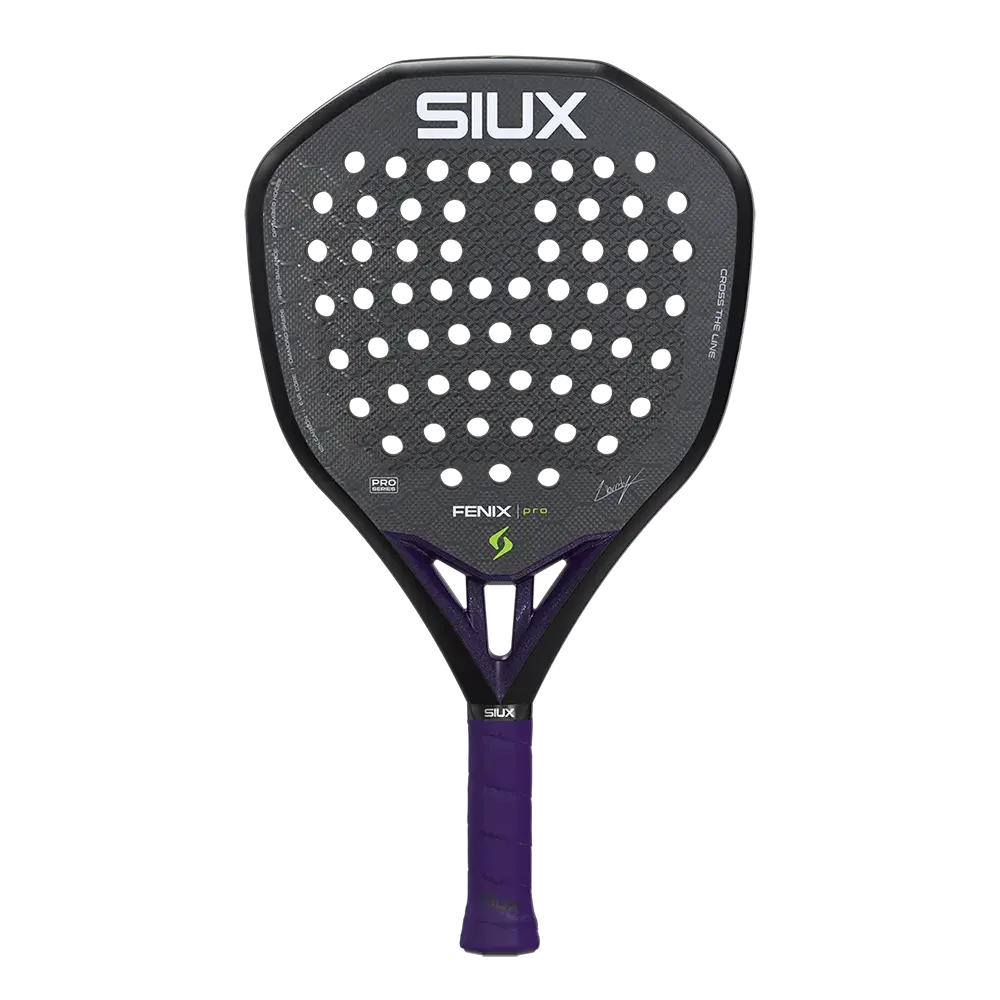
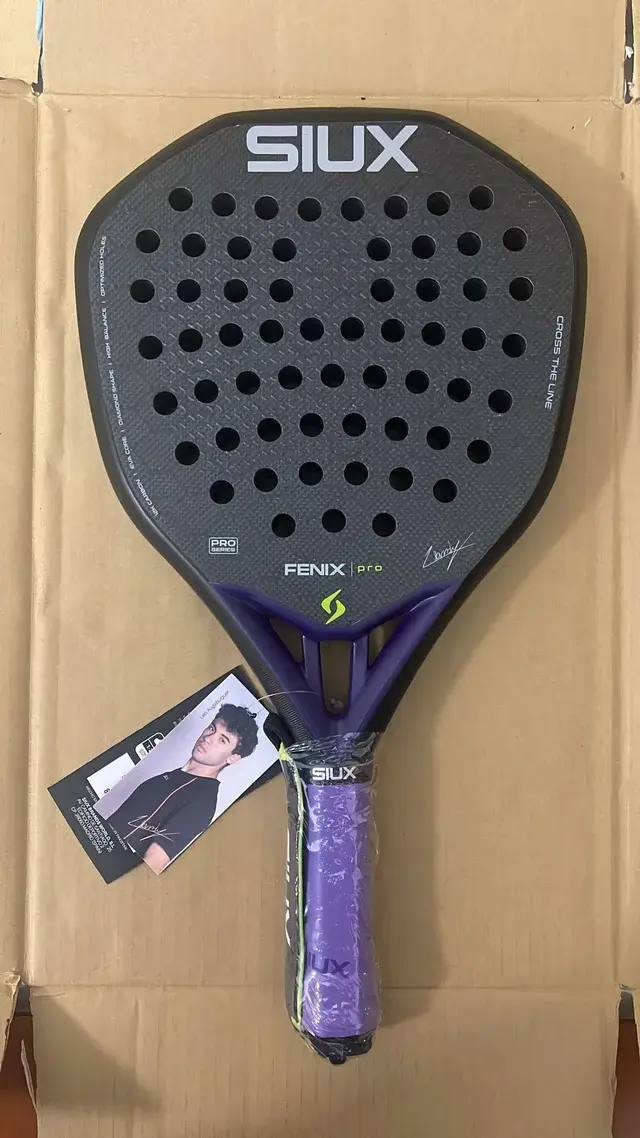
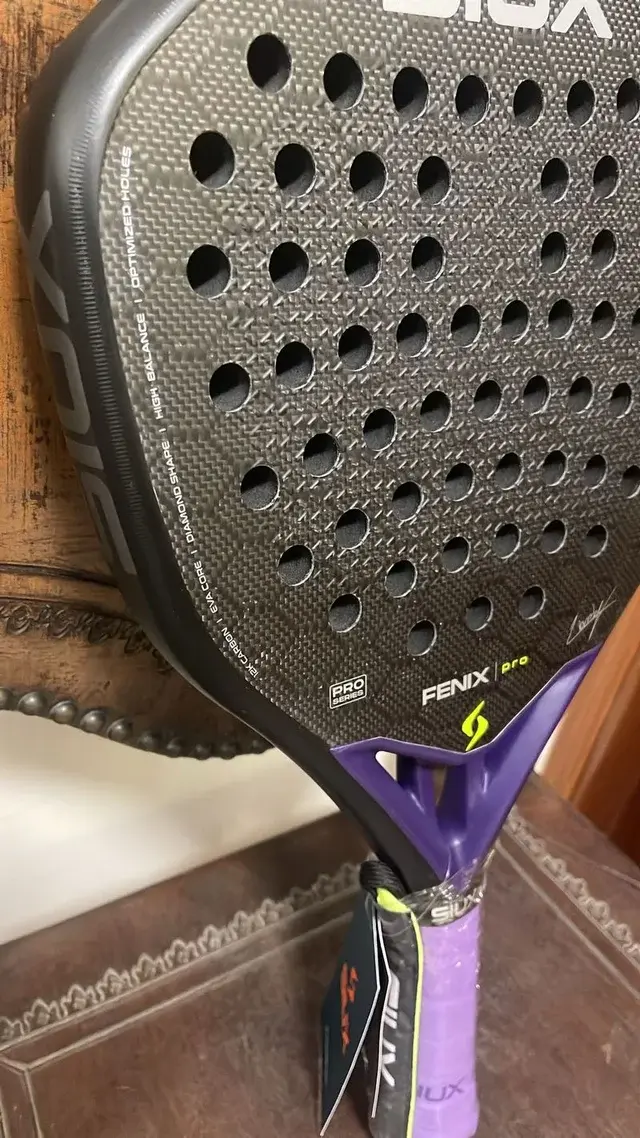
Version and lineup identification
Within Siux’s 2026 lineup, the Fenix Pro 2026 Black sits at the very top of the brand’s offensive hierarchy. The Fenix family has always represented Siux’s power-first philosophy, but the 2026 Pro version pushes this concept further into the competition segment. Rather than aiming for broader accessibility, the Pro model is tuned for players who already generate high swing speeds and expect the racket to remain stable and predictable at full acceleration.
Compared to the Fenix Pro 5 Black, the 2026 iteration retains the same attacking DNA—high balance, overhead-oriented geometry, and a narrow performance window—but with a noticeably firmer and more direct response. The tuning shift favors control and stability at maximum swing speed, while reducing the elastic rebound and forgiveness that some players relied on in the previous generation. This positions the Fenix Pro 2026 Black not as a comfort upgrade, but as a more demanding, competition-level evolution.
Within the broader Siux range, the distinction becomes clearer when compared to the Fenix Elite 2026. While both rackets share a similar offensive orientation and high balance, the Elite version is tuned for easier power access and a slightly wider effective hitting zone. The Pro 2026 Black, by contrast, sacrifices accessibility in favor of precision and rigidity, offering more reliable response at full pace but significantly less tolerance on imperfect contact.
When placed alongside other Siux models such as the Pegasus or Diablo lines, the Fenix Pro 2026 Black represents the extreme end of the spectrum. Those models prioritize all-court balance, defensive tolerance, and consistency across longer rallies, whereas the Fenix Pro is unapologetically specialized. Its high balance and dense construction deliver a much higher power ceiling, but at the cost of forgiveness and ease of use in transitional and defensive phases.
Technical specifications
| Spec | Value | What it means |
|---|---|---|
| Shape | Hybrid (diamond-leaning) | High balance, power-oriented |
| Weight range | ~355–375 g | Heavier = more stability, lighter = more speed |
| Profile | 38 mm | Listed spec to confirm during demo: 38 mm. |
| Balance | High — approximately 27.0–27.5 cm | More power, less maneuverability |
| Face material | 12K carbon | Good stiffness and durability |
| Core | EVA Pro / high-density EVA | Good balance of control and feel |
| Frame | Full carbon construction | Structural rigidity and durability |
| Surface finish | Pronounced 3D textured face | Determines feel and response |
| Handle | Extended grip | Listed spec to confirm during demo: Extended grip. |
| Player level | Advanced / competitive | Ideal skill level for this racket |
| Racket type | Power-oriented offensive model | Listed spec to confirm during demo: Power-oriented offensive model. |
Construction and materials
The Siux Fenix Pro 2026 Black is built around a 12K carbon face paired with a high-density EVA Pro core, a combination intended to maximize structural rigidity and energy transfer at high swing speeds. Compared to previous generations, the material tuning favors firmness and direct response rather than elastic rebound.
The full carbon frame contributes to overall stiffness and stability, particularly noticeable during overhead acceleration. This rigidity helps the racket maintain shape and directional control under high load but reduces dwell time and limits assistance on lower-speed shots. The resulting impact feel is firm and decisive, with minimal deformation at contact.
A pronounced 3D textured surface enhances friction between the ball and the face, supporting spin generation on vibora, kick smash, and aggressive slice shots. However, the effectiveness of this texture is highly dependent on contact precision. When contact drifts outside the effective zone, the structural stiffness amplifies the loss of rebound rather than compensating for it.
The extended grip length supports two-handed preparation and overhead leverage, reinforcing the racket’s attacking orientation but adding slightly to swing inertia when compared to standard-length handles.
Shape and mould behavior
The Fenix Pro 2026 Black uses a hybrid, diamond-leaning mould that places the sweet spot high on the face, clearly prioritizing overhead play. This geometry works in conjunction with the high balance to generate significant leverage during smashes and aggressive overheads.
In centered contact scenarios, the mould produces a direct, linear ball trajectory with high exit speed. The racket feels stable and controlled when swung at full pace, particularly on flat smashes and high-speed bandejas. This is where the design intent is most clearly realized.
Outside the sweet spot, however, the mould offers limited forgiveness. Vertical mis-hits below the optimal zone reduce depth, while lateral mis-hits result in a sharp drop in rebound efficiency. The contrast between optimal and suboptimal contact is pronounced, making shot quality highly dependent on positioning and timing.
As a result, the mould behavior reinforces the racket’s specialist nature: it excels when the player dictates play from above but becomes demanding and less tolerant in defensive or reactive situations.
Stiffness, feel, and comfort
The Siux Fenix Pro 2026 Black sits firmly in the upper stiffness range of the 2026 market. The combination of a 12K carbon face and a high-density EVA Pro core produces a clearly firm and rigid response, especially noticeable at medium-to-high swing speeds. Compared directly to the Fenix Pro 5 Black, the 2026 version feels less elastic and more direct, with reduced dwell time and a sharper energy release on clean contact.
Impact feel is best described as solid and dry rather than elastic. The racket does not cushion the ball; instead, it transmits a clear sense of structural rigidity. Vibrations are controlled at a structural level, but this is achieved through stiffness rather than damping, meaning the racket feels stable without feeling soft. Players sensitive to feedback will immediately notice that the racket favors precision and firmness over comfort.
Over longer sessions, comfort becomes conditional. At optimal contact and with active technique, the racket remains manageable. Under fatigue or when contact quality drops, the firm response and high balance increase physical load, particularly on the shoulder and forearm. This reinforces the model’s competition-level positioning rather than all-day playability.
Sweet spot and forgiveness
The sweet spot on the Fenix Pro 2026 Black is small to medium in absolute terms and clearly positioned high on the face, consistent with its diamond-leaning hybrid geometry. This placement aligns perfectly with overhead play but limits usability in neutral or defensive situations.
Centered contact produces clean output with good directional control and high ball speed. However, even moderate lateral deviation leads to a pronounced drop in rebound efficiency. The loss of depth and pace on off-center hits is immediate and clearly noticeable, particularly on backhand defense and stretched forehands.
Forgiveness is therefore below average, even within the offensive racket category. Compared to the Fenix Elite 2026, the Pro version offers a narrower effective zone and higher penalty for mis-hits. Compared to all-court hybrids in the Siux range, the difference is substantial. The racket does not attempt to mask errors and instead reinforces the need for early preparation, clean positioning, and consistent timing.
Power and smash behavior
Power is the defining strength of the Siux Fenix Pro 2026 Black. The racket offers a very high power ceiling, placing it among the most explosive attacking models of the 2026 season. When swing speed is high and contact occurs in the upper central zone, smash output is exceptional, with strong ball acceleration and efficient energy transfer.
Flat smashes benefit most from the racket’s rigidity and balance, producing fast, penetrating trajectories. Kick smashes and viboras also perform at a high level, aided by the aggressive surface texture, although they still require precise contact to fully engage the racket’s potential.
Power accessibility, however, is clearly limited. The racket provides minimal assistance on slower or improvised swings. Without active acceleration, ball output drops quickly, especially from the back of the court. This creates a clear separation between maximum power and usable power, reinforcing the racket’s identity as a tool for players who actively generate speed rather than rely on the racket for help.
Net performance under pace
At the net, the Siux Fenix Pro 2026 Black behaves exactly as its balance suggests. With a balance point around 27.0–27.5 cm, the racket carries noticeable head weight, which provides solidity on punch volleys and finishing shots but increases inertia during rapid reaction exchanges. When preparation is early and contact is clean, the racket feels stable and authoritative, allowing confident finishing at the net.
In fast exchanges under pressure, however, maneuverability becomes conditional. Players using weights closer to 360–365 g will find the racket manageable, while setups approaching 370 g or more noticeably slow down recovery speed. In rushed situations, the narrow sweet spot amplifies the penalty for late or misaligned contact, often resulting in short or neutral balls rather than aggressive responses.
As a result, net play with the Fenix Pro 2026 Black favors proactive positioning and decisive finishing rather than reactive blocking. It rewards players who arrive early and dictate tempo but offers limited forgiveness in chaotic exchanges.
Off-center stability and torsional resistance
Off-center stability and torsional resistance is adequate but uncompromising. Structurally, the full carbon frame maintains shape and resists excessive twisting, but energy transfer drops sharply once contact leaves the effective zone.
Lateral mis-hits are particularly penalized. Even small deviations toward the edges of the face produce a noticeable loss of depth and ball speed. Vertical mis-hits below the sweet spot reduce rebound efficiency and flatten trajectories, making defensive lifts and controlled resets more difficult.
Compared to the Fenix Pro 5 Black, the 2026 version feels slightly more stable at full acceleration, but this improvement does not translate into greater forgiveness. The racket remains highly sensitive to contact precision, reinforcing its identity as a performance tool rather than a safety net.
Practical on-court takeaways
In real match conditions, the Siux Fenix Pro 2026 Black is a high-reward, high-demand racket. It excels when the player controls rallies through overhead dominance, aggressive positioning, and sustained swing speed. In these scenarios, the racket delivers outstanding power and reliable response at full pace.
Conversely, the racket becomes demanding in defensive or transitional phases. Under fatigue or pressure, when preparation time decreases and contact quality drops, consistency declines quickly. Players who rely on passive defense, blocked returns, or late adjustments will struggle to extract stable performance.
Practically speaking, the Fenix Pro 2026 Black is best suited for advanced left-side attackers who are willing to trade forgiveness and comfort for maximum offensive potential. For players who accept this trade-off, it can be a decisive weapon. For those seeking stability, progression, or all-court balance, the limitations will outweigh the benefits.
Comparison within the SIUX lineup
Within the Siux 2026 lineup, the Fenix Pro 2026 Black represents the most aggressive and least forgiving offensive option. Its role is clearly defined when compared to other Siux models: it maximizes peak power and overhead dominance while minimizing assistance and tolerance.
Compared to the Siux Fenix Elite 2026, the Pro version is noticeably stiffer and more direct. While both share a high balance and attacking orientation, the Elite offers easier power access and a slightly wider effective hitting zone, making it more manageable over long matches. The Pro 2026 Black, by contrast, prioritizes control at maximum swing speed and accepts a higher penalty on imperfect contact.
Against the Siux Diablo Pro 2026, the difference is philosophical. Diablo Pro is built as a control-oriented hybrid with a more central balance and a larger sweet spot, supporting consistency from the back of the court and under pressure. The Fenix Pro 2026 Black sacrifices that stability to unlock a significantly higher power ceiling in overhead play.
When compared to all-court models like Siux Pegasus, the contrast becomes even sharper. Pegasus favors balance, defensive tolerance, and rally stability, while the Fenix Pro exists at the opposite end of the spectrum, designed to finish points rather than extend them.
For a same-brand choice, compare SIUX Fenix Pro 2026 Black Review with SIUX Electra STUPA PRO 2026 Shadow Red Review, SIUX Diablo Pro 2026 Review and SIUX Pegasus Pro 2026 Review. The useful test is not the badge or score alone: check whether the alternative changes balance, face response, easy depth or comfort in a way that matches your normal rallies.
Comparison with other brands
When placed against competing offensive rackets from other brands, the Siux Fenix Pro 2026 Black stands out primarily for its power ceiling, not for ease of use.
Compared to Bullpadel Vertex 05 GEO, the Fenix Pro offers similar peak smash output but feels more rigid and less forgiving. The Vertex GEO provides a slightly broader sweet spot and more predictable response in transitional play, while the Fenix Pro feels more specialized and punishing outside optimal contact.
Against Adidas Metalbone, the Fenix Pro lacks the adjustability and balance customization that Metalbone offers. While both target attacking players, the Metalbone Attack delivers more accessible power and a wider usability range, whereas the Fenix Pro emphasizes raw output at the cost of consistency.
Compared to NOX AT10 Attack, the difference is clear: the AT10 prioritizes control, dwell time, and repeatability, making it more suitable for structured point construction. The Fenix Pro, by contrast, is built to end points quickly and decisively from overhead positions.
When contrasted with Wilson Defy Pro V1, the Fenix Pro 2026 Black offers a higher and more reliable power ceiling. While the Defy Pro excels in maneuverability, its extremely narrow sweet spot limits finishing consistency. The Fenix Pro remains demanding but delivers more decisive overhead performance when struck cleanly.
Technical positioning
The Siux Fenix Pro 2026 Black is best positioned as a competition-level attacking racket with a clear power-first identity.
It is designed for advanced players who consistently generate high swing speeds and dominate points through overhead play. The racket offers one of the highest power ceilings in the 2026 market, paired with firm response and stability at full acceleration.
At the same time, its high balance, stiff construction, and narrow sweet spot make it unsuitable for players seeking forgiveness, progression, or all-court stability. The Fenix Pro 2026 Black does not adapt to the player; it demands adaptation from the player.
In practical terms, it is a specialist weapon for left-side attackers who accept reduced tolerance and comfort in exchange for maximum offensive impact.
Technical performance score
Ten categories, each 0-10. Methodology →
- Maneuverability and handling7
- Net performance under pace7
- Control and placement precision7.5
- Defensive output and depth access6.5
- Off-center stability and torsional resistance6.5
- Sweet spot usability6.5
- Spin generation potential8
- Power ceiling9
- Power accessibility6.5
- Comfort and impact feedback6.5
Final verdict — SIUX Fenix Pro Black scores 71/100. A competent mid-range option with balanced performance across categories, well suited to developing and recreational players.
Common questions
It is best suited for advanced and competitive left-side players who generate high swing speeds and dominate points through overhead play. Players must be comfortable with high balance (~27 cm) and limited forgiveness.
The 2026 version is stiffer and more direct, with less elastic rebound and slightly better control at full acceleration. It is more demanding overall, offering less comfort and forgiveness than the Pro 5.
No. While the power ceiling is very high, power accessibility is limited. Effective output requires active acceleration and clean contact, particularly in the upper central zone.
Forgiveness is below average. The sweet spot is narrow and positioned high on the face. Lateral mis-hits result in a noticeable drop in depth and pace.
Only conditionally. Defense requires active technique and early preparation. Passive or late defensive shots are not well supported by the racket’s geometry and balance.
At 360–365 g, the racket remains manageable. Above 370 g, inertia increases significantly, reducing maneuverability and increasing fatigue over long matches.
No. The combination of high balance, stiff response, and limited forgiveness makes it unsuitable for intermediate players or those still developing consistent mechanics.