SIUX Diablo Pro 2026 Review
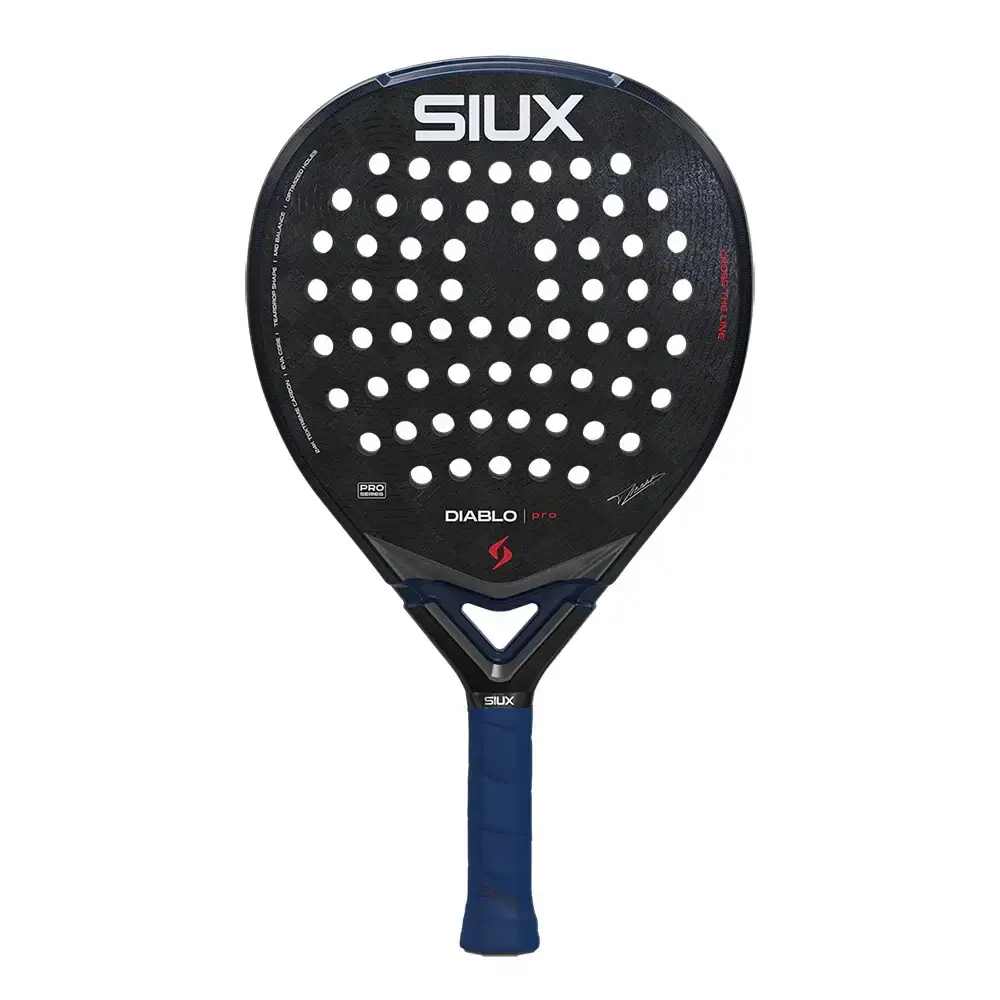
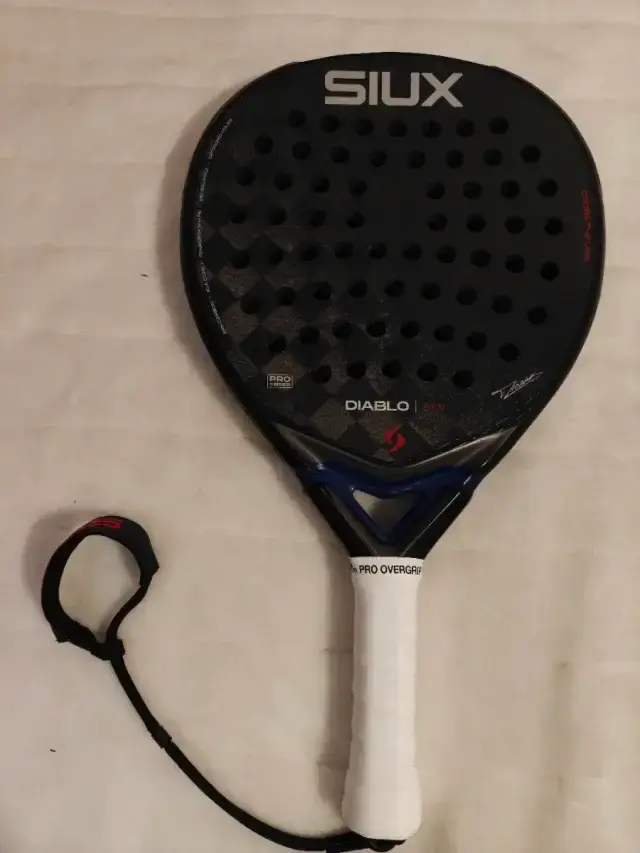
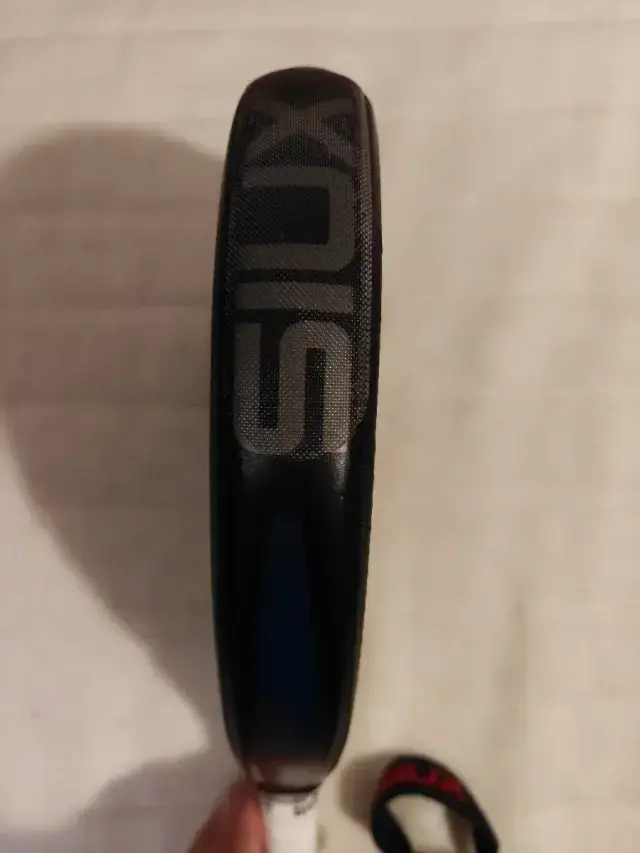
Version and lineup identification
Within the SIUX 2026 Pro lineup, the Diablo Pro occupies a clearly defined middle ground between the brand’s two extremes. On one side sits the Fenix Pro 2026, a diamond-shaped, head-heavy racket built for maximum overhead power and aggressive finishing. On the other, the Electra Pro 2026 targets a calmer, more forgiving all-court profile with softer response and higher tolerance. The Diablo Pro 2026 is intentionally positioned between these two, both in geometry and in on-court behavior.
Compared to previous Diablo generations, the 2026 version marks a decisive shift. Earlier Diablo models leaned heavily toward control and softness, often at the expense of punch and stability under pace. The 2026 iteration is noticeably firmer and more direct, narrowing the gap toward Fenix in terms of power ceiling while still retaining the maneuverability and balance that define the Diablo identity. This change effectively modernizes the line, aligning it with faster, more aggressive contemporary padel without abandoning its all-court roots.
Relative to the Electra Pro, the Diablo Pro delivers a more assertive response. The face feels stiffer, ball exit is quicker, and volleys carry more weight. At the same time, it remains less physically demanding than the Fenix Pro, both in swing commitment and in match endurance. In practical terms, Diablo Pro 2026 is the most neutral Pro option in the SIUX range: not the softest, not the hardest, not the most powerful, but the most adaptable across different tactical roles and partner dynamics.
Technical specifications
| Spec | Value | What it means |
|---|---|---|
| Shape | Teardrop (hybrid) | Balanced power and control |
| Weight | ~355–375 g (unstrung, sample-dependent) | Heavier = more stability, lighter = more speed |
| Balance | Medium to medium-high (~25.8–26.1 cm) | More power, less maneuverability |
| Face material | 24K carbon | Stiff, precise and powerful |
| Frame | Full carbon construction | Structural rigidity and durability |
| Core | EVA Pro | Good balance of control and feel |
| Surface finish | Lightly textured / sanded finish | Determines feel and response |
| Frame thickness | 38 mm | Thicker = more power and rebound |
| Stiffness category | Medium-firm | Listed spec to confirm during demo: Medium-firm. |
| Target player level | Advanced / Expert | Ideal skill level for this racket |
| Intended playing style | All-court Pro with offensive bias | Listed spec to confirm during demo: All-court Pro with offensive bias. |
Construction and materials
The SIUX Diablo Pro 2026 is built around a full carbon structure, combining a rigid carbon frame with 24K carbon faces. This construction choice is central to the racket’s updated behavior, providing higher torsional stability and a more immediate energy transfer compared to earlier Diablo models. The 24K carbon layer contributes to a crisp response on contact, especially noticeable during flat drives and aggressive volleys.
At the core, EVA Pro balances the stiffness of the carbon faces. Rather than acting as a trampoline, the core compresses progressively under load, allowing controlled output at lower swing speeds and increased power only when acceleration rises. This pairing results in a response that feels deliberate and predictable, rather than elastic or bouncy. Vibrations are filtered adequately for a Pro-level frame, though feedback remains clear and informative.
The surface finish is lightly textured rather than aggressively rough. This choice favors control and consistency over extreme spin generation, reinforcing the Diablo Pro’s positioning as an all-court tool rather than a spin-specialist weapon.
Shape and mould behavior
The tear-shaped mould places the sweet spot slightly above the geometric center, introducing an offensive bias without adopting the full demands of a diamond profile. This geometry supports overhead shots and finishing volleys while maintaining reasonable forgiveness in defensive and transitional phases.
On court, the mould behaves predictably across different shot types. Defensive lobs and controlled back-court drives feel stable and easy to manage, while offensive acceleration produces a noticeable increase in ball speed without sudden or erratic rebound. The racket does not feel top-heavy, which contributes to its quick handling and ease of repositioning during fast exchanges.
The balance between shape and weight distribution allows smooth transitions from defense to attack. Players can step forward aggressively without feeling that the racket is working against them, a trait that differentiates the Diablo Pro from more extreme head-heavy designs.
Stiffness, feel, and comfort
In terms of stiffness, the Diablo Pro 2026 sits firmly in the medium-firm category. Impact feel is solid and well defined, with a clear sense of contact location on the face. This clarity helps advanced players fine-tune placement and trajectory, particularly in net play and controlled overheads.
Comfort is acceptable but not a primary design goal. The EVA Pro core mitigates harsh vibrations, yet mis-hits are clearly felt, especially toward the lower face and outer edges. Compared to softer SIUX models like the Electra Pro, the Diablo Pro transmits more feedback to the arm, though it remains less demanding than the hardest Pro frames in the lineup.
Overall, the feel encourages confident, committed strokes. Players with refined technique will appreciate the precision and stability, while those seeking maximum comfort or error masking may find the response too honest for their needs.
Sweet spot and forgiveness
For a Pro-oriented, tear-shaped racket, the Diablo Pro 2026 offers a notably usable sweet spot. The effective hitting area extends vertically from the lower-central face into the upper-middle section, which improves consistency on volleys, bandejas, and controlled smashes. This vertical spread is one of the most meaningful upgrades compared to earlier Diablo generations, which were more centralized and less tolerant.
Lateral forgiveness is solid but not expansive. Off-center hits toward the sides of the face retain directional stability, but ball speed and depth drop in a predictable way. The racket does not mask technical errors; instead, it provides clear feedback that helps advanced players adjust timing and contact point. Compared to the Electra Pro 2026, forgiveness is lower, while compared to the Fenix Pro 2026, the Diablo Pro is noticeably more tolerant and easier to manage in match conditions.
Overall, forgiveness is best described as competitive-Pro level: sufficient to sustain long rallies under pressure, but not designed to compensate for inconsistent contact or late preparation.
Power and smash behavior
Power delivery on the Diablo Pro 2026 is progressive and player-driven. At moderate swing speeds, the racket prioritizes control and placement, producing a clean, linear ball exit without excess rebound. As acceleration increases, the carbon face and EVA Pro core work together to unlock a higher power ceiling, particularly on flat overheads and viboras.
Smash performance is strong but not extreme. The Diablo Pro does not generate free power in the way that diamond-shaped, head-heavy rackets do. Instead, it rewards correct positioning, timing, and full-body acceleration. Clean contact near the upper sweet spot produces convincing finishing speed, while slightly mistimed smashes lose penetration rather than flying long.
This behavior makes the racket well suited to constructed attacking play. Players who rely on placement, angles, and repeated pressure rather than single-hit winners will find the power output sufficient and controllable across a full match.
Net performance under pace
At the net, the Diablo Pro 2026 excels in stability and precision. Volleys feel firm and direct, with minimal face deformation on contact. This allows players to punch the ball with confidence, maintaining depth and direction even during high-tempo exchanges.
Fast reaction volleys and counter-volleys benefit from the racket’s balanced swing weight. Preparation is quick, and the head responds accurately to small wrist adjustments, making it effective in rapid exchanges close to the net. Blocks against hard incoming shots remain composed, with the frame resisting torsional twist.
Touch shots, such as drop volleys and short angled finishes, are easy to execute due to the predictable rebound and clear feedback. While not the fastest racket in the SIUX lineup, the Diablo Pro offers a strong blend of control, stability, and responsiveness, making it a reliable choice in aggressive net-centric play.
Off-center stability and torsional resistance
Stability is one of the Diablo Pro 2026’s strongest technical traits. The full carbon frame and 24K carbon faces provide high torsional resistance, which becomes evident when contact drifts away from the sweet spot during fast rallies. Off-center hits do not cause excessive frame twist, and ball trajectory remains readable, even if pace is reduced.
Lateral mis-hits toward the outer edges primarily affect depth rather than direction. The ball tends to land shorter but rarely sprays wide, which helps reduce unforced errors under pressure. Lower-face contact is the most sensitive zone, especially on defensive digs and stretched volleys, where energy transfer drops more noticeably. Still, the response remains controlled rather than erratic.
Compared to the Fenix Pro 2026, the Diablo Pro is significantly more stable and forgiving on imperfect contact. Compared to the Electra Pro 2026, it sacrifices a small degree of comfort but gains rigidity and punch. Overall, stability is tuned for competitive play, supporting consistency without artificially inflating forgiveness.
Practical on-court takeaways
In real match scenarios, the Diablo Pro 2026 performs best as a tempo-controlling all-court racket. It allows players to build points from the back court with confidence, transition forward efficiently, and apply sustained pressure at the net without feeling rushed or overloaded.
The racket suits players who value repeatable shot quality over one-shot power. It handles long rallies well, maintains composure during fast exchanges, and does not become unpredictable as fatigue sets in. This makes it particularly effective in tournament play or long training sessions, where stability and reliability are more important than maximum peak output.
Defensively, the Diablo Pro supports controlled lobs, blocks, and counter-attacks, provided technique is solid. Offensively, it rewards structured acceleration and good positioning rather than brute force. Players who rely on intelligent point construction, partner coordination, and net dominance will extract the most value from this frame.
Comparison within the SIUX lineup
Within SIUX’s 2026 generation, the Pro models form a spectrum from accessible all-court control to raw overhead attack. At one end sits the Electra STUPA PRO 2026, which combines a forgiving feel with solid stability and accessible offensive potential. Moving up the aggressiveness scale, the Diablo Pro 2026 offers a more balanced, controlled response with higher power ceiling and firmer impact. The Fenix Pro 2026 pushes further into power-oriented territory, emphasizing punch and acceleration at the expense of tolerance. Beyond that, models like the Pegasus Pro 2026 (or similar hard response variants) occupy more niche, high-stiffness roles with immediate energy transfer but require advanced technique.
This internal hierarchy allows players to choose based on priorities:
- Electra STUPA PRO — accessible and stable all-court performance with good tolerance.
- Diablo Pro — balanced Pro performance that rewards acceleration and timing while maintaining usability.
- Fenix Pro — near maximum power ceiling for finishing play, with higher physical demands.
- Pegasus/other hard models — aggressive, direct response with minimal dwell for players with excellent mechanics.
For a same-brand choice, compare SIUX Diablo Pro 2026 Review with SIUX Electra STUPA PRO 2026 Shadow Red Review, SIUX Pegasus Pro 2026 Review and SIUX Fenix Pro 2026 Black Review. The useful test is not the badge or score alone: check whether the alternative changes balance, face response, easy depth or comfort in a way that matches your normal rallies.
Comparison with other brands
Against other brands’ Pro-level rackets in 2026, the SIUX Diablo Pro occupies a unique niche: it blends controlled power and stability with wider forgiveness than many pure attack frames, without drifting into overly defensive or control-first territory.
Compared to Bullpadel Vertex 05 Geo (and standard Vertex models), Diablo Pro feels more stable on off-center contact and offers a broader usable hitting area, while Vertex is more head-driven and tends toward higher raw punch under full acceleration. Vertex can produce deeper penetrating drives when timing is perfect, but Diablo Pro maintains more consistent depth across a range of contacts.
Versus HEAD Extreme Motion 2026, Diablo Pro trades some of Motion’s faster maneuverability for firmer impact and higher midrange ball speed. Motion typically feels quicker in fast net exchanges and slightly easier in defense, while Diablo Pro offers firmer control on volleys and a more linear power response under pace. Extreme Motion’s high balance relative to its weight gives it a slightly different feel, but in terms of on-court adaptability, Diablo Pro is comparable.
Against NOX AT10 Luxury Genius 18K and Attack variants, Diablo Pro generally feels less rigid and more forgiving. AT10 18K tends toward a controlled hybrid balance and excellent placement precision, whereas Attack versions push toward punching overheads with high physical demand. Diablo Pro sits between these extremes, offering more accessible power than AT10 18K but more stability and forgiveness than most Attack-oriented NOX frames.
When compared with Babolat Air Viper, Diablo Pro’s response is noticeably more stable and direct. Air Viper often feels more elastic on medium swings and can generate easier power thanks to its surface and balance, but it can also introduce less predictable depth under pressure. Diablo Pro, with its stiffer carbon structure and progressive core, rewards commitment and timing with predictable ball exit and fewer surprises.
Overall, Diablo Pro’s cross-brand position is that of a versatile Pro-level racket that balances offensive punch with match adaptability, rather than aligning strictly with ultra-power or ultra-forgiveness archetypes.
Technical positioning
The SIUX Diablo Pro 2026 is technically positioned as a balanced all-court Pro racket with an emphasis on controlled aggression and adaptability. It is not designed to be the most powerful racket on the market, nor is it aimed at players seeking maximum forgiveness or comfort. Instead, Diablo Pro’s engineering purpose is to support players who:
• Build points with structured defense and net pressure rather than one-shot finishes • Want a racket that feels consistent under pace and across extended rallies • Need a predictable, linear response that they can trust under match conditions • Seek a performance window wide enough to allow dynamic transitions from back court to net
From a materials and design perspective, Diablo Pro balances a medium-firm stiffness profile with a tear-shaped mould and 24K carbon face, producing a racket that performs reliably across fast exchanges, controlled overheads, and defensive transitions. The EVA Pro core ensures that energy transfer remains smooth without overwhelming rebound, helping maintain depth and placement precision.
In terms of playstyle categorization, Diablo Pro best fits players in the advanced to expert bracket who prioritize control and consistency but still need enough offensive capability to dictate points at decisive moments. It does not seek to redefine power or forgiveness benchmarks; instead, it provides a well-calibrated platform that rewards technique, timing, and intelligent construction of play.
Technical performance score
Ten categories, each 0-10. Methodology →
- Maneuverability and handling8
- Net performance under pace7.5
- Control and placement precision7.5
- Defensive output and depth access7
- Off-center stability and torsional resistance7.5
- Sweet spot usability7.5
- Spin generation potential7
- Power ceiling7.5
- Power accessibility7.5
- Comfort and impact feedback7
Final verdict — SIUX Diablo Pro scores 74/100. A strong performer with balanced performance across categories, a solid choice for intermediate to advanced players.
Common questions
The Diablo Pro 2026 is best suited for advanced and expert players who value stability and predictable response. It fits players who construct points through positioning, controlled acceleration, and net presence rather than relying purely on maximum smash power. Advanced intermediates with solid technique may adapt, but beginners and most intermediates will find it demanding.
The Electra is more forgiving and offers a wider usable sweet spot, making it easier to sustain depth and consistency under pressure. The Diablo Pro feels firmer and more direct, with better torsional stability but slightly less automatic output. Electra favors all-court accessibility, while Diablo Pro leans toward structured, precision-based play.
Yes, but the increase comes from improved energy transfer rather than trampoline effect. Power scales linearly with swing speed, especially on overhead shots, but it remains below SIUX’s pure power frames like the Fenix line.
The sweet spot is usable and noticeably improved compared to earlier Diablo versions, especially vertically. Off-center hits lose pace gradually rather than collapsing completely, but lateral forgiveness is still limited compared to Electra or hybrid-shaped frames.
Comfort is acceptable for a Pro frame. Impact feedback is firm and honest, with manageable vibration damping, but mis-hits are clearly transmitted. Players with arm sensitivity may prefer a softer or more forgiving model.
It can work defensively for advanced players with good footwork, but it does not generate depth automatically. The racket rewards active defense and clean mechanics rather than late or passive retrieval.
Compared to aggressive diamonds from brands like HEAD or Bullpadel, the Diablo Pro offers less peak power but better directional stability. Versus softer control frames, it delivers a firmer, more connected response with higher offensive ceiling.