HEAD Extreme Motion 2026
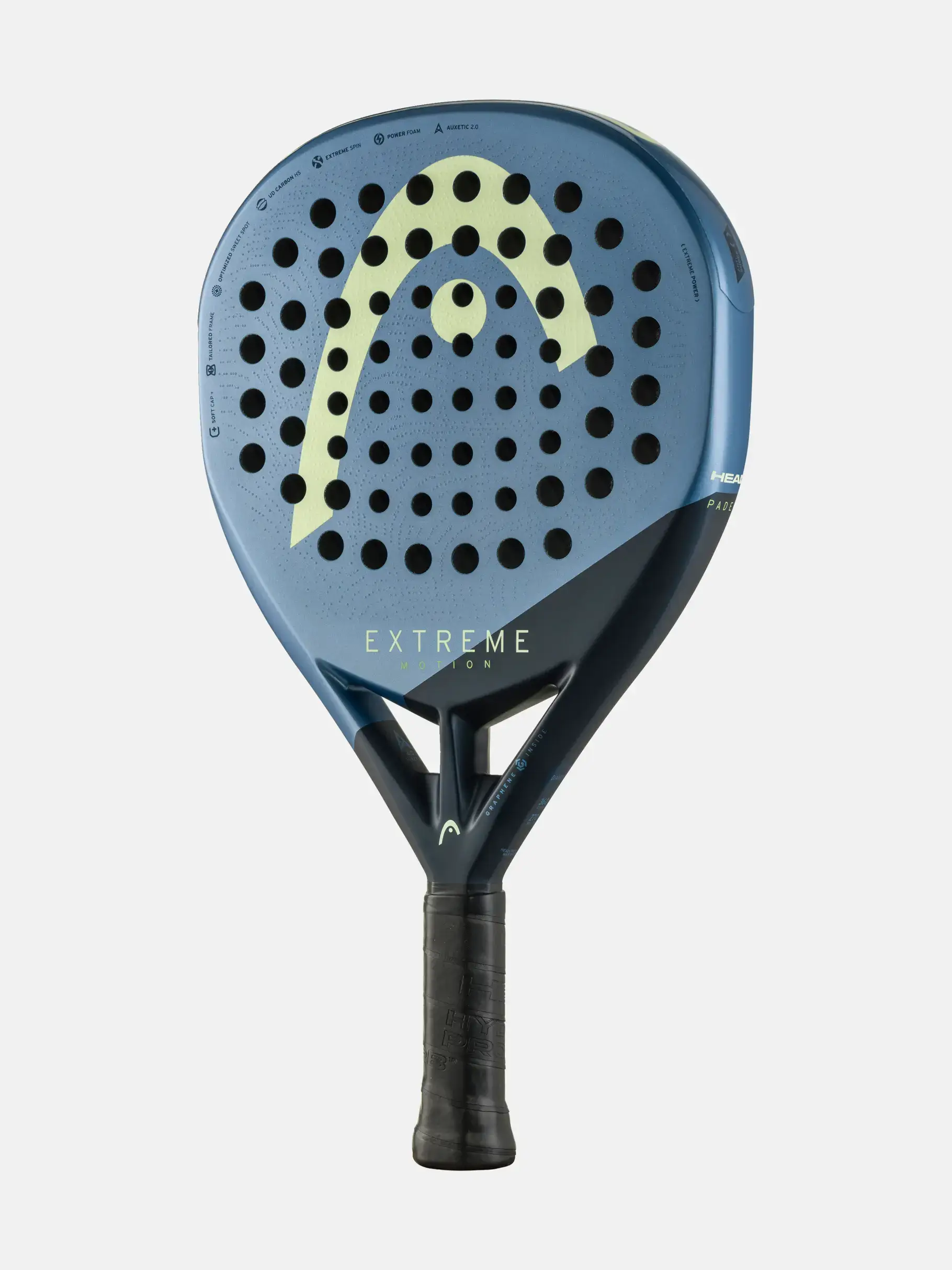
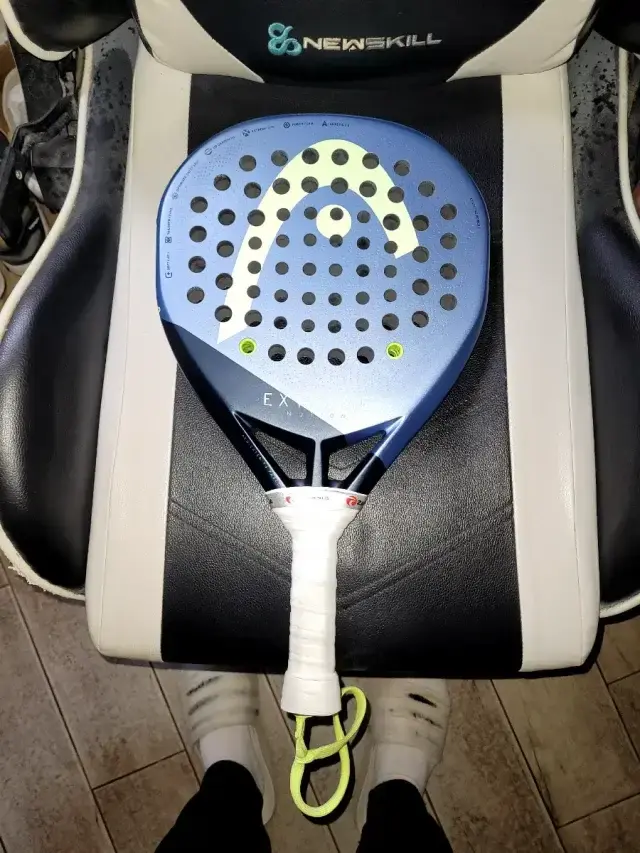
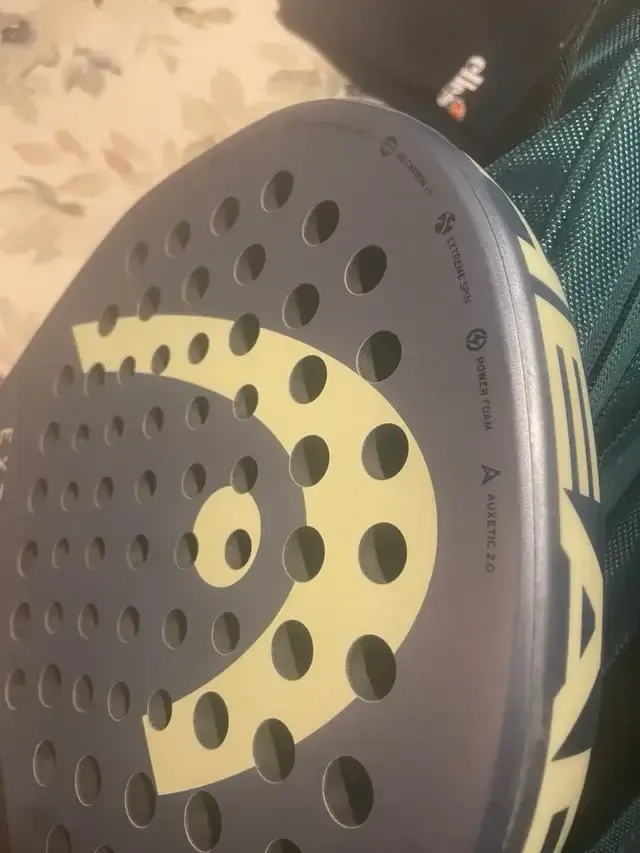
Version and lineup identification
Within the HEAD Extreme family, the Extreme Motion 2026 functions as the bridge between the uncompromising Extreme Pro and the more balanced segments of HEAD’s range, such as Speed and Gravity. While all Extreme models share a diamond geometry and an attacking DNA, Motion is deliberately tuned to reduce inertia and expand real-world usability.
Compared to the Extreme Pro, Motion carries less static mass (around 360 g unstrung) and presents a noticeably lower swing weight despite a similarly high balance point. This translates into faster preparation, easier recovery after overheads, and greater consistency in defensive and transitional phases. Where the Pro rewards early positioning and punishes hesitation, Motion allows players to arrive slightly late and still produce functional depth.
In the broader HEAD lineup, Extreme Motion clearly differentiates itself from Speed Pro, which prioritizes control and point construction, and from Gravity Pro, which focuses on dwell time and tolerance. Motion does not aim to replace those models. Instead, it offers a more aggressive alternative for players who still want maneuverability and match sustainability.
Although some retailers and reviewers label it as a 2025 release, the Extreme Motion has not undergone structural or material changes since its September 2025 launch. From a performance standpoint, it should be considered the official 2026 Extreme Motion, and it is treated as such in this review.
Technical specifications
| Spec | Value | What it means |
|---|---|---|
| Shape | Diamond | High balance, power-oriented |
| Weight | ~360 g (unstrung, without overgrip) | Heavier = more stability, lighter = more speed |
| Balance | ~270 mm (head-heavy) | Affects swing feel and power |
| Head size | 494 cm² | Listed spec to confirm during demo: 494 cm². |
| Frame thickness | 38 mm | Thicker = more power and rebound |
| Face material | Carbon (full carbon construction, not as stiff as Pro tuning) | Stiff, precise and powerful |
| Core | Power Foam | Affects rebound and comfort |
| Surface texture | Extreme Spin (3D rough decal) | Determines feel and response |
| Technology | Auxetic 2.0 | Listed spec to confirm during demo: Auxetic 2.0. |
| Grip system | Soft Cap+ (replaceable safety cord) | Listed spec to confirm during demo: Soft Cap+ (replaceable safety cord). |
| Target player level | Upper-intermediate to advanced | Ideal skill level for this racket |
| Playing style | Attacking all-court with emphasis on speed, net play, and accessible power | Listed spec to confirm during demo: Attacking all-court with emphasis on speed, net play, and accessible power. |
Construction and materials
The HEAD Extreme Motion 2026 shares most of its core construction philosophy with the Extreme Pro, but with a tuning that prioritizes usability over absolute stiffness. The frame is built around a full carbon construction combined with Power Foam, delivering a responsive and energetic rebound without the overly rigid feel associated with the Pro variant.
Auxetic 2.0 plays an important role in how the racket communicates impact. Rather than dramatically softening contact, it improves feedback consistency across the face, helping players distinguish clean hits from marginal ones. This contributes to the more predictable response that reviewers associate with the Motion version.
Power Foam remains the central engine for ball speed. In Motion, it feels slightly less abrupt than in the Pro, allowing for smoother energy transfer on medium and high swing speeds. The Extreme Spin surface adds mechanical grip for topspin and slice shots, supporting aggressive viboras and kick smashes without making the racket feel uncontrollably lively.
The Soft Cap+ system provides basic vibration filtering and safety cord customization. While it does not turn Motion into a comfort-first racket, it reduces harsh feedback enough to make the racket more sustainable over long sessions compared to the Pro.
Shape and mould behavior
The Extreme Motion 2026 uses the same diamond geometry as the Pro, with a high balance point and a sweet spot positioned toward the upper-central portion of the face. However, the mould behavior feels more neutral in motion, largely due to the lower static weight and reduced swing inertia.
The sweet spot is still compact relative to hybrid or teardrop shapes, but it is more usable across a wider vertical range. Upper-face contact remains the most rewarding, especially for overheads, while mid-face contact retains sufficient depth and stability to keep rallies alive when finishing is not immediately possible.
In dynamic play, the mould favors speed-driven offense rather than mass-driven dominance. Fast preparation and acceleration allow players to apply pressure repeatedly without the same physical cost as Extreme Pro. Late contact is still penalized, but not to the same abrupt degree.
Overall, the mould behavior reinforces Motion’s role as an attacking all-court racket: aggressive enough to finish points, yet tolerant enough to handle defensive transitions, fast exchanges, and longer match scenarios.
Stiffness, feel, and comfort
The HEAD Extreme Motion 2026 sits firmly in the medium–firm stiffness range, positioned below the Extreme Pro but clearly above control-oriented models in HEAD’s lineup. Impact response is crisp and direct, yet noticeably less abrupt than the Pro version. This tuning allows the racket to transmit useful feedback without feeling excessively rigid or punishing.
Auxetic 2.0 plays a stabilizing role rather than a softening one. On clean contact, the feel is solid and connected, with a predictable rebound that makes depth control easier at medium and high swing speeds. On marginal contact, the feedback remains readable instead of collapsing into a dull or erratic response, which helps players adjust during rallies.
Comfort is acceptable for an attacking diamond racket. While this is not a comfort-first platform, vibration levels are controlled well enough to sustain long sessions. Compared to Extreme Pro, shoulder and forearm fatigue accumulates more slowly, particularly during extended net exchanges and repeated overheads. Players sensitive to stiffness will still notice the firm character, but it is significantly more manageable than the Pro variant.
Sweet spot and forgiveness
The sweet spot on the Extreme Motion 2026 is clearly wider than on the Extreme Pro, though still compact relative to hybrid or round shapes. It is positioned high on the face, consistent with the diamond geometry, and optimized for overhead play and aggressive net positioning.
Vertical tolerance is improved. Upper-face and mid-face contact both produce usable depth and speed, whereas the Pro version heavily favors only the uppermost contact zone. Lateral forgiveness is moderate: shots drifting toward the sides of the face lose pace and directional precision, but not to the point of immediate point loss.
In practical terms, the Motion offers functional forgiveness rather than comfort-oriented forgiveness. It does not mask technical errors, but it allows slight timing or positioning mistakes to remain playable. This is a key reason why Motion performs better than Pro in defensive transitions and longer rallies.
Power and smash behavior
Power delivery on the Extreme Motion 2026 is best described as accessible rather than extreme. The racket generates strong ball speed without requiring maximum physical commitment, particularly on viboras, flat overheads, and fast attacking volleys.
Power Foam provides a responsive rebound that activates efficiently at medium-to-high swing speeds. Unlike the Extreme Pro, Motion does not rely as heavily on mass to create penetration. Instead, it rewards acceleration and clean mechanics, making it easier to repeat aggressive shots without fatigue.
Smash performance is reliable but not dominant. Flat smashes and kick smashes travel with good speed and height, and por-3 finishes are achievable under favorable conditions. However, the power ceiling is lower than the Pro version, especially on off-center contact or when fatigue sets in. This trade-off is intentional: Motion sacrifices maximum brutality to deliver more repeatable offensive output across an entire match.
Overall, the power profile aligns with Motion’s all-court attacking identity—strong enough to finish points, yet controlled enough to maintain consistency under pressure.
Net performance under pace
At the net, the HEAD Extreme Motion 2026 delivers one of its strongest performances. The reduced static weight and lower swing inertia compared to the Extreme Pro translate into faster preparation and quicker racket head recovery, which are decisive in rapid volley exchanges. Punch volleys come off clean and direct, with enough mass behind the ball to pressure opponents without overcommitting.
In fast counter-volley situations, Motion feels noticeably more agile than the Pro. Blocks and reflex volleys are easier to stabilize, especially when reacting late or when the ball arrives with pace. The diamond shape still favors assertive net positioning, but the racket allows players to stay active and reactive rather than purely anticipatory.
Spin support from the Extreme Spin surface is sufficient to shape aggressive angled volleys and short, dipping finishes. While not a spin-first platform, Motion provides reliable grip to control trajectory during fast exchanges. Overall, net play is where Motion clearly separates itself from heavier power rackets, offering speed-driven control without sacrificing attacking intent.
Off-center stability and torsional resistance
Stability on centered contact is solid, benefiting from the carbon construction and balanced frame tuning. Clean hits resist torsional movement well, maintaining directional integrity even when playing at high pace.
On off-center contact, stability decreases in a controlled and predictable way. Lateral mis-hits reduce pace and precision, but the racket does not collapse abruptly. Compared to the Extreme Pro, Motion retains more usable depth on slightly mistimed shots, particularly in defensive blocks and transition volleys.
Lower-face contact remains the most vulnerable area, as expected with a diamond mould. Shots struck low on the face tend to sit shorter and lose penetration. However, the loss is progressive rather than sudden, which helps players recover and stay in the point. In this sense, Motion offers practical tolerance, not forgiveness in the comfort-oriented sense, but enough stability to remain competitive under pressure.
Practical on-court takeaways
In real match conditions, the HEAD Extreme Motion 2026 rewards active, attacking all-court padel. Players who like to step forward, accelerate through overheads, and control the net will benefit most from its blend of speed and power accessibility.
The racket performs best when used proactively. Fast preparation, early positioning, and continuous movement unlock its strengths, especially in quick exchanges and repeated attacking sequences. Motion also proves more sustainable over long matches than heavier diamond rackets, as it reduces physical strain without neutralizing offensive potential.
Defensively, Motion is capable but not passive. It supports controlled lobs, blocks, and counter-attacks, yet still requires sound technique. Players seeking automatic depth or error-masking forgiveness should look elsewhere. For those who want a diamond-shaped racket that keeps up with the pace of modern padel while remaining playable across full matches, the Extreme Motion 2026 strikes a convincing balance.
Comparison within the Head lineup
Within HEAD’s 2026 range, the Extreme Motion firmly occupies the mid-to-high offensive segment between the pure power Extreme Pro and the more balanced all-court/controlled families like Speed and Gravity. It shares the diamond geometry characteristic of the Extreme series, but differs meaningfully in mass distribution, swing behavior, and on-court tolerance.
Compared to the Extreme Pro 2026, Motion is lighter (~360 g vs ~370 g) and more maneuverable, allowing players to maintain attacking intent without the high inertia penalties of Pro. Motion also exhibits a wider and more forgiving usable sweet spot, which translates into better defensive play and more consistent depth on non-ideal contact. Extreme Pro, on the other hand, clearly dominates in absolute power and overhead finishing authority.
Against Speed Pro 2026, Extreme Motion emphasizes offensive output and speed over all-court control and placement nuance. Speed Pro typically has a more neutral balance, calmer response, and better dwell time for constructive rallies. Motion pushes harder toward attacking pressure while sacrificing some defensive smoothness.
When juxtaposed with Gravity Pro 2026, the contrast widens further: Gravity Pro is engineered for players who favor precision, spin control, and dwell-time responsiveness, while Motion targets players who want accessible power blended with more dynamic handling.
For a same-brand choice, compare HEAD Extreme Motion 2026 Review with HEAD Extreme Pro 2026 Review. The useful test is not the badge or score alone: check whether the alternative changes balance, face response, easy depth or comfort in a way that matches your normal rallies.
Comparison with other brands
When compared to similar attacking rackets from other brands, the Extreme Motion 2026 aims to balance speed, control, and accessible power rather than out-power every opponent or out-forgive errors.
Against Siux Fenix Pro 2026, both rackets are positioned toward the power end of the spectrum, but Fenix Pro often feels sharper and slightly more punishing off-center. Motion’s broader usable sweet spot and lower inertia make it more consistent in dynamic play and defense, while Fenix Pro typically delivers more dramatic acceleration when contact is perfect.
In comparison to Bullpadel Vertex 05 GEO (Pro standard), Motion tends to feel quicker and more maneuverable, especially in fast net exchanges. Vertex 05 models often benefit from a slightly broader sweet spot and a more stable feel on heavy overheads, at the cost of a slower recovery after powerful shots. Motion’s strength is in maintaining pressure across transitions rather than escalating a single power shot to its maximum.
Versus Babolat Air Viper, Extreme Motion holds its own in terms of offensive potential but approaches power differently. Air Viper often provides more free acceleration on medium swings due to its surface texture and balance, whereas Motion’s power feels more controlled and intention-driven. Players who prefer precision in fast exchanges may favor Motion, while those who value elastic response may incline toward Air Viper.
Finally, compared to NOX AT10 Luxury Genius 12K/18K 2026, Motion feels more power-oriented and faster in acceleration, while AT10 models generally prioritize placement precision and predictability across varying swing speeds.
Technical positioning
The HEAD Extreme Motion 2026 is technically positioned as an offensive all-court diamond that prioritizes speed-driven pressure and match sustainability over pure mass-based power. Within HEAD’s portfolio, it deliberately avoids the extremes: it is less punishing and less inertial than Extreme Pro, yet clearly more aggressive and faster than Speed or Gravity models.
From a performance engineering standpoint, Motion converts acceleration and preparation into output rather than relying on static weight. This makes it particularly effective for modern padel patterns—rapid transitions, repeated net engagements, and overheads executed under time pressure. The result is a racket that can maintain offensive intent across an entire match, not just in short finishing sequences.
The trade-off is intentional. Peak power and off-center stability are not pushed to the maximum, but the overall usability window is widened. For players who want a diamond shape that supports aggressive play without narrowing the margin for error too aggressively, Extreme Motion 2026 occupies a well-defined and highly relevant technical niche.
Technical performance score
Ten categories, each 0-10. Methodology →
- Maneuverability and handling8
- Net performance under pace8
- Control and placement precision7
- Defensive output and depth access7
- Off-center stability and torsional resistance7
- Sweet spot usability7.5
- Spin generation potential7
- Power ceiling7.5
- Power accessibility8
- Comfort and impact feedback7
Final verdict — HEAD Extreme Motion scores 74/100. A strong performer with balanced performance across categories, a solid choice for intermediate to advanced players.
Common questions
Yes, significantly. While both rackets share a diamond shape and attacking DNA, the Motion version is lighter (around 360 g unstrung versus ~370 g for Pro) and has a noticeably lower swing weight. In real match conditions this translates into faster preparation, easier recovery after overheads, and less physical fatigue. Players coming from the Extreme Pro often report that Motion allows them to stay aggressive deeper into a match instead of peaking early and fading.
On paper, yes — the balance is still around 270 mm and clearly head-heavy. In play, however, the perceived swing weight is lower than expected. Many players on Reddit describe it as “head-heavy but quick,” meaning the racket carries attacking intent without feeling sluggish in fast exchanges or defensive transitions.
For a diamond-shaped racket, forgiveness is above average. The sweet spot is larger and more usable than on the Extreme Pro, especially vertically. That said, it is still smaller and less tolerant than hybrid or teardrop models like HEAD Speed Pro or NOX AT10. Off-center hits lose pace and precision progressively rather than collapsing instantly, which helps consistency under pressure.
For most intermediates, only if they already play an attacking style and have stable technique. The racket does not automatically generate depth or mask poor contact. Advanced intermediates who feel that Extreme Pro is too demanding often see Motion as a logical step down without abandoning aggressive play.
Compared to Bullpadel Vertex models, Extreme Motion generally feels faster and easier to maneuver, especially at the net, but slightly less dominant on pure overhead power. Against Siux Fenix Pro, Motion offers better usability and match sustainability, while Fenix Pro tends to reward perfect contact with higher peak acceleration but punishes mistakes more harshly.
No meaningful performance differences have been reported. The Extreme Motion was launched in September 2025 and is sometimes labeled as a 2025 model, but the construction, materials, and on-court behavior remain unchanged for the 2026 season. It should be treated as the current 2026 model.
Within the attacking diamond category, yes — relatively. The medium–firm stiffness and Auxetic 2.0 tuning help control vibration, making it more sustainable than Extreme Pro. However, it is not a comfort-oriented racket, and players with arm sensitivity may still prefer softer or more flexible platforms.