Cork Extreme Deus Review
Version and lineup identification
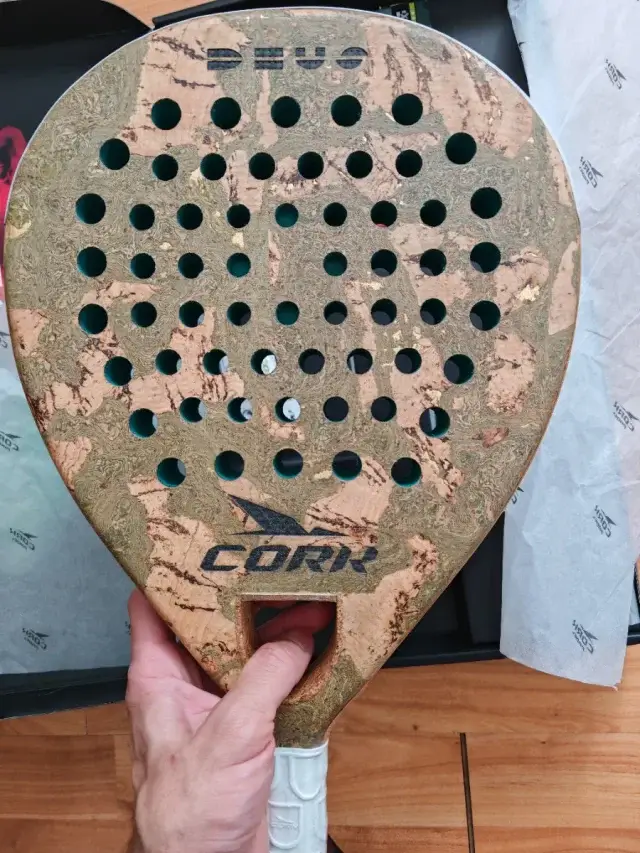
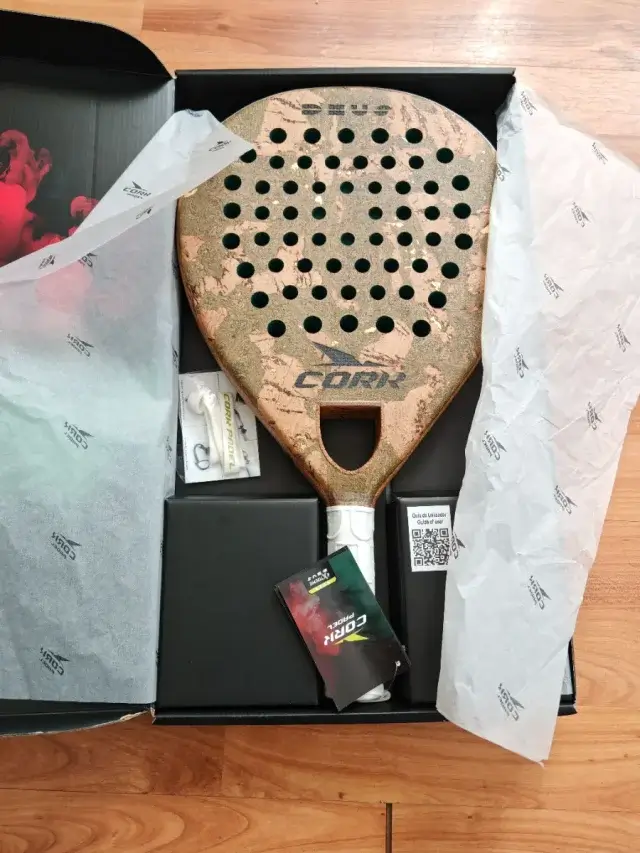
Cork Extreme Deus is a power padel racket for intermediate to advanced players. It scores 77/100 in the padel.how review model, with the rating based on its specification profile and playing characteristics.
In the Cork range, Cork Extreme Deus should be read primarily as a power racket rather than as a neutral all-round frame. The review score is built from the listed construction, weight and balance profile, then cross-checked against the ten padel.how performance categories.
Technical specifications
| Spec | Value | What it means |
|---|---|---|
| Shape | Hybrid / teardrop | Defines sweet-spot position, handling and power bias. |
| Weight | Official selectable ranges: 356-360, 360-365, 366-370, 371-375 g | Affects swing speed, stability and arm fatigue. |
| Face | Full Carbon Flex / 100% carbon structure; rough face | Controls first impact feel, stiffness and rebound response. |
| Core | Extreme high-density rubber/foam | Shapes comfort, vibration filtering and easy depth. |
| Surface | Rough face | Influences spin grip on viboras, bandejas and shaped volleys. |
| Frame | Full Carbon Flex, structurally 100% carbon | Adds structure and resistance to twisting. |
| Handle | replaceable waterproof antibacterial strap; soft oval cap anti-vibration system | Listed spec to confirm during demo: replaceable waterproof antibacterial strap; soft oval cap anti-vibration system. |
| Technologies | Full Carbon Flex, Extreme high-density rubber, multi-diameter drilling, Cork anti-vibration system, replaceable waterproof antibacterial strap, rough face | Brand systems that tune feel, spin, stability or comfort. |
Construction and materials
The specification profile centers on face: Full Carbon Flex / 100% carbon structure; rough face; core: Extreme high-density rubber/foam; frame: Full Carbon Flex, structurally 100% carbon. Its shape, balance and weight place it in the power category, with the listed construction supporting the playing profile described below.
The face is listed as Full Carbon Flex / 100% carbon structure; rough face, while the core is Extreme high-density rubber/foam. That pairing matters because the face controls first impact response and the core controls rebound depth, vibration filtering and how much help the racket gives when the swing is not perfectly loaded.
Shape and mould behavior
The Hybrid / teardrop shape and its listed balance balance define how Cork Extreme Deus behaves before the ball even reaches the strings. A lower or centered balance normally helps hand speed and recovery; a higher balance increases leverage but asks for cleaner preparation.
With a listed weight of Official selectable ranges: 356-360, 360-365, 366-370, 371-375 g, the practical question is not only total mass but swing inertia. Players should test whether the head arrives on time during glass recovery, second volleys and late defensive blocks.
Stiffness, feel, and comfort
The comfort and vibration score is 5.5/10. That places Cork Extreme Deus as a racket that must be judged by impact quality over a full session, not only by the first few clean hits.
Players who like clear feedback should appreciate the directness of the Full Carbon Flex / 100% carbon structure; rough face / Extreme high-density rubber/foam package. Players who want a very soft, muted impact should demo it carefully, especially on cold days or with hard balls.
Sweet spot and forgiveness
The sweet spot and forgiveness score is 8/10. That means the racket has enough usable hitting area for its category, but the exact tolerance depends on how well the player's contact point matches the Hybrid / teardrop mould.
In match play, the key test is low-face and outside-edge contact. A forgiving racket keeps defensive lobs and block volleys playable there; a demanding one loses depth quickly and turns small timing errors into free points for the opponent.
Power and smash behavior
Power ceiling scores 8.5/10. The racket is strongest when the player can accelerate through the ball and use the listed balance and construction instead of asking the core to create easy rebound by itself.
For smashes, viboras and hard bandejas, Cork Extreme Deus rewards clean mechanics more than passive contact. If the swing is late, the power profile will feel narrower than the headline score suggests.
Net performance under pace
Net play scores 7.5/10 and maneuverability scores 7/10. Together, those numbers describe how quickly the racket can be set for blocks, controlled volleys and sudden second contacts.
At the net, the best use case is deliberate pressure: firm blocks, early volleys and controlled redirection. Players who rely on very fast wrist reactions should compare the racket against a lighter or more centered alternative before choosing it.
Off-center stability and torsional resistance
Off-center stability scores 7/10. This is the category that shows whether the frame keeps the face square when contact drifts toward the edge or when the incoming ball is heavy.
The listed construction should be judged under pressure, not only during free hitting. Test Cork Extreme Deus on hard returns, backhand blocks and emergency volleys where the racket has to resist twisting without a perfect swing path.
Practical on-court takeaways
Choose it if you want power performance and the listed specification profile matches your preferred weight, balance and feel.
Avoid it if you prefer a very different balance, softer impact or a more specialized racket profile than this model offers.
During a demo, run three checks: defensive depth from the glass, volley control under pace, and one sequence of overheads when the arm is already tired. Those moments reveal more than a few clean warm-up shots.
Comparison within the Cork lineup
Inside the Cork lineup, Cork Extreme Deus belongs closest to the power branch. Compare it first with nearby Cork models that change only one major variable: balance, face stiffness or core response.
If another Cork racket feels easier but scores lower, the easier racket can still be the better match. The score measures technical potential; the lineup comparison is about how much of that potential a player can use repeatedly.
Comparison with other brands
Against other brands, compare Cork Extreme Deus with rackets that share the same Hybrid / teardrop geometry and similar balance rather than with every model at the same price. Shape and inertia drive more on-court behavior than branding.
The most useful cross-brand comparison is a three-racket test: one softer control option, one more powerful alternative and Cork Extreme Deus. That makes the trade-off between control (9/10), power (8.5/10), comfort (5.5/10) and stability (7/10) visible.
Choose Cork Extreme Deus if you want power performance, can work with the its listed balance balance, and value the score profile led by control and placement precision, power ceiling, power accessibility.
Avoid it if your priority is a much softer impact, maximum free depth on passive defense, or the easiest possible handling in long rallies.
Compare it with one more forgiving racket and one more aggressive racket before buying. That shows whether the total 77/100 score fits your real match pattern or only your preferred shot.
Choose Cork Extreme Deus Review if you want a Hybrid / teardrop racket around Official selectable ranges: 356-360, 360-365, 366-370, 371-375 g, with its listed balance and a 77/100 score profile.
Avoid it if your priority is the opposite feel: a much easier low-balance frame, a softer impact, or maximum free power from passive swings.
Choose Cork Extreme Deus Review if you want a Hybrid / teardrop racket around Official selectable ranges: 356-360, 360-365, 366-370, 371-375 g, with its listed balance and a 77/100 score profile.
Avoid it if your priority is the opposite feel: a much easier low-balance frame, a softer impact, or maximum free power from passive swings.
Technical positioning
Technically, Cork Extreme Deus sits as a power racket with 8/10 spin generation, 8/10 defensive output and 7/10 off-center stability.
The final score of 77/100 is therefore not a simple recommendation for every player. It marks a specific performance envelope: useful when the player profile matches the racket, less useful when comfort, easy lift or hand speed are the real priorities.
Technical performance score
Ten categories, each 0-10. Methodology →
- Maneuverability and handling7
- Net performance under pace7.5
- Control and placement precision9
- Defensive output and depth access8
- Off-center stability and torsional resistance7
- Sweet spot usability8
- Spin generation potential8
- Power ceiling8.5
- Power accessibility8.5
- Comfort and impact feedback5.5
Final verdict — Cork Extreme Deus scores 77/100. Treat it as a specific fit decision: strongest when the player profile matches the racket balance, materials and score pattern, weaker when comfort or easy handling matter more than its headline strengths.
Common questions
Cork Extreme Deus is best for intermediate to advanced players looking for power performance.
Key listed specs include shape: Hybrid / teardrop; weight: Official selectable ranges: 356-360, 360-365, 366-370, 371-375 g; face: Full Carbon Flex / 100% carbon structure; rough face; core: Extreme high-density rubber/foam.
Cork Extreme Deus scores 77/100 in the padel.how review model.