How to Learn Padel Step by Step
When building your learning plan, use Tips that do not help to keep each focus point specific.
Learning padel is less about talent and more about building the right habits in the right order. Many beginners improve slowly not because padel is difficult, but because they try to learn everything at once.
A step-by-step approach makes progress feel natural. If you focus on the right things at each stage, you’ll become more consistent, more confident, and enjoy the game much sooner.
A step-by-step approach makes progress feel natural. If you focus on the right things at each stage, you’ll become more consistent, more confident, and enjoy the game much sooner.
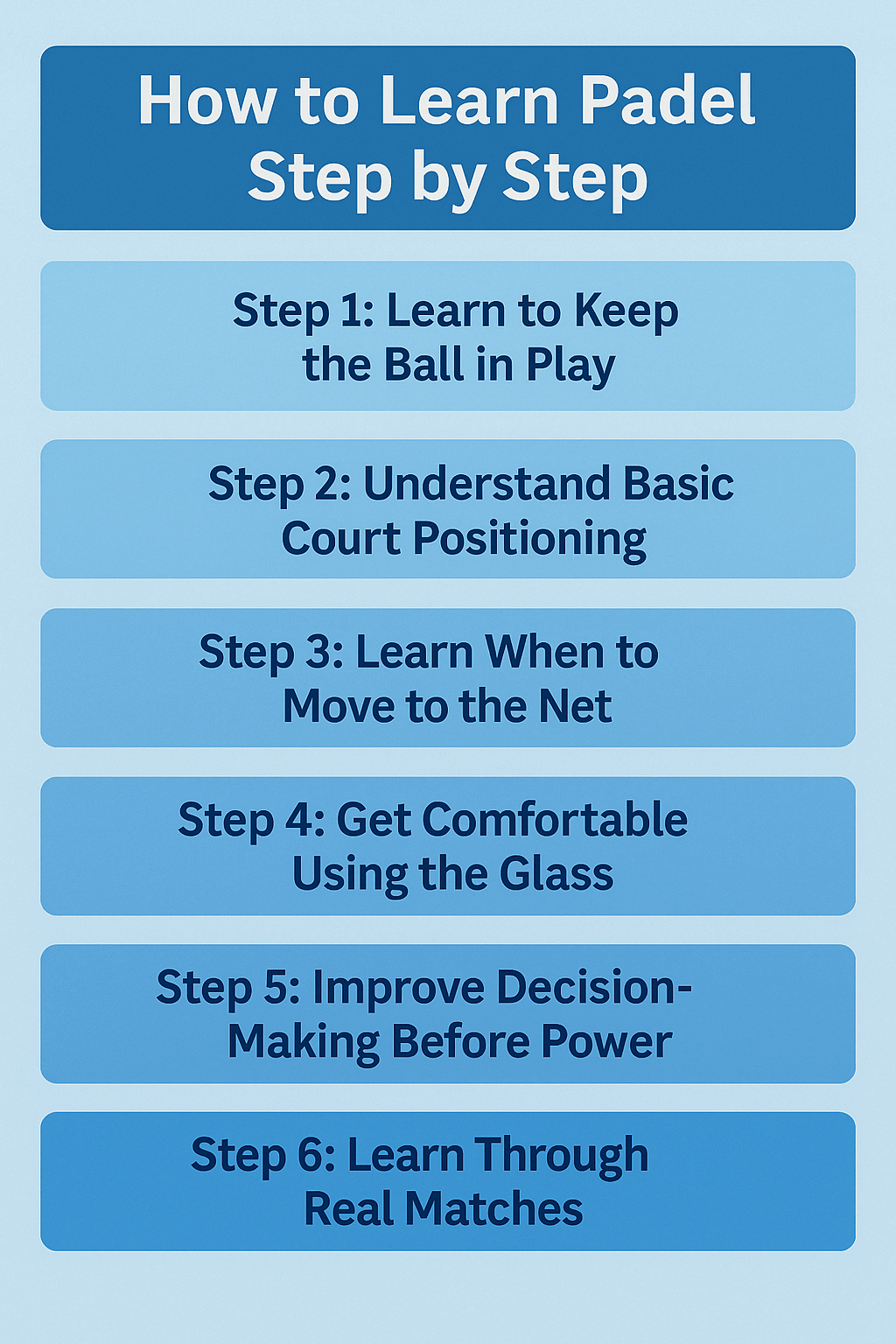
Step 1: Learn to Keep the Ball in Play
The first real skill in padel is not the smash or the volley—it’s consistency. At the beginning, your only goal should be to keep rallies going without rushing the point.
This means hitting higher over the net, aiming through the middle of the court, and accepting slower rallies. If the ball comes off the glass, give yourself time to let it rebound instead of panicking and swinging early.
Most beginners improve fastest when they stop trying to win points and start trying to build them.
This means hitting higher over the net, aiming through the middle of the court, and accepting slower rallies. If the ball comes off the glass, give yourself time to let it rebound instead of panicking and swinging early.
Most beginners improve fastest when they stop trying to win points and start trying to build them.
Step 2: Understand Basic Court Positioning
Once you can sustain a rally, positioning becomes the next priority. In padel, position matters more than shot variety.
From the back of the court, your goal is to stay side by side with your partner and recover to the middle after each shot. At the net, both players should move forward together and retreat together. Being out of sync is one of the biggest reasons beginners lose points quickly.
Good positioning makes the game feel slower and gives you more time to react.
From the back of the court, your goal is to stay side by side with your partner and recover to the middle after each shot. At the net, both players should move forward together and retreat together. Being out of sync is one of the biggest reasons beginners lose points quickly.
Good positioning makes the game feel slower and gives you more time to react.
Step 3: Learn When to Move to the Net
Knowing when to approach the net is a key step in learning padel properly. Moving forward too early usually leads to being lobbed. Moving too late keeps you stuck defending.
A common rule of thumb is to move forward after a good lob, a deep ball that pushes opponents back, or a slow return that gives you time. When you move in, do it calmly and together with your partner.
Net play becomes much easier once you arrive in control rather than sprinting forward.
A common rule of thumb is to move forward after a good lob, a deep ball that pushes opponents back, or a slow return that gives you time. When you move in, do it calmly and together with your partner.
Net play becomes much easier once you arrive in control rather than sprinting forward.
Step 4: Get Comfortable Using the Glass
Many players struggle with padel simply because they avoid the glass. Treating wall rebounds as part of the game, not a mistake, is a major learning milestone.
At first, don’t try to do anything clever. Let the ball bounce, watch how it comes off the glass, and hit it back safely. Over time, you’ll learn how much space to give yourself and how to control the rebound.
Comfort with the glass turns defense into patience instead of panic.
At first, don’t try to do anything clever. Let the ball bounce, watch how it comes off the glass, and hit it back safely. Over time, you’ll learn how much space to give yourself and how to control the rebound.
Comfort with the glass turns defense into patience instead of panic.
Step 5: Improve Decision-Making Before Power
Padel rewards good decisions far more than strong shots. Beginners often swing harder to compensate for poor positioning or late contact, which usually creates more errors.
Instead of asking “Can I hit harder?”, ask “Do I have time?” and “Is my partner in position?”. Choosing the safer shot often keeps you in the point and puts pressure on the opponents.
Power becomes useful only after control and timing are already there.
Instead of asking “Can I hit harder?”, ask “Do I have time?” and “Is my partner in position?”. Choosing the safer shot often keeps you in the point and puts pressure on the opponents.
Power becomes useful only after control and timing are already there.
Step 6: Learn Through Real Matches
Structured drills help, but padel is learned fastest through real match situations. Matches force you to read the score, manage pressure, and adapt to different opponents.
Early on, treat matches as learning sessions. Experiment with lobs, focus on positioning, and accept mistakes as part of the process. Playing regularly, even short matches, accelerates learning more than occasional long practice sessions.
Early on, treat matches as learning sessions. Experiment with lobs, focus on positioning, and accept mistakes as part of the process. Playing regularly, even short matches, accelerates learning more than occasional long practice sessions.
Common Mistakes When Learning Padel
A typical mistake is trying to copy advanced players too early. Smashes, aggressive volleys, and tricky shots look attractive but often slow down learning.
Another common issue is ignoring communication with your partner. Simple signals, short calls, and checking positioning between points make a big difference and prevent confusion.
Learning padel works best when patience comes before ambition.
Another common issue is ignoring communication with your partner. Simple signals, short calls, and checking positioning between points make a big difference and prevent confusion.
Learning padel works best when patience comes before ambition.
How to Apply This Step-by-Step Approach
For your next sessions, pick just one step to focus on. One day it might be consistency, another day positioning, and another day using the glass. Keeping the focus narrow makes improvement visible and motivating.
Over a few weeks, these steps naturally combine. The game starts to feel calmer, rallies get longer, and decisions become clearer without conscious effort.
Over a few weeks, these steps naturally combine. The game starts to feel calmer, rallies get longer, and decisions become clearer without conscious effort.
FAQ
Most players feel comfortable after a few weeks, but real confidence usually comes after consistent play over several months.
Lessons can help, especially early on, but regular play and focused practice are just as important.
Many beginners find padel easier to start because of the smaller court and wall rebounds, but both sports require time to master.
Two to three sessions per week is enough for steady improvement if you play consistently.
Control, positioning, and understanding the court should come before power or advanced shots.
For a practical skill map, read padel levels explained.
For the learning curve, see is padel hard to learn?.