How to Choose Padel Balls
For a complete first-kit budget, see the under-$150 starter set guide. Padel starter set under $150.
Padel balls look simple at first glance, but they play a much bigger role in how the game feels than many players expect. The right ball affects rally length, control, smash effectiveness, and even how fast you improve. For beginners, the wrong ball can make padel feel chaotic. For experienced players, it can completely change timing and decision-making.
What Makes a Padel Ball Different from a Tennis Ball
Padel and tennis use balls that look similar, but they behave differently for a reason: padel balls are designed to keep rallies controllable in a smaller court with walls. The biggest measurable difference is internal pressure. In practice, padel balls typically sit around ~0.6–0.8 bar, while tennis balls are commonly around ~1.8–2.0 bar. That’s not a tiny difference — it’s roughly 2.5–3× more pressure in a tennis ball, which explains why tennis balls “jump” off the surface and feel more explosive.
Bounce data makes this easier to understand. In an independent lab-style comparison of padel balls (drop height / test method shown in the table), several models landed in the ~141–153 cm range on a standardized bounce test. For example, some balls in the table show bounce values like 141 cm, 142 cm, 145 cm, 150 cm, 153 cm. Even a 10–12 cm difference matters in padel because it affects whether you can play a controlled volley, take the ball after the glass, or whether the ball pops up into an uncomfortable height that forces a panic swing.
The second practical difference is how the ball behaves after contact with the racket and walls. With lower pressure, padel balls tend to give you a more predictable rebound off glass and allow you to “work” the point with lobs, chiquitas and controlled volleys instead of turning every rally into a reaction test. Tennis balls can be used in an emergency, but in real padel conditions they usually produce: higher bounce, faster pace, and more rushed decision-making — especially noticeable on defensive shots and after the glass.
Bounce data makes this easier to understand. In an independent lab-style comparison of padel balls (drop height / test method shown in the table), several models landed in the ~141–153 cm range on a standardized bounce test. For example, some balls in the table show bounce values like 141 cm, 142 cm, 145 cm, 150 cm, 153 cm. Even a 10–12 cm difference matters in padel because it affects whether you can play a controlled volley, take the ball after the glass, or whether the ball pops up into an uncomfortable height that forces a panic swing.
The second practical difference is how the ball behaves after contact with the racket and walls. With lower pressure, padel balls tend to give you a more predictable rebound off glass and allow you to “work” the point with lobs, chiquitas and controlled volleys instead of turning every rally into a reaction test. Tennis balls can be used in an emergency, but in real padel conditions they usually produce: higher bounce, faster pace, and more rushed decision-making — especially noticeable on defensive shots and after the glass.
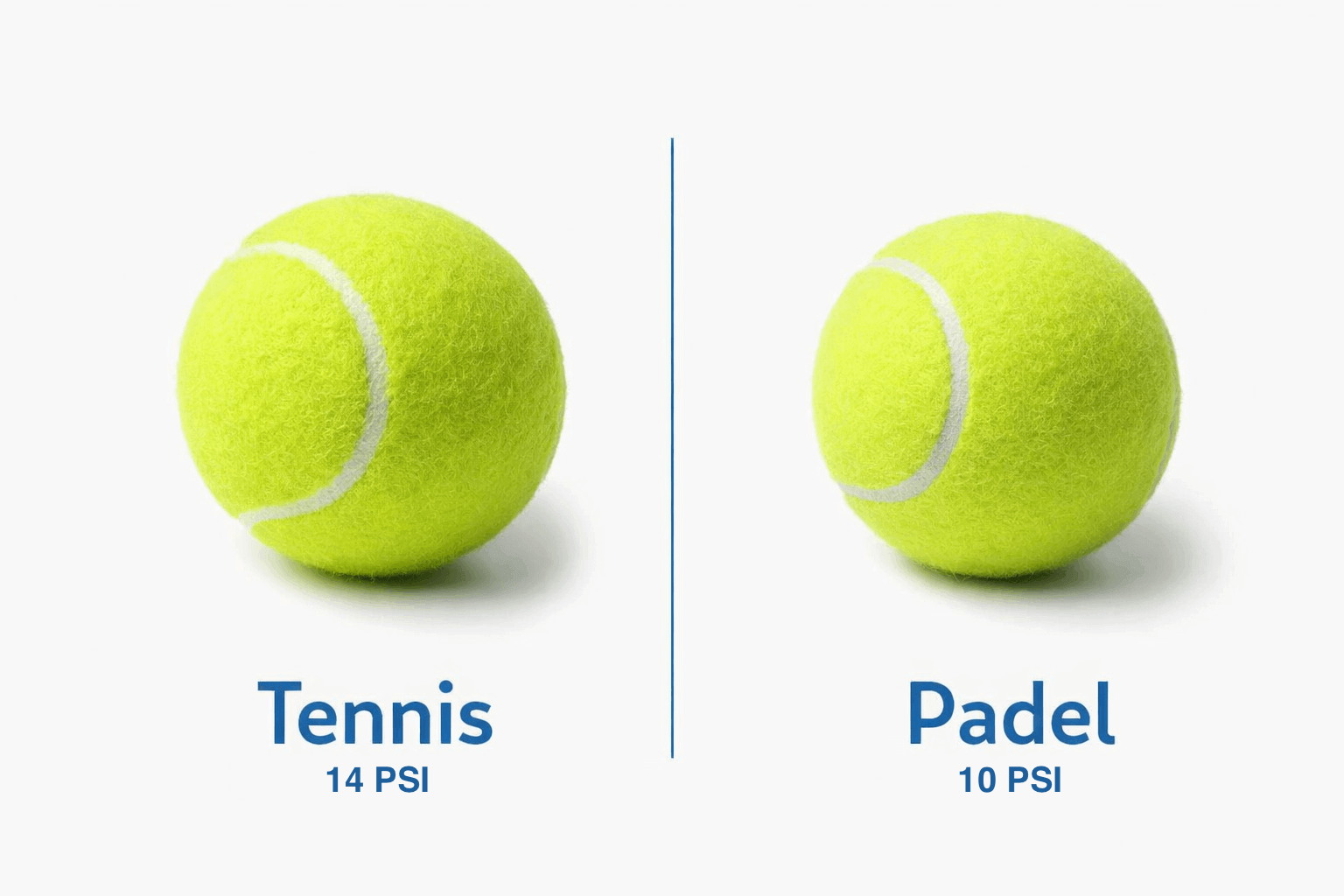
Ball Pressure: Regular vs Fast Padel Balls
Most brands sell at least two categories: standard/regular and “fast” padel balls. The difference is not magic — it’s mostly pressure and how the ball keeps that pressure during play.
A “fast” ball generally gives you:
That can be useful on slower courts (cold indoor courts, heavy turf, humid conditions) where the ball feels sluggish. But on a warm day, a fast ball can make padel feel chaotic, especially at intermediate and below: rallies shorten, defensive blocks float up, and players start swinging harder to compensate.
A regular ball is usually the better baseline choice because it keeps the game readable. In practice: regular balls give you longer rallies and better learning feedback. If you’re still building consistency, timing, and glass defense, you’re better off picking predictability over speed — the “fast” option often increases unforced errors without actually improving your padel.
A “fast” ball generally gives you:
- a higher, livelier bounce,
- a slightly quicker ball through the air,
- and more “reward” for aggressive overheads.
That can be useful on slower courts (cold indoor courts, heavy turf, humid conditions) where the ball feels sluggish. But on a warm day, a fast ball can make padel feel chaotic, especially at intermediate and below: rallies shorten, defensive blocks float up, and players start swinging harder to compensate.
A regular ball is usually the better baseline choice because it keeps the game readable. In practice: regular balls give you longer rallies and better learning feedback. If you’re still building consistency, timing, and glass defense, you’re better off picking predictability over speed — the “fast” option often increases unforced errors without actually improving your padel.
How Long Do Padel Balls Last?
For recreational players, it helps to think in matches, not “days”.
A realistic baseline without a pressurizer is:
That’s not because the felt suddenly disappears. It’s because pressure drops and compression behavior changes. The table you shared is useful here because it shows how balls change after heavy use. In the lab test results, some balls show far better overall durability scores than others — for example, the “overall grade quality and durability” row ranges from 9.2 (best in test) down to 5.9 (lowest in the table). That spread matters because it means some balls keep their characteristics far longer, while others lose bounce/feel quickly even if they felt great straight out of the can.
If you want a simple “court test” to decide whether balls are still good: play two lobs from the same spot with the same swing. If you suddenly need to swing harder to get the same depth, or the ball stops kicking up off the turf the way it did earlier, pressure is already gone enough to change the game.
A realistic baseline without a pressurizer is:
- 1 match: ball feels freshest (highest bounce and speed it will have)
- 2–3 matches: still very playable for most clubs
- 4 matches: many players start noticing the ball feels heavier/flatter
- 5+ matches: usually only acceptable for casual training, not for “proper” match feel
That’s not because the felt suddenly disappears. It’s because pressure drops and compression behavior changes. The table you shared is useful here because it shows how balls change after heavy use. In the lab test results, some balls show far better overall durability scores than others — for example, the “overall grade quality and durability” row ranges from 9.2 (best in test) down to 5.9 (lowest in the table). That spread matters because it means some balls keep their characteristics far longer, while others lose bounce/feel quickly even if they felt great straight out of the can.
If you want a simple “court test” to decide whether balls are still good: play two lobs from the same spot with the same swing. If you suddenly need to swing harder to get the same depth, or the ball stops kicking up off the turf the way it did earlier, pressure is already gone enough to change the game.
Can You Extend Ball Life with a Ball Pressurizer?
Yes — and the mechanism is straightforward.
A pressurizer doesn’t “pump air into the ball.” Instead, it raises the external pressure around the ball so the ball doesn’t bleed pressure between sessions. The biggest benefit is consistency: you stop starting every session with new balls and then quickly switching to flat balls mid-week.
In real-world use, a good routine is:
With that routine, many club players extend balls from “2–4 match life” to something closer to 6–10 matches depending on how hard they play and what ball they use. The key is timing: if you wait until balls already feel dead, the pressurizer can’t reverse the change — it can only slow further loss.
One practical recommendation for the article: we can describe the pressurizer as a “budget stabilizer.” If you train weekly, it saves money, but more importantly it keeps your training feedback stable — which is exactly what most recreational players actually need.
A pressurizer doesn’t “pump air into the ball.” Instead, it raises the external pressure around the ball so the ball doesn’t bleed pressure between sessions. The biggest benefit is consistency: you stop starting every session with new balls and then quickly switching to flat balls mid-week.
In real-world use, a good routine is:
- put balls into the pressurizer immediately after play (don’t leave them loose overnight),
- keep them sealed until next session.
With that routine, many club players extend balls from “2–4 match life” to something closer to 6–10 matches depending on how hard they play and what ball they use. The key is timing: if you wait until balls already feel dead, the pressurizer can’t reverse the change — it can only slow further loss.
One practical recommendation for the article: we can describe the pressurizer as a “budget stabilizer.” If you train weekly, it saves money, but more importantly it keeps your training feedback stable — which is exactly what most recreational players actually need.
Which Balls Are Best for Beginners?
Beginners should not chase “pro” labels. The best beginner ball is the one that stays predictable and doesn’t force panic swings.
A useful way to frame this with numbers is durability/consistency. Your table shows large differences in “overall grade quality and durability” across common balls used for recreational training — from 9.2, to 8.4, then down through 7.x, 6.x, and 5.9. That matters more for beginners than tiny differences in initial speed. If your ball becomes inconsistent after a short time, you learn the wrong timing and you end up swinging harder, which increases injury risk.
Also, beginners typically benefit from balls that aren’t overly fast. When the ball is too lively, new players do three things automatically: they grip tighter, swing late, and rush to the net at the wrong time. A slightly calmer, more durable ball gives them time to read bounces, understand positioning, and build basic control. That’s why “durability + predictable bounce” beats “fast and exciting” for most people learning padel.
A useful way to frame this with numbers is durability/consistency. Your table shows large differences in “overall grade quality and durability” across common balls used for recreational training — from 9.2, to 8.4, then down through 7.x, 6.x, and 5.9. That matters more for beginners than tiny differences in initial speed. If your ball becomes inconsistent after a short time, you learn the wrong timing and you end up swinging harder, which increases injury risk.
Also, beginners typically benefit from balls that aren’t overly fast. When the ball is too lively, new players do three things automatically: they grip tighter, swing late, and rush to the net at the wrong time. A slightly calmer, more durable ball gives them time to read bounces, understand positioning, and build basic control. That’s why “durability + predictable bounce” beats “fast and exciting” for most people learning padel.
Playing Conditions That Affect Ball Choice
Climate and court conditions strongly influence how padel balls behave.
Warm temperatures and dry air make balls faster. Cold weather and indoor courts slow them down. Artificial turf with more sand reduces bounce and grip differently compared to cleaner surfaces.
If padel feels uncontrollably fast, switching to regular-pressure balls often solves the issue instantly. If rallies feel sluggish and lobs die early, a faster ball can bring the game back to balance.
Matching the ball to the environment is more important than matching it to marketing labels.
Warm temperatures and dry air make balls faster. Cold weather and indoor courts slow them down. Artificial turf with more sand reduces bounce and grip differently compared to cleaner surfaces.
If padel feels uncontrollably fast, switching to regular-pressure balls often solves the issue instantly. If rallies feel sluggish and lobs die early, a faster ball can bring the game back to balance.
Matching the ball to the environment is more important than matching it to marketing labels.
Common Mistakes When Choosing Padel Balls
Many players focus on branding rather than behavior. Buying the same ball professionals use does not guarantee better play — in fact, it often creates worse conditions for amateurs.
Another mistake is waiting too long to replace or pressurize balls. Once pressure is lost, technique suffers, timing breaks down, and injuries become more likely due to over-hitting.
Finally, mixing tennis balls and padel balls during training creates inconsistent feedback and slows learning, especially when practicing wall play.
Another mistake is waiting too long to replace or pressurize balls. Once pressure is lost, technique suffers, timing breaks down, and injuries become more likely due to over-hitting.
Finally, mixing tennis balls and padel balls during training creates inconsistent feedback and slows learning, especially when practicing wall play.
FAQ
Padel balls typically contain around 0.6–0.8 bar of internal pressure. This is significantly lower than tennis balls, which are usually around 1.8–2.0 bar, and explains the lower bounce and more controlled pace in padel.
For recreational play, padel balls usually stay playable for 2–4 matches without a pressurizer. With consistent use of a ball pressurizer after each session, many players extend usability to 6–10 matches, depending on playing intensity and ball quality.
You can, but it is not recommended. Tennis balls have much higher pressure, resulting in higher bounce and faster pace, which breaks padel’s rhythm and makes glass play and defense harder to learn correctly.
Price does not guarantee durability. Some mid-range balls outperform premium models in pressure retention and consistency.
Yes. “Fast” padel balls usually have slightly higher initial pressure and livelier bounce, making them suitable for cold or slow courts. Regular balls are more predictable and generally better for learning and club play.
Yes, but they do not restore dead balls. A pressurizer helps slow down pressure loss between sessions. To be effective, balls must be placed inside immediately after play, before they lose most of their pressure.
Beginners benefit most from balls with stable bounce and high durability, rather than maximum speed. Balls that maintain consistent characteristics over several matches help reduce rushed swings and improve timing.
For sport-by-sport differences, see padel balls vs tennis balls and the ball pressurizer guide.