How to Choose a Padel Racket
If this is your first purchase, read Beginner racket mistakes before you compare shapes, balance and feel.
For a tighter first-purchase plan, see the under-$150 padel starter set guide before choosing a racket. Padel starter set under $150.
Choosing a padel racket is not about buying the newest model or copying what pros use. For most players—especially beginners—the best racket is the one that feels comfortable, protects your arm and shoulder, and helps you build control. This guide explains how padel rackets work, what shapes and materials actually change on court, and how to choose the right level of complexity as you improve.
Start with Your Level, Not the Brand
The biggest mistake beginners make is treating a padel racket like a status symbol. In reality, your first racket is a learning tool. The goal is not to “unlock power” or buy something that looks professional. The goal is to find a racket that lets you practice technique without punishing your body.
A beginner does not need an expensive or demanding racket. In the early stage, you are learning timing, spacing, compact swings, and basic control near the glass. If the racket is too stiff, too heavy, or too head-heavy, it increases vibration and workload on the wrist, elbow, and shoulder. That can lead to pain or injury long before your technique is stable enough to justify a performance racket.
As you progress, the “best racket” changes. When you start understanding your role on court, you can move to a racket that supports how you play. Many teams naturally develop a split: the left-side player (in a right-handed pair) often takes more overheads and finishes points, while the right-side player tends to build and control rallies. That does not mean left side always needs a sledgehammer and right side must use a pillow. It means that once your fundamentals are solid, your racket choice can start matching your patterns. At higher intermediate and advanced levels, players sometimes choose stiffer and more aggressive rackets—because they can handle them physically and technically.
For a beginner, buying a heavy, stiff racket is often the fastest way to develop arm and shoulder problems. It’s not that those rackets are “bad.” They are simply built for players who can generate speed efficiently, contact the ball cleanly, and manage the load over long matches.
A beginner does not need an expensive or demanding racket. In the early stage, you are learning timing, spacing, compact swings, and basic control near the glass. If the racket is too stiff, too heavy, or too head-heavy, it increases vibration and workload on the wrist, elbow, and shoulder. That can lead to pain or injury long before your technique is stable enough to justify a performance racket.
As you progress, the “best racket” changes. When you start understanding your role on court, you can move to a racket that supports how you play. Many teams naturally develop a split: the left-side player (in a right-handed pair) often takes more overheads and finishes points, while the right-side player tends to build and control rallies. That does not mean left side always needs a sledgehammer and right side must use a pillow. It means that once your fundamentals are solid, your racket choice can start matching your patterns. At higher intermediate and advanced levels, players sometimes choose stiffer and more aggressive rackets—because they can handle them physically and technically.
For a beginner, buying a heavy, stiff racket is often the fastest way to develop arm and shoulder problems. It’s not that those rackets are “bad.” They are simply built for players who can generate speed efficiently, contact the ball cleanly, and manage the load over long matches.
Racket Shape: Why Round Is Easier Than Diamond
Padel rackets usually come in three main shapes: round, teardrop (sometimes called hybrid), and diamond. Shape is not a cosmetic detail. It changes where the racket is forgiving, how it accelerates, and how easy it is to control the ball under pressure.
A round racket is generally the easiest for beginners because it has a larger effective hitting area—what players call the sweet spot. With a bigger sweet spot, small mistakes in timing or contact position are less costly. That matters a lot in padel because beginners hit many balls slightly late, slightly off-center, or while moving awkwardly near the glass. Round rackets also tend to have a lower balance, meaning the weight sits closer to the handle. This makes the racket easier to maneuver, especially at the net and in defensive reactions.
A teardrop shape sits in the middle. The sweet spot shifts slightly upward compared to a round racket. Many players like teardrop rackets because they feel more “alive” and offer a bit more punch without becoming difficult. Teardrop is often a good step once you feel you can control your swing and consistently find the center of the racket. It can be a realistic second racket for a player who has learned basic control and wants a bit more performance.
A diamond shape is the most demanding. The sweet spot is smaller and higher, and the balance is typically higher too, meaning more weight in the head. This can help generate power on overheads, but it makes the racket slower to maneuver and harder on the arm. In padel, slow maneuverability is not a small issue—it affects volleys, quick exchanges at the net, and defensive reactions off the glass. Diamond rackets are designed for aggressive players who can consistently contact the ball cleanly, especially above shoulder height. Many strong left-side players prefer this style because their role often includes finishing points with overheads and applying pressure.
The trap is that beginners see diamond rackets marketed as “power” and assume power equals improvement. In practice, power without control increases errors and increases stress on the body. If you are still learning how to use the glass, how to keep volleys compact, and how to build points patiently, a round racket makes improvement faster—not slower—because it keeps the game manageable.
A round racket is generally the easiest for beginners because it has a larger effective hitting area—what players call the sweet spot. With a bigger sweet spot, small mistakes in timing or contact position are less costly. That matters a lot in padel because beginners hit many balls slightly late, slightly off-center, or while moving awkwardly near the glass. Round rackets also tend to have a lower balance, meaning the weight sits closer to the handle. This makes the racket easier to maneuver, especially at the net and in defensive reactions.
A teardrop shape sits in the middle. The sweet spot shifts slightly upward compared to a round racket. Many players like teardrop rackets because they feel more “alive” and offer a bit more punch without becoming difficult. Teardrop is often a good step once you feel you can control your swing and consistently find the center of the racket. It can be a realistic second racket for a player who has learned basic control and wants a bit more performance.
A diamond shape is the most demanding. The sweet spot is smaller and higher, and the balance is typically higher too, meaning more weight in the head. This can help generate power on overheads, but it makes the racket slower to maneuver and harder on the arm. In padel, slow maneuverability is not a small issue—it affects volleys, quick exchanges at the net, and defensive reactions off the glass. Diamond rackets are designed for aggressive players who can consistently contact the ball cleanly, especially above shoulder height. Many strong left-side players prefer this style because their role often includes finishing points with overheads and applying pressure.
The trap is that beginners see diamond rackets marketed as “power” and assume power equals improvement. In practice, power without control increases errors and increases stress on the body. If you are still learning how to use the glass, how to keep volleys compact, and how to build points patiently, a round racket makes improvement faster—not slower—because it keeps the game manageable.
Balance and Weight
Many players obsess over weight, but balance is often the bigger story. Two rackets can weigh the same, yet one feels easy and the other feels like a hammer. That difference is usually balance.
Balance describes where the racket “wants” to rest. A lower balance means the weight sits closer to your hand. The racket feels quick, maneuverable, and less tiring in fast exchanges. A higher balance means the weight shifts toward the head. This can add punch, but it also increases the load on your forearm and shoulder, especially when you swing repeatedly or when you play overheads.
If you are choosing your first racket, prioritize lower or medium balance. It will feel calmer at the net, easier in defense, and more forgiving when you are late. High balance makes sense only once you have stable preparation and a body that can handle repeated overhead work without discomfort.
Weight still matters, but it should be viewed through comfort and repeatability. A racket that feels great for five minutes can feel heavy after an hour of volleys, lobs, and overheads. Beginners often underestimate fatigue, and fatigue is what makes technique fall apart.
There is no perfect number, but typical ranges help as a starting point. Many adult players end up somewhere around the mid- to high-300 gram range. Lighter rackets are easier on the arm and often better for control, but if a racket is too light for your swing, it can feel unstable on contact. Heavier rackets can feel solid and powerful, but they punish late contact and increase strain. What you want is the heaviest racket you can swing comfortably for a full session without feeling your shoulder and forearm tighten.
A practical way to think about it: if your racket starts feeling “slow” in quick volley exchanges or you feel tension building in your forearm, it’s likely too head-heavy or too heavy for you right now. That doesn’t mean you are weak—it means your current stage of technique and conditioning doesn’t match that racket.
Balance describes where the racket “wants” to rest. A lower balance means the weight sits closer to your hand. The racket feels quick, maneuverable, and less tiring in fast exchanges. A higher balance means the weight shifts toward the head. This can add punch, but it also increases the load on your forearm and shoulder, especially when you swing repeatedly or when you play overheads.
If you are choosing your first racket, prioritize lower or medium balance. It will feel calmer at the net, easier in defense, and more forgiving when you are late. High balance makes sense only once you have stable preparation and a body that can handle repeated overhead work without discomfort.
Weight still matters, but it should be viewed through comfort and repeatability. A racket that feels great for five minutes can feel heavy after an hour of volleys, lobs, and overheads. Beginners often underestimate fatigue, and fatigue is what makes technique fall apart.
There is no perfect number, but typical ranges help as a starting point. Many adult players end up somewhere around the mid- to high-300 gram range. Lighter rackets are easier on the arm and often better for control, but if a racket is too light for your swing, it can feel unstable on contact. Heavier rackets can feel solid and powerful, but they punish late contact and increase strain. What you want is the heaviest racket you can swing comfortably for a full session without feeling your shoulder and forearm tighten.
A practical way to think about it: if your racket starts feeling “slow” in quick volley exchanges or you feel tension building in your forearm, it’s likely too head-heavy or too heavy for you right now. That doesn’t mean you are weak—it means your current stage of technique and conditioning doesn’t match that racket.
What a Padel Racket Is Made Of
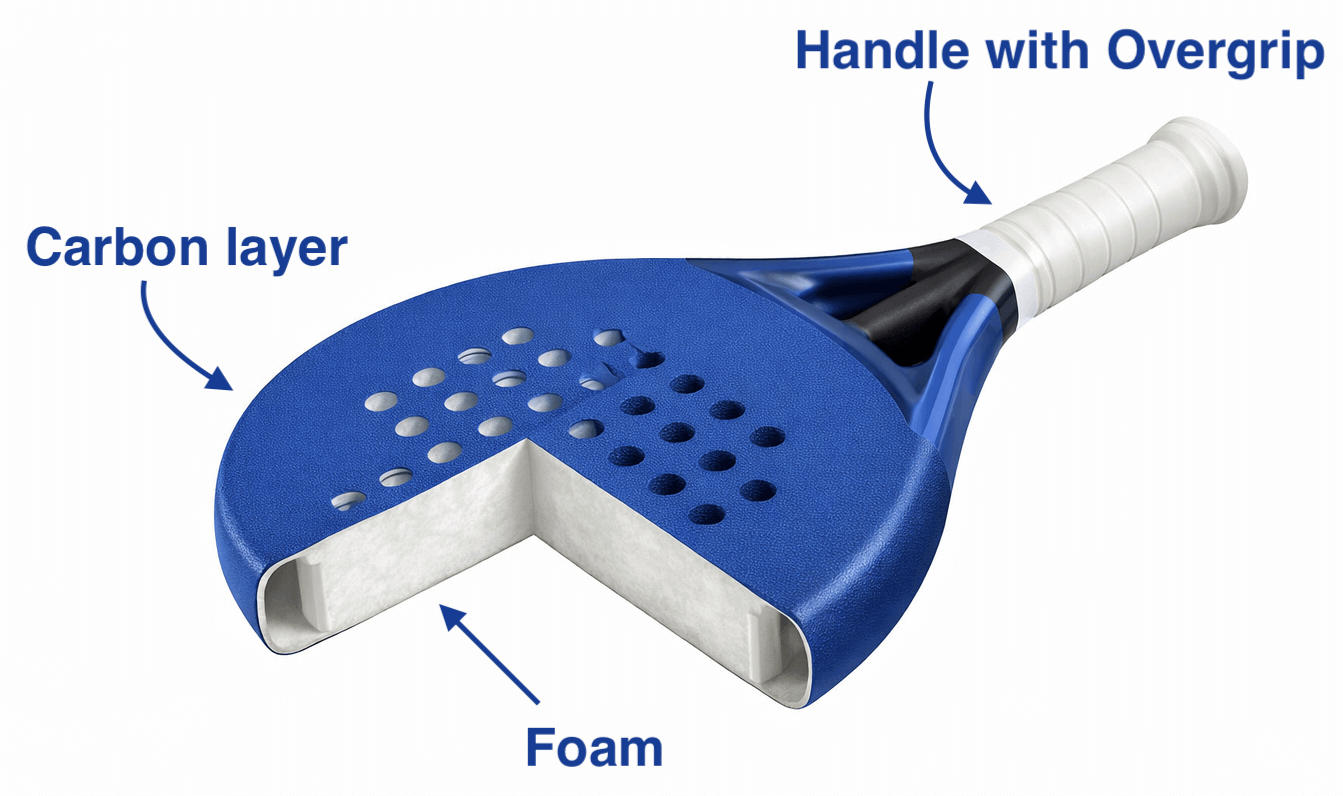
A padel racket has three major components that define how it feels: the core (foam), the face material, and the frame structure. You do not need to be an engineer to choose well, but you do need to understand what actually changes when brands throw around marketing terms.
The core is usually some form of EVA foam, available in softer and harder versions. A softer core tends to feel more comfortable. It absorbs impact, reduces vibration, and makes control easier because the ball sits on the face slightly longer. Many beginners feel immediate confidence with softer rackets because they don’t feel punished for imperfect contact.
A harder core returns more energy. It can feel faster and more direct, but it also requires cleaner technique. If you contact the ball late or off-center, a hard core can feel harsh. That harshness is not just “feel.” It’s more stress transmitted into the arm.
The face material is often fiberglass or carbon. Fiberglass is generally more flexible and forgiving. It often feels softer and easier to control. Carbon faces are stiffer, and stiffness increases with higher “K” weaves in many models, though marketing can be confusing. In practical terms, carbon tends to feel more crisp and powerful, but less forgiving. A stiff carbon face on top of a hard core is usually the most demanding combination. That might be perfect for a high-level player who hits cleanly and wants a fast response, but it is often a poor choice for beginners.
The frame also matters. Some rackets are designed to be more rigid, others to absorb impact better. The more rigid the frame, the more direct the response—again, good for performance, demanding for comfort. When you combine high balance, heavy weight, hard foam, and stiff face, you get a racket that can be great in the right hands and painful in the wrong ones.
If you are a beginner or early intermediate, it is usually smarter to choose a racket that reduces vibration and encourages control. You can always move toward stiffness later. The reverse path—recovering from arm pain caused by an overly demanding racket—slows progress dramatically.
The core is usually some form of EVA foam, available in softer and harder versions. A softer core tends to feel more comfortable. It absorbs impact, reduces vibration, and makes control easier because the ball sits on the face slightly longer. Many beginners feel immediate confidence with softer rackets because they don’t feel punished for imperfect contact.
A harder core returns more energy. It can feel faster and more direct, but it also requires cleaner technique. If you contact the ball late or off-center, a hard core can feel harsh. That harshness is not just “feel.” It’s more stress transmitted into the arm.
The face material is often fiberglass or carbon. Fiberglass is generally more flexible and forgiving. It often feels softer and easier to control. Carbon faces are stiffer, and stiffness increases with higher “K” weaves in many models, though marketing can be confusing. In practical terms, carbon tends to feel more crisp and powerful, but less forgiving. A stiff carbon face on top of a hard core is usually the most demanding combination. That might be perfect for a high-level player who hits cleanly and wants a fast response, but it is often a poor choice for beginners.
The frame also matters. Some rackets are designed to be more rigid, others to absorb impact better. The more rigid the frame, the more direct the response—again, good for performance, demanding for comfort. When you combine high balance, heavy weight, hard foam, and stiff face, you get a racket that can be great in the right hands and painful in the wrong ones.
If you are a beginner or early intermediate, it is usually smarter to choose a racket that reduces vibration and encourages control. You can always move toward stiffness later. The reverse path—recovering from arm pain caused by an overly demanding racket—slows progress dramatically.
The Injury Risk: Why Beginners Should Avoid Heavy, Stiff Rackets
Padel looks gentle compared to tennis, but the injury profile can surprise new players. Many issues are not caused by one dramatic moment. They come from repeated micro-stress: late contact, awkward volleys, rushed overheads, and thousands of small impacts.
A stiff racket transmits more vibration. A head-heavy racket increases leverage against your arm. A heavy racket increases overall workload. Combine those with beginner technique—often late, often tense—and you create the perfect recipe for elbow discomfort, forearm tightness, and shoulder irritation.
The tricky part is that beginners often don’t feel it immediately. The first few sessions might feel fine. Then you play more, your technique is still forming, and suddenly the discomfort appears. At that stage, people often try to “push through,” which is exactly what makes it worse.
Your first racket should be something you can use frequently without pain. That is the fastest path to improvement because it lets you train consistently. If you want more power, the safer way is to develop better technique and timing first, not to buy a more extreme racket.
A stiff racket transmits more vibration. A head-heavy racket increases leverage against your arm. A heavy racket increases overall workload. Combine those with beginner technique—often late, often tense—and you create the perfect recipe for elbow discomfort, forearm tightness, and shoulder irritation.
The tricky part is that beginners often don’t feel it immediately. The first few sessions might feel fine. Then you play more, your technique is still forming, and suddenly the discomfort appears. At that stage, people often try to “push through,” which is exactly what makes it worse.
Your first racket should be something you can use frequently without pain. That is the fastest path to improvement because it lets you train consistently. If you want more power, the safer way is to develop better technique and timing first, not to buy a more extreme racket.
New vs Last-Year Models
You do not need the newest model from a big brand. For beginners and most amateurs, last-year rackets are often the best deal in padel. Brands update cosmetics and small details every season. Sometimes those changes matter, but for most non-advanced players they do not justify the price difference.
A discounted racket from the previous season can perform nearly identically for your level, while saving a meaningful amount of money. That saved money can be better spent on court time, lessons, or shoes—things that improve your game far more than having the newest release.
This is also a low-risk way to experiment. If you are not yet sure whether you prefer a round or teardrop shape, buying a discounted model reduces the cost of getting it wrong.
A discounted racket from the previous season can perform nearly identically for your level, while saving a meaningful amount of money. That saved money can be better spent on court time, lessons, or shoes—things that improve your game far more than having the newest release.
This is also a low-risk way to experiment. If you are not yet sure whether you prefer a round or teardrop shape, buying a discounted model reduces the cost of getting it wrong.
Try Before You Buy: Rentals, Test Programs, and Return Policies
The best way to choose a racket is to hit balls with it. Almost every padel club offers rentals. Beginners should take advantage of this and try a few rackets before buying. You will learn quickly what feels comfortable, what feels too heavy, and what feels too stiff.
Some stores offer test programs where you can order a racket for a week, play with it, then either return it or buy it. If you have access to this, it’s one of the smartest ways to buy because it replaces guesswork with real feedback.
If you buy online, choose a shop with convenient delivery and clear return conditions. One practical warning: some shops refuse returns if you remove the plastic wrap from the handle. Buyers often remove it immediately out of habit, then discover the racket doesn’t feel right and can’t return it. Treat that plastic like a return seal. Keep it intact until you are sure you will keep the racket.
Some stores offer test programs where you can order a racket for a week, play with it, then either return it or buy it. If you have access to this, it’s one of the smartest ways to buy because it replaces guesswork with real feedback.
If you buy online, choose a shop with convenient delivery and clear return conditions. One practical warning: some shops refuse returns if you remove the plastic wrap from the handle. Buyers often remove it immediately out of habit, then discover the racket doesn’t feel right and can’t return it. Treat that plastic like a return seal. Keep it intact until you are sure you will keep the racket.
Choosing by Role: Left Side vs Right Side, Control vs Finish
Once you move beyond the beginner stage, your role on court can shape your racket choice. Many pairs develop a dynamic where one player builds points and keeps the rally stable, while the other looks for opportunities to attack overheads and finish. In many right-handed pairs, the left-side player takes more overhead responsibility because they can cover the middle forehand and finish with power. That role often benefits from slightly higher balance and a bit more stiffness—once technique and physical conditioning can handle it.
The right-side player in the same pair often benefits from a control-oriented setup. A lower balance, forgiving shape, and comfortable feel helps keep volleys consistent, manage lobs, and maintain structure. Control rackets also help when you are defending and trying to reset the rally.
The key is progression. Beginners should not choose based on role fantasies. They should choose based on comfort and safety. Role-specific rackets make sense only after you can consistently execute the basic patterns of your side of the court.
The right-side player in the same pair often benefits from a control-oriented setup. A lower balance, forgiving shape, and comfortable feel helps keep volleys consistent, manage lobs, and maintain structure. Control rackets also help when you are defending and trying to reset the rally.
The key is progression. Beginners should not choose based on role fantasies. They should choose based on comfort and safety. Role-specific rackets make sense only after you can consistently execute the basic patterns of your side of the court.
Choosing a Padel Racket for Women
Padel rackets designed for women are not a marketing trick — they exist for very practical reasons. In women’s padel, the game is generally more control-oriented, with longer rallies and fewer aggressive overhead finishes. Because of this, comfort, maneuverability, and injury prevention matter even more than raw power.
Women’s padel rackets are typically lighter, most commonly falling in the 335–355 gram range. This reduction in weight helps lower the load on the wrist, elbow, and shoulder, especially during repeated volleys and defensive play near the glass. Many models also feature a lower balance, with the center of gravity closer to the handle. This makes the racket easier to control in fast exchanges and reduces strain during long matches.
Manufacturers usually adjust materials as well. Women’s rackets often use softer cores and more forgiving face materials to dampen vibration. This is particularly important because padel involves many off-center contacts, especially in defensive situations. Less vibration means better comfort and a lower risk of chronic arm issues.
While some advanced female players do choose heavier or stiffer rackets, this typically happens only after technique and physical conditioning are well developed. For most women — beginners and intermediates especially — a lighter, balanced racket supports consistent play and long-term progression far better than an aggressive setup.
Women’s padel rackets are typically lighter, most commonly falling in the 335–355 gram range. This reduction in weight helps lower the load on the wrist, elbow, and shoulder, especially during repeated volleys and defensive play near the glass. Many models also feature a lower balance, with the center of gravity closer to the handle. This makes the racket easier to control in fast exchanges and reduces strain during long matches.
Manufacturers usually adjust materials as well. Women’s rackets often use softer cores and more forgiving face materials to dampen vibration. This is particularly important because padel involves many off-center contacts, especially in defensive situations. Less vibration means better comfort and a lower risk of chronic arm issues.
While some advanced female players do choose heavier or stiffer rackets, this typically happens only after technique and physical conditioning are well developed. For most women — beginners and intermediates especially — a lighter, balanced racket supports consistent play and long-term progression far better than an aggressive setup.
Choosing a Padel Racket for Kids
For children, racket choice is not about performance at all — it is about safety, learning, and enjoyment. A racket that is too heavy or too stiff makes it harder for kids to control the ball and increases the risk of developing bad habits or arm discomfort early on.
Children’s padel rackets usually weigh around 325–335 grams, sometimes even slightly less depending on age and size. This lighter weight allows kids to swing freely, react faster, and focus on coordination rather than fighting the racket. Balance is also kept low, making the racket easier to handle at the net and in defensive situations.
Material choice is especially important for junior rackets. Most kids’ models do not use carbon in the face. Carbon adds stiffness and transmits more vibration, which is unnecessary and potentially harmful for young players. Instead, manufacturers use softer materials that absorb impact and protect the arm.
Most major padel brands offer junior rackets styled like adult models, which helps kids feel confident and motivated, but internally these rackets are designed very differently. They are lighter, softer, and more forgiving — exactly what young players need while learning basic technique and movement.
Choosing the right junior racket allows kids to enjoy padel, improve naturally, and transition to adult rackets later without rushing or risking injury.
Children’s padel rackets usually weigh around 325–335 grams, sometimes even slightly less depending on age and size. This lighter weight allows kids to swing freely, react faster, and focus on coordination rather than fighting the racket. Balance is also kept low, making the racket easier to handle at the net and in defensive situations.
Material choice is especially important for junior rackets. Most kids’ models do not use carbon in the face. Carbon adds stiffness and transmits more vibration, which is unnecessary and potentially harmful for young players. Instead, manufacturers use softer materials that absorb impact and protect the arm.
Most major padel brands offer junior rackets styled like adult models, which helps kids feel confident and motivated, but internally these rackets are designed very differently. They are lighter, softer, and more forgiving — exactly what young players need while learning basic technique and movement.
Choosing the right junior racket allows kids to enjoy padel, improve naturally, and transition to adult rackets later without rushing or risking injury.
Learn From Real Reviews, Not Marketing Claims
Specifications on paper are only part of the picture. Two rackets with similar weight, shape, and materials can feel very different once you step on court. Balance, vibration, ball output, and forgiveness are things you only really understand when you see the racket used in real playing conditions.
That is why it makes sense to study independent reviews and practical video breakdowns, not promotional content. Look for reviews where the racket is tested during real rallies, under pressure, and across different shots — volleys, bandejas, overheads, and defensive balls. This gives you a much clearer idea of how the racket behaves over time, not just how it looks in a studio.
Photos from players who have already bought and used the racket are equally valuable. Wear marks, surface texture, grip thickness, and balance impressions often tell you more than official product photos. Seeing how a racket ages after weeks or months of play helps you avoid unpleasant surprises.
If you want to explore technical, non-commercial racket reviews focused on on-court performance, you can use resources like padel.how, where rackets are analyzed through real play, detailed photos, and practical observations rather than marketing language.
This extra step often saves money, prevents injuries, and leads to a racket choice that actually fits your game — not just your expectations.
That is why it makes sense to study independent reviews and practical video breakdowns, not promotional content. Look for reviews where the racket is tested during real rallies, under pressure, and across different shots — volleys, bandejas, overheads, and defensive balls. This gives you a much clearer idea of how the racket behaves over time, not just how it looks in a studio.
Photos from players who have already bought and used the racket are equally valuable. Wear marks, surface texture, grip thickness, and balance impressions often tell you more than official product photos. Seeing how a racket ages after weeks or months of play helps you avoid unpleasant surprises.
If you want to explore technical, non-commercial racket reviews focused on on-court performance, you can use resources like padel.how, where rackets are analyzed through real play, detailed photos, and practical observations rather than marketing language.
This extra step often saves money, prevents injuries, and leads to a racket choice that actually fits your game — not just your expectations.
How to Apply This When Buying Your Racket
Start by narrowing your choice to two or three rackets that match your level and comfort: preferably round or teardrop, with a lower or medium balance and a softer feel. Then try to hit with them, even if it’s only through club rentals. Pay attention to what happens after twenty minutes, not after two minutes. If your forearm tightens, volleys feel slow, or overheads feel heavy, that racket is probably too demanding right now.
When you buy online, protect your ability to return it. Keep the handle wrap intact until you are confident. If possible, prioritize shops that offer a test period. This approach may feel slower than grabbing the flashiest racket, but it prevents expensive mistakes and keeps your training consistent—which is what actually improves your level.
When you buy online, protect your ability to return it. Keep the handle wrap intact until you are confident. If possible, prioritize shops that offer a test period. This approach may feel slower than grabbing the flashiest racket, but it prevents expensive mistakes and keeps your training consistent—which is what actually improves your level.
FAQ
No. Expensive rackets are usually designed for advanced players and assume clean technique, fast preparation, and high physical tolerance. For beginners, they often feel too stiff and demanding, which slows learning and increases the risk of arm or shoulder discomfort. A comfortable, forgiving racket helps beginners progress faster than a premium model.
Round-shaped rackets are usually the best choice for beginners. They have a larger sweet spot and a lower balance, which makes them easier to control and more forgiving on off-center hits. This is especially important when learning to play near the glass or reacting quickly at the net.
Yes. A racket that is too heavy, too stiff, or too head-heavy can increase vibration and load on the wrist, elbow, and shoulder. When combined with beginner technique, this often leads to overuse injuries rather than one sudden injury. Choosing a comfortable racket is one of the simplest ways to reduce injury risk.
In most cases, no. Professional players use rackets that match their physical conditioning, technique, and playing role. These rackets are often harder, heavier, and less forgiving. For amateur players, using a pro-style racket usually creates more problems than benefits.
Most standard men’s padel rackets weigh between 355 and 375 grams, depending on the model and balance. This range suits many recreational and competitive male players.
However, there are also lighter rackets for men, sometimes weighing 320–330 grams. These models are usually stiffer to compensate for the lower weight and are designed for players who want fast maneuverability with a firm feel. They are not automatically easier to use and can still be demanding on the arm.
However, there are also lighter rackets for men, sometimes weighing 320–330 grams. These models are usually stiffer to compensate for the lower weight and are designed for players who want fast maneuverability with a firm feel. They are not automatically easier to use and can still be demanding on the arm.
Women’s padel rackets usually fall in the 335–355 gram range. They are often designed with a lower balance and softer feel to improve control and reduce strain. This matches the generally more control-oriented nature of women’s padel and helps prevent overuse injuries.
Yes. Junior padel rackets are lighter, typically around 325–335 grams, and use softer materials. Most do not include carbon faces, as carbon increases stiffness and vibration. Kids’ rackets are designed to protect the arm and help develop coordination, not to generate power.
For beginners and most amateur players, last-year models are often the smarter choice. Technically, they are very similar to current models but usually cost much less. This allows you to choose a good racket without overpaying.
Yes. Testing is the safest way to choose a racket. Many clubs offer rentals, and some shops allow test periods. Hitting balls for 30–60 minutes tells you more than any specification sheet. If testing isn’t possible, choose a store with a clear return policy and avoid removing the plastic wrap from the handle until you are sure.
Compare the current shortlist in the best padel rackets guide.
For a deeper look at grams and swing feel, read padel racket weight explained.
For the next decisions, compare soft vs hard EVA, racket shapes, and racket weight.
Before buying, compare racket shapes, racket balance, and racket materials.